Why This Site Is Interesting
Wynwood is one of the few neighborhoods where a smaller office building can feel like a feature instead of a limitation.
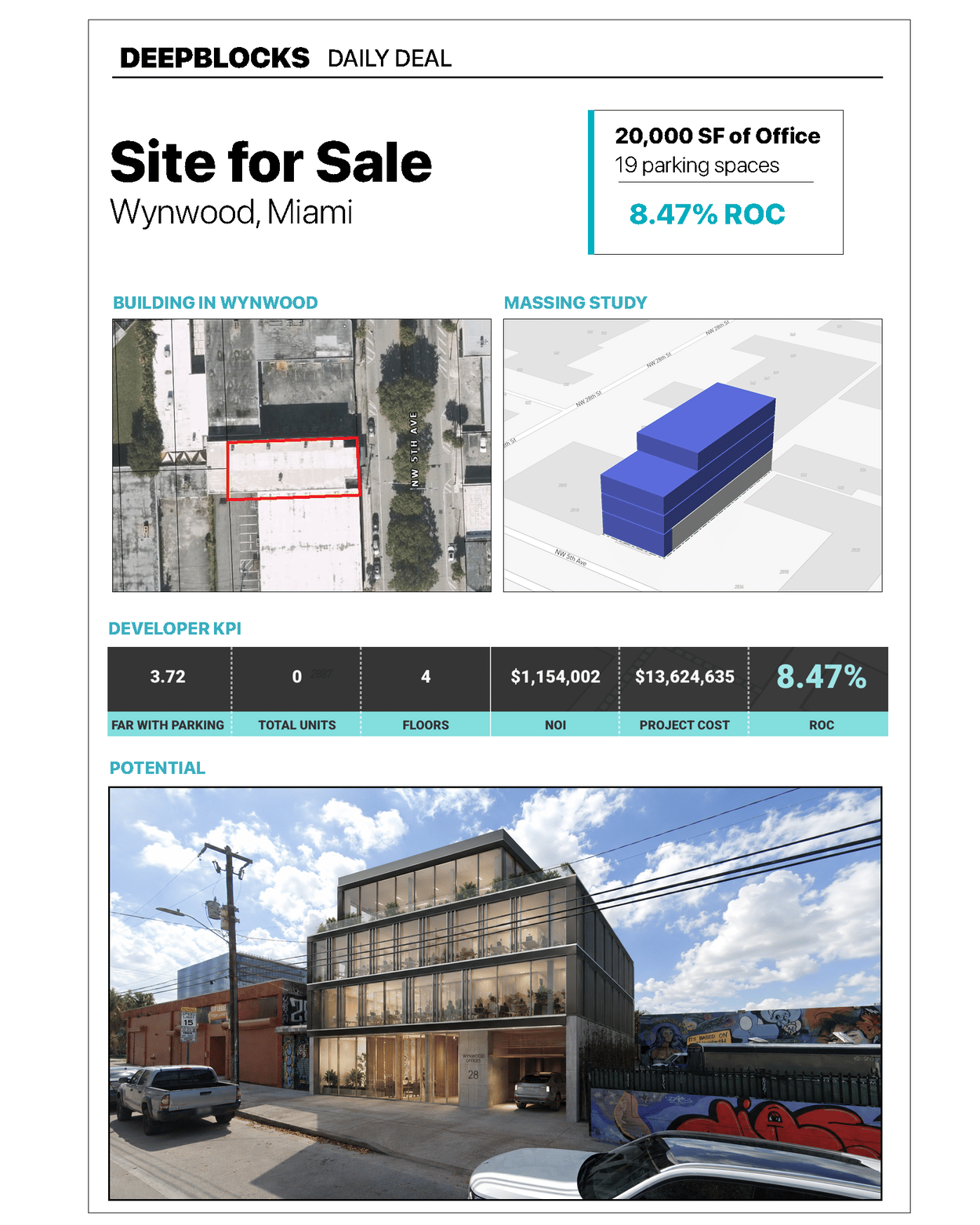
For this Deepblocks Daily Deal, we looked at a commercial site for sale with 13,000 SF of existing warehouse space. The property sits in T5-O zoning within the NRD-1 overlay, which makes it especially interesting for a boutique office concept.
This area feels well suited for creative office, startup office, design firms, showrooms, agencies, or a single company that wants its own identity instead of becoming one tenant in a larger office building.
That is the central idea behind the study:
Can this site support a boutique Wynwood office project at a scale that is small enough to be special, but large enough to be economically meaningful?
The concept could go in two directions.
One version is a single-user building, where a tech startup, creative company, or design-driven business occupies the entire property. The other version is a multi-tenant boutique office project, split into a series of smaller suites.
Both strategies depend on the same core question:
Can the parking work?
Explore the live Developer study here:
View the Developer Study
The Boutique Office Concept
The current site includes 13,000 SF of warehouse space, but the test case looks at a larger office opportunity.
We modeled a 20,000 SF office building.
That scale is important. It is large enough to create a meaningful commercial project, but still small enough to preserve the boutique character that can make Wynwood office space attractive.
A 20,000 SF building could potentially serve as a headquarters for one company. It could also be divided into multiple office suites for smaller tenants that want the Wynwood location without needing a massive footprint.
That flexibility is part of the appeal.
In a market where many office projects are designed around larger institutional tenants, boutique office can offer something different: identity, visibility, walkability, and a more curated tenant experience.
For Wynwood, that may matter.
Parking Is the Main Constraint
At this scale, parking is usually the issue.
In the City of Miami, small and mid-sized commercial projects can quickly become constrained by parking requirements. The building program may look reasonable on paper, but once the required parking is added, the site can become much harder to solve.
That is why the NRD-1 overlay matters.
The overlay creates meaningful parking-reduction potential, including reductions tied to office floor plates below 20,000 SF.
For this study, we took a conservative approach. Rather than assuming the 20,000 SF threshold applies only to a single floor plate or footprint, we treated it as the total combined office area across all floors.
That means the test case is intentionally restrained:
20,000 SF of total office area.
With that program, the model shows that the site can fit approximately 19 parking spaces on the ground floor.
If the project uses some form of parking structure, that parking count could potentially increase to approximately 38 spaces.
That creates two different feasibility paths.
The first is the simpler version: keep parking on the ground floor and limit complexity.
The second is the more aggressive version: introduce structured parking to increase capacity, but accept the added cost and operational complexity.
The Development Assumptions
For the initial study, the key assumptions are:
- Existing warehouse space: 13,000 SF
- Modeled office program: 20,000 SF
- Zoning: T5-O
- Overlay: NRD-1
- Ground-floor parking capacity: 19 spaces
- Potential structured parking capacity: 38 spaces
- Office lease assumption: $65–$70/SF
- Low-end construction cost assumption: $330/SF for 2–4 story office construction
At 20,000 SF, the lease assumption implies potential annual gross rent of roughly:
- $1.3 million at $65/SF
- $1.4 million at $70/SF
That is before vacancy, operating expenses, tenant improvements, leasing commissions, financing costs, land cost, soft costs, contingencies, and any premium associated with structured parking.
The construction assumption also needs to be treated carefully. At $330/SF, a 20,000 SF office building implies approximately $6.6 million in hard construction cost before other development costs are added.
That makes the parking decision especially important.
If the project can work with 19 ground-floor spaces, it may stay simpler and more cost controlled. If it needs 38 spaces, the added parking capacity may help leasing, but the cost of achieving it has to be justified.
The Leasing Question
The leasing assumption is one of the most important parts of the study.
At $65–$70/SF, the project needs to deliver an office product that feels differentiated enough to command strong rents.
That may be possible in Wynwood, especially if the building offers identity, visibility, and a more private experience than a larger office project. A single tenant may value the ability to control the whole building, brand the space, and create a headquarters-like environment.
For smaller tenants, the appeal may be different.
They may want a Wynwood address, creative energy, walkability, and a building that feels more distinct than a standard office suite. A boutique multi-tenant strategy could work if the spaces are designed efficiently and the building has enough character to justify the rent.
The question is not just whether office tenants exist.
The question is whether the project can find tenants who value this specific format.
The Parking Tradeoff
The parking strategy creates the main development tradeoff.
With 19 ground-floor spaces, the project may be simpler and less expensive. But the lower parking count could limit tenant demand, depending on the target user and how much they rely on cars.
With 38 structured spaces, the building may become more marketable to a broader range of tenants. But structured parking adds cost, complexity, and design constraints.
This is where the developer has to decide what problem they are solving.
Is the goal to create a lean boutique office project with minimal complexity?
Or is the goal to create a more fully parked building that can compete for a wider tenant pool?
Both versions may be viable, but they are different deals.
What We Would Want Feedback On
This study raises several questions for office developers, brokers, architects, and Wynwood operators:
- Is 20,000 SF the right scale for boutique office on this site?
- Are $65–$70/SF office rents reasonable for this product?
- Is $330/SF a realistic low-end construction cost for a 2–4 story Wynwood office building?
- Would a single tenant want to occupy the entire building?
- Would smaller tenants prefer a divided boutique office format?
- Are 19 parking spaces enough if the project leans into transit, walkability, and neighborhood demand?
- Would increasing capacity to 38 spaces through a parking structure justify the added cost?
These are the assumptions that decide whether the project is just interesting conceptually or actually worth pursuing.
The Takeaway
This Wynwood site is interesting because it sits at the intersection of three important variables: zoning flexibility, parking constraints, and boutique office demand.
The existing property includes 13,000 SF of warehouse space, but the study tests a 20,000 SF office project under a conservative interpretation of the NRD-1 parking-reduction potential.
At that scale, the site appears able to fit 19 parking spaces on the ground floor, with a possible path to 38 spaces if some form of parking structure is used.
The economics depend heavily on whether the project can achieve $65–$70/SF office rents and whether construction can stay near the assumed $330/SF low-end cost for 2–4 story office construction.
The bigger strategic question is even more interesting:
Can a boutique office building in Wynwood compete by offering identity, flexibility, and location instead of scale?
That is what makes the deal worth testing.
Explore the live Developer study here:
View the Developer Study