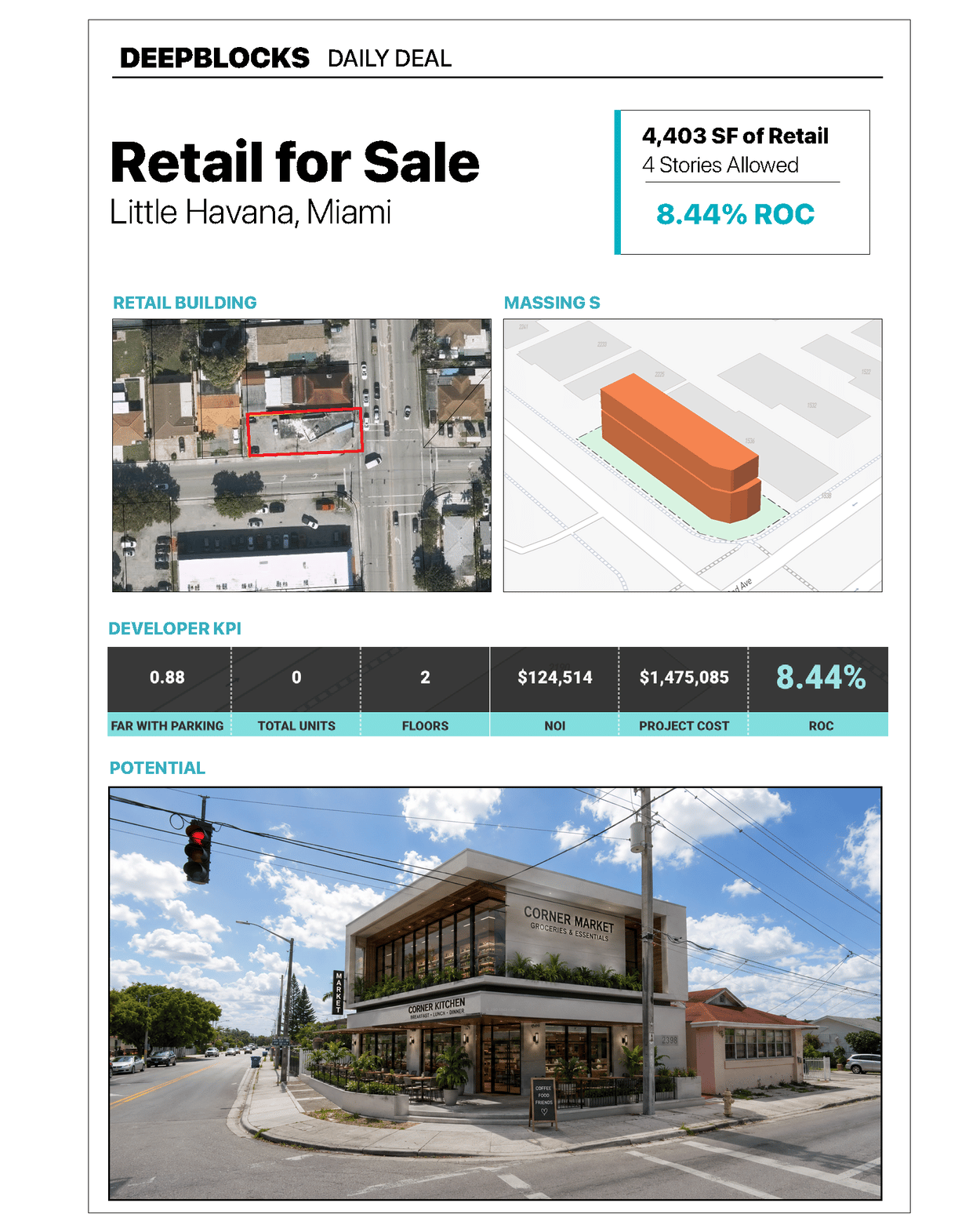
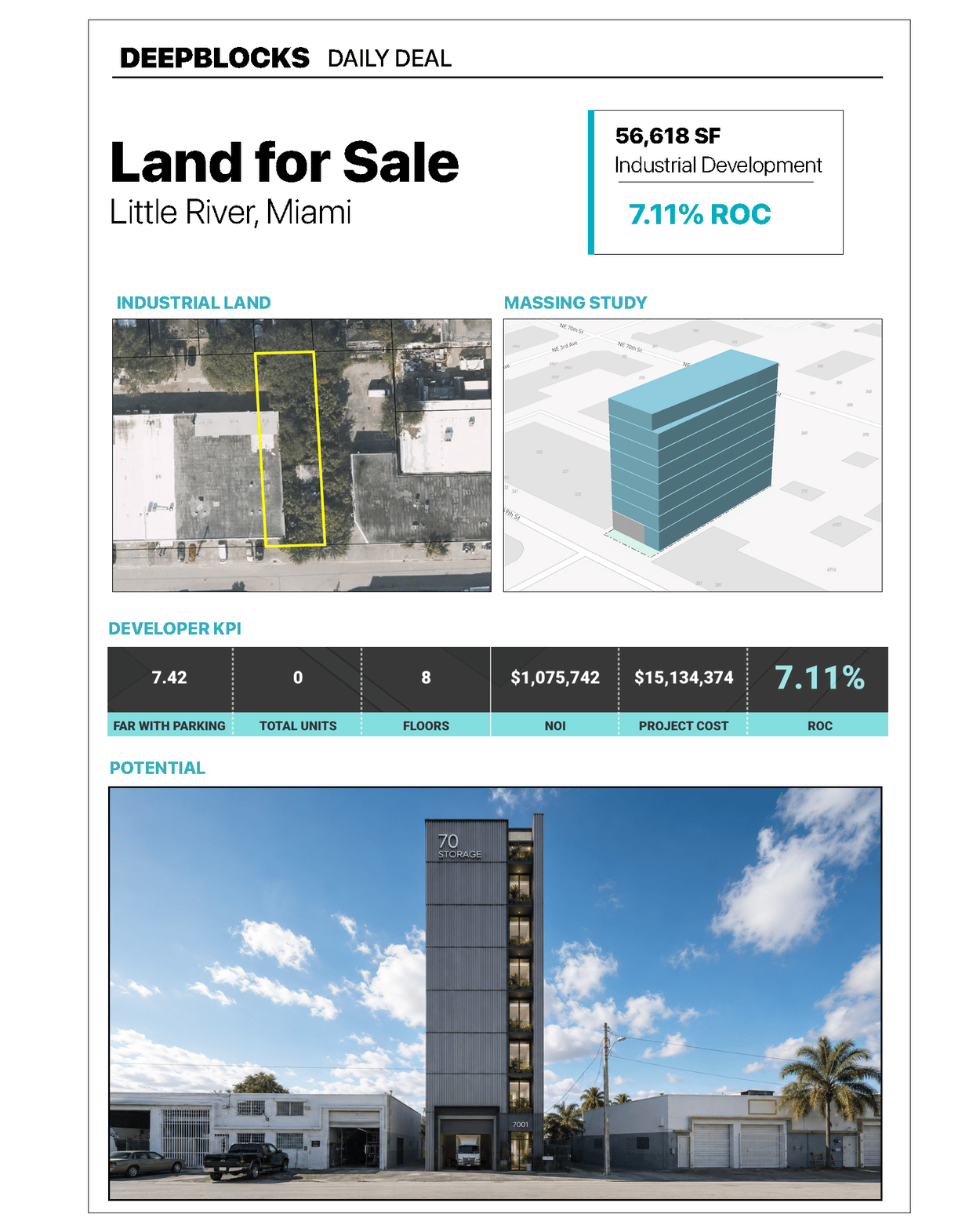
That may sound obvious, but it is one of the most important lessons behind the creation of Developer, the core product that became the foundation of Deepblocks.
In 2019, after five major iterations of the user interface, we completed Developer with a simple goal: help real estate professionals analyze development and renovation deals faster, more visually, and with better logic.
At the time, most early stage deal analysis still happened in two separate worlds.
In one world, there was the spreadsheet.
Units. Rents. Costs. Vacancy. Construction cost. Purchase price. Return on capital.
In the other world, there was the site.
Setbacks. Parking. Height. Lot coverage. Unit density. Existing structure. Physical envelope.
Both worlds mattered, but they were usually analyzed separately.
That separation creates a dangerous blind spot.
A spreadsheet can tell you a deal works while the site is quietly telling you it does not.
You can assume 80 units.
You can assume an ideal unit size.
You can assume the required parking count.
You can assume the amenity area.
You can assume the return.
But if those assumptions do not physically fit on the parcel, the pro forma is only a theory.
You can explore developer here:
Open the Deepblocks Developer Explorer
The Problem With Financial Assumptions Alone
A traditional real estate spreadsheet is extremely powerful.
It can model revenue, expenses, debt, equity, construction cost, rent growth, exit cap rates, and returns. It can help investors understand whether a deal is worth pursuing.
But a spreadsheet has one major limitation.
It does not know the shape of the site.
It does not know where the setbacks are.
It does not know whether parking fits on the ground floor.
It does not know whether the building height triggers a more expensive code requirement.
It does not know whether the new program fits inside an existing shell.
It does not know whether the zoning actually allows the project implied by the financial model.
This is why early feasibility can be so misleading.
The numbers may work because the model assumes a program that cannot be built.
The deal may look profitable because the spreadsheet has not been forced to confront the physical constraints of the parcel.
That gap between financial possibility and physical reality is where many bad assumptions begin.
Why Developer Had to Connect the Model and the Site
Developer was built to connect both sides of the feasibility problem.
The core idea was not only to make a better financial model.
It was to combine the financial model with a 3D zoning and massing model, so that physical constraints and financial projections could update together.
As the program changes, the building changes.
As the unit mix changes, the area changes.
As the parking count changes, the envelope changes.
As the physical model changes, the financial return changes.
That connection is the paradigm shift.
The question is no longer just:
Does this deal work in a spreadsheet?
The better question is:
Does this deal work on the site?
That is a very different standard.
It forces the analysis to become more grounded. It also helps real estate professionals ask better questions earlier in the process.
Can the required parking fit on the ground floor?
Can the unit count fit under the height limit?
Can the desired program fit inside the existing shell?
Can the building achieve the required efficiency?
What happens to the return if a zoning controller forces the building to shrink?
What happens if the unit mix changes?
What happens if the site cannot physically support the assumptions that made the deal attractive?
These are not small questions.
They are the questions that determine whether a project is real.
Feasibility Is Not Only Financial
One of the biggest mistakes in early real estate analysis is treating feasibility as a financial exercise only.
Financial feasibility matters, of course. No project moves forward without a compelling economic case.
But financial feasibility is only one side of the problem.
The other side is physical feasibility.
Can the thing you are modeling actually exist?
Can it fit within the allowable envelope?
Can it satisfy parking?
Can it respect setbacks?
Can it stay under the height limit?
Can it meet density requirements?
Can it work inside the geometry of the existing building?
When those answers are not connected to the financial model, the deal team is forced to rely on assumptions, separate drawings, manual checks, and delayed feedback.
That creates friction.
It slows down the decision.
More importantly, it can create false confidence.
A beautiful return in a spreadsheet does not mean much if the building required to produce that return cannot be built.
Where the AI Story Begins
This is where the AI story starts for Deepblocks.
AI in real estate is not only about typing a question into a model and getting a polished answer back.
That is useful, but it is not the whole picture.
The more important foundation is structure.
Before AI can reason about real estate, the messy parts of real estate need to be translated into logic.
Zoning has to become logic.
Site constraints have to become logic.
Financial assumptions have to become logic.
Program decisions have to become logic.
Physical envelopes have to become logic.
Once those pieces are structured, machines can begin to reason across them.
They can compare sites.
They can identify constraints.
They can test scenarios.
They can surface bottlenecks.
They can help the expert move faster without replacing the expert’s judgment.
That distinction matters.
The goal is not to remove the real estate expert from the process.
The goal is to give the expert better leverage.
A broker can evaluate more sites.
A developer can test more scenarios.
An investor can understand risk earlier.
An architect can see how the program interacts with the envelope.
A team can move from assumption to evidence faster.
Why This Matters for Real Estate Experts
The best real estate professionals already understand that a deal is not one thing.
It is a relationship between market demand, capital, zoning, construction, design, politics, timing, and execution.
Developer was built around that reality.
It does not treat the pro forma as separate from the parcel.
It treats the deal as a system.
That is important because the future of real estate technology will not be defined only by faster spreadsheets or prettier renderings.
It will be defined by tools that connect the assumptions.
The market assumption.
The zoning assumption.
The physical assumption.
The cost assumption.
The return assumption.
When those assumptions are connected, the expert can see the deal more clearly.
Not later.
Earlier.
And early clarity is valuable because real estate decisions are expensive.
A bad assumption at the beginning of a project can create months of wasted work. A missed constraint can change the entire investment thesis. A zoning controller that appears late can turn an exciting opportunity into a dead deal.
The earlier those constraints become visible, the better the decision.
The Lesson
The spreadsheet is not the site.
A pro forma can describe a profitable project.
But the parcel decides whether that project can exist.
That is why real feasibility cannot be only financial.
It has to be physical.
It has to connect the economics to the envelope.
It has to connect the unit mix to the zoning.
It has to connect the return to the site.
That was the first major lesson behind Developer, and it remains one of the most important ideas behind Deepblocks.
The future of AI in real estate starts with this shift.
Not replacing the expert.
Not hiding the complexity.
Not pretending every answer can be reduced to a simple prompt.
The future starts by turning real estate complexity into structured logic, so experts can make better decisions faster.
Because the deal does not work when the spreadsheet says it works.
The deal works when the spreadsheet and the site agree.
You can explore developer here:
Open the Deepblocks Developer Explorer