Why I Set Out to Build a Self-Correcting Marketing Lab
I set out to build a self-correcting marketing lab.
Deepblocks has a new deal flow infrastructure, and I wanted our network to know about it.
The technology delivers on-market deals directly to real estate professionals based on their investment strategy. From there, they can run quick development scenarios and decide whether an opportunity deserves deeper analysis.
That matters because early real estate evaluation is expensive.
Before a team commits to underwriting, design, entitlement review, consultant work, or deeper diligence, they need a faster way to answer a simple question:
Is this opportunity worth more time?
Because part of the workflow is free to use, the outreach model had to be low cost.
It did not yet justify a sales team.
It did not yet justify a high-touch onboarding process.
It did not justify spending heavily just to find out whether there was demand.
So the question became:
Can I build a system that gets the message to our network, tracks what works, and improves over time?
That was the beginning of the marketing lab.
Why Deal Flow Infrastructure Needs a Different Marketing Model
A deal flow product creates a specific kind of marketing challenge.
The value is practical, but the buyer still needs to understand the workflow.
A real estate professional may immediately understand the pain of sourcing opportunities, reviewing deals, and deciding what deserves attention. But they may not immediately understand why a new infrastructure layer should exist between deal discovery and feasibility analysis.
That means the marketing has to educate.
It has to explain the value of receiving on-market deals based on investment strategy.
It has to explain why quick development scenarios matter.
It has to explain why early screening should be faster, more visual, and easier to repeat.
It also has to do all of this without assuming a large sales team or expensive onboarding process.
That is why the marketing system could not just be a campaign engine.
It needed to be a learning system.
The Outreach Problem: Low Cost, High Learning
Because part of the workflow is free, the go-to-market strategy had to be disciplined.
A free or partially free workflow changes the economics of outreach. You cannot spend as if every user is already a high-value customer. You cannot build a heavy sales motion before you know which segment is most responsive. You cannot assume the first version of the message will be the best version.
The system has to learn before the company spends heavily.
That means the real question is not only:
How do we reach more people?
The better question is:
How do we learn which message, audience, and use case actually matters?
That is a very different design problem.
It turns marketing from a broadcast activity into a feedback system.
The First Vision Was Ambitious
At first, the idea was ambitious.
Maybe too ambitious.
The marketing lab would create content. It would turn that content into email variants. It would schedule campaigns. It would track replies. It would track whether anyone converted to the paid version. Then it would analyze which messages were connected to positive replies or payments.
If a pattern emerged, the system would use that learning to shape future content.
In other words, a self-correcting marketing lab.
That was the vision.
Content would not be created randomly. It would be connected to market feedback.
Email campaigns would not be one-off blasts. They would become experiments.
Replies would not disappear into an inbox. They would become signals.
Paid conversions would not only be revenue. They would become evidence.
The system would not just send campaigns.
It would learn from them.
The Original AI Marketing Lab Concept
The original concept was not simply:
Use AI to write emails.
It was closer to a small marketing operations team rebuilt in software.
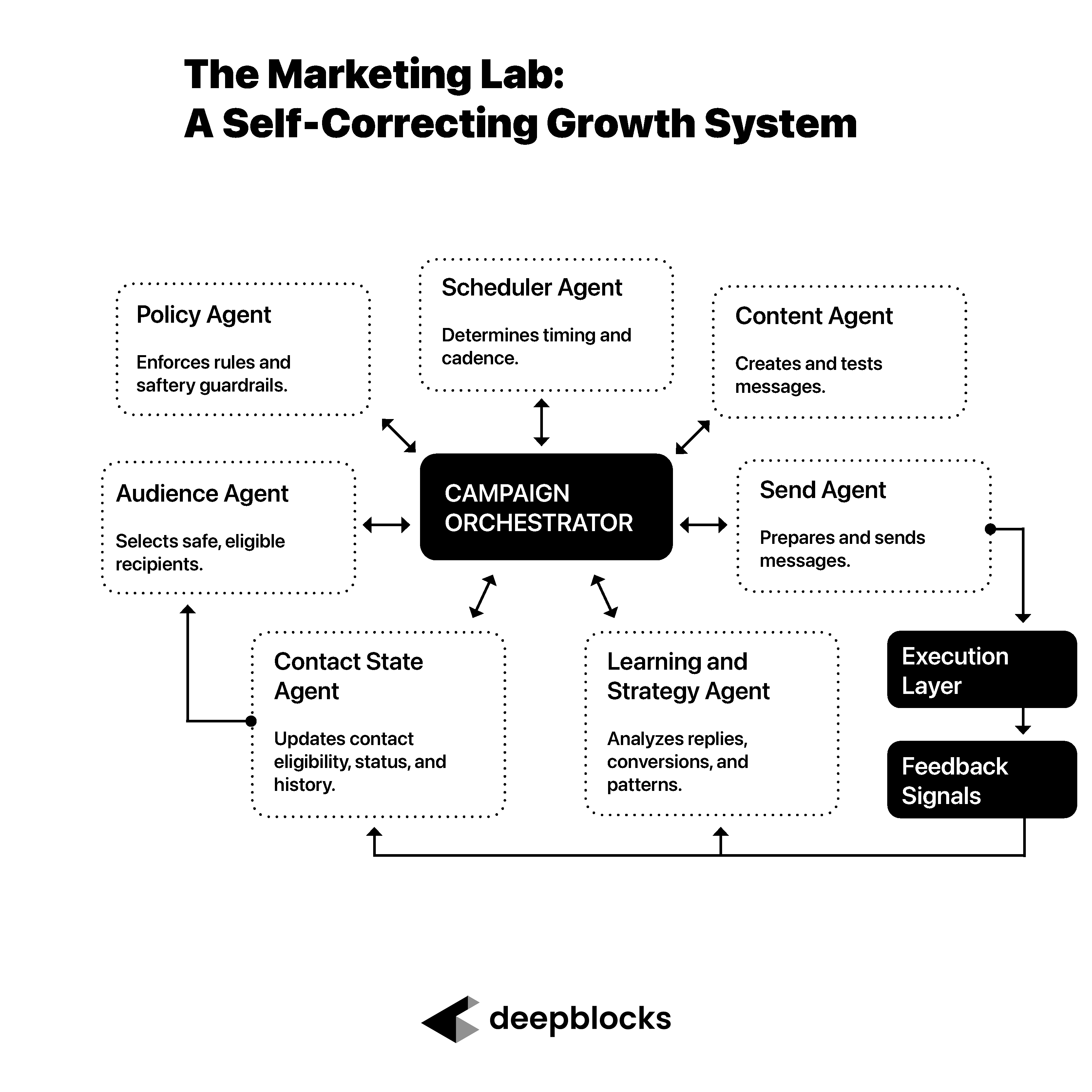
The system would start with a business goal, a contact list, a message strategy, and safety rules. From there, a set of specialized agents would coordinate the campaign.
One agent would help shape the campaign strategy.
One agent would create content and message variants.
One agent would select safe, eligible recipients.
One agent would prepare and send messages.
One agent would listen for replies, delivery events, bounces, complaints, unsubscribes, and other feedback.
One agent would update contact state.
One agent would schedule the next rollout.
One agent would keep the system inside policy and safety boundaries.
The point was not full autonomy.
The point was controlled autonomy.
The system had to create, send, listen, update, learn, and improve — without losing the discipline required for responsible outreach.
Why Contact State Matters in AI Outreach
A normal contact list is not enough for a self-correcting marketing system.
A contact list tells you who someone is.
A contact state system tells you what has happened with them.
That distinction matters.
The marketing lab needed to know who was eligible to contact, who had already received a campaign, who replied, who bounced, who unsubscribed, who complained, who converted, who should be suppressed, and who might be safe to contact again later.
Without contact state, the system cannot safely continue a rollout.
It may send too often.
It may ignore suppression rules.
It may fail to distinguish between interest, rejection, no response, and conversion.
It may treat every contact as if they are starting from zero.
That is not a learning system.
That is just automation.
For the marketing lab to work, contact state had to become the system of record.
Feedback Creates Two Different Loops
The marketing lab needed two feedback loops.
The first was the operational loop.
This loop answers questions like:
Who replied?
Who bounced?
Who unsubscribed?
Who should not be contacted again?
Who is still eligible?
When should the next send happen?
This loop keeps the system safe and orderly.
The second was the learning loop.
This loop answers different questions:
Which messages got meaningful replies?
Which audiences understood the value fastest?
Which objections kept appearing?
Which campaigns created conversions?
Which content should become the next email?
Which email should become the next post?
Which response patterns suggest real product demand?
This loop makes the system smarter.
Both loops matter.
The operational loop protects the outreach.
The learning loop improves the strategy.
Together, they turn campaign activity into market intelligence.
Why AI Marketing Is Not Just Content Generation
This is the real promise of AI in marketing.
Not:
Write me a post.
Not:
Send more emails.
Not:
Create ten subject lines.
Those tasks are useful, but they are only fragments of the system.
The bigger opportunity is to connect content, distribution, response, and product-market learning.
A marketing lab should help answer better questions:
Which version of the message works?
Which audience cares?
Which use case is most intuitive?
Which reply suggests curiosity?
Which reply suggests real demand?
Which conversion came from which message?
Which piece of content should influence the next campaign?
Which campaign should influence product strategy?
That is not just marketing automation.
That is market learning.
Why This Matters for Real Estate Technology
This is especially important for real estate technology.
Real estate buyers often need education before they understand the value of a new tool. They may know the pain, but not the category. They may recognize the workflow problem, but not yet believe there is a better way to solve it.
That creates a different kind of marketing challenge.
You are not only announcing a product.
You are teaching the market how to think about a workflow differently.
For Deepblocks, the message is not just that we can email deals.
The message is that deal flow can become more strategic.
On-market opportunities can be matched to investment criteria. Development scenarios can be tested quickly. A professional can decide earlier whether an opportunity deserves more time.
That is a workflow shift.
And workflow shifts require learning.
Different users will care about different parts of the system.
A developer may care about whether a deal is worth underwriting.
A broker may care about surfacing relevant opportunities.
An investor may care about filtering based on strategy.
An architect may care about quickly testing development potential.
An analyst may care about comparing scenarios before going deeper.
The marketing lab needs to learn which message resonates with which audience.
That is why it cannot just produce content.
It has to listen.
The Difference Between a Content Machine and a Market-Learning Machine
A content machine creates output.
A market-learning machine improves judgment.
That is the distinction.
A content machine can generate posts, emails, subject lines, and campaign copy.
A market-learning machine asks:
What happened after we sent it?
Who responded?
What did they say?
What did they misunderstand?
Which message created action?
Which audience ignored it?
Which users converted?
Which signals should shape the next campaign?
The value is not only in producing more.
The value is in understanding more.
That is why the marketing lab matters.
It is not just a way to scale outreach.
It is a way to make each outreach cycle more intelligent than the last.
Why the Ambition Had to Be Controlled
The more ambitious the marketing lab became, the more important the earlier lesson became:
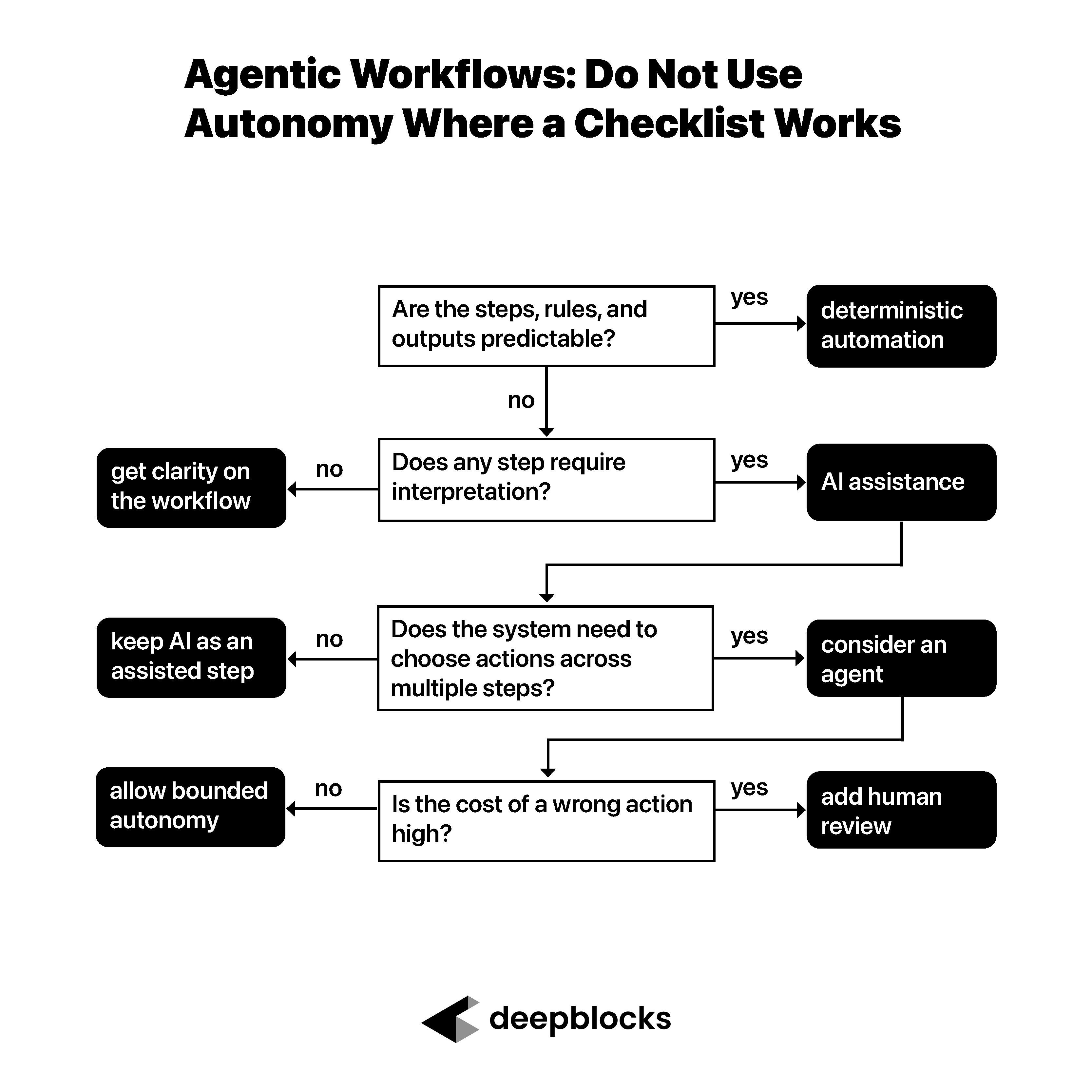
Do not use autonomy where a checklist works.
A marketing lab does not need to be fully autonomous to be useful.
Some parts can be deterministic.
Some parts can be AI-assisted.
Some parts can be agentic.
Some parts need human review.
That is the practical lesson.
The goal was not to prove that agents could run marketing.
The goal was to solve a marketing problem at low cost.
That meant building only as much autonomy as the problem required.
The system had to be useful before it could be impressive.
Conclusion: A Marketing Lab Is a Market-Learning Machine
A marketing lab is not just a content machine.
It is a market-learning machine.
That is the distinction that matters.
Content matters.
Email matters.
Campaigns matter.
Replies matter.
Conversions matter.
But the real value comes from connecting them.
When the system learns from every signal, marketing becomes more than promotion. It becomes a way to test demand, refine the message, understand the market, and improve the product strategy.
That was the goal of the marketing lab.
To build a low-cost system that could help Deepblocks reach more people, learn what resonated, and improve over time.
Not just more content.
Not just more emails.
A self-correcting growth system.


