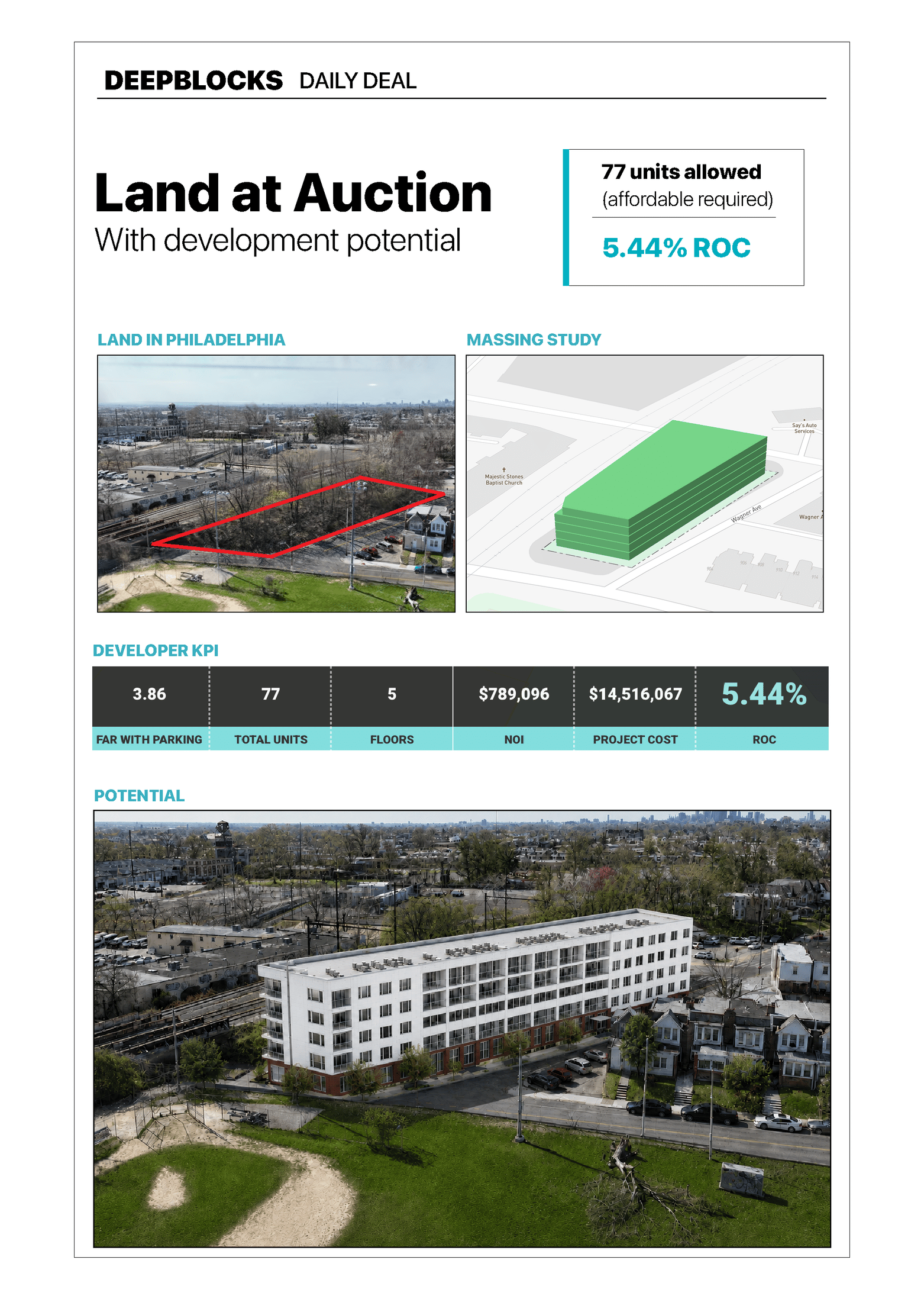

A Philadelphia development site is heading to auction on May 18 with a starting bid of $1.
But this is not really a $1 opportunity.
There is a minimum $20,000 transaction fee, so the more important question is not whether someone can bid $1.
The more important question is whether the site can actually support the 77 units referenced in the listing materials.
That number may be possible, but only under a very specific zoning path.
Explore the Deepblocks model here:
Open the project stacking plan
The Base Zoning Math
The site is 21,464 square feet and zoned CMX-2.
Under CMX-2, the base density allows one dwelling unit for every 480 square feet of lot area. Fractional units are typically rounded down.
That means the base calculation is:
21,464 SF divided by 480 SF per unit equals 44.7 units.
Rounded down, the base zoning supports 44 units.
So the base zoning does not get the project to 77 units.
It gets the project to 44.
That is the first important distinction.
The 77-unit number is not simply a base-density result. It appears to depend on zoning bonuses.
How the Site Gets From 44 Units to 77 Units
To reach 77 units, the project needs to move beyond the base CMX-2 density.
The first major bonus is the low-income mixed-income housing bonus. That bonus can provide a 50% increase in permitted units.
Starting from 44 base units, a 50% bonus adds 22 units.
That brings the project from 44 units to 66 units.
The second possible bonus is the green roof bonus. That can provide an additional 25% increase in permitted units.
Using the 44-unit base, the green roof bonus adds another 11 units.
That brings the total to:
44 base units + 22 low-income bonus units + 11 green roof bonus units = 77 units.
That is the key to the deal.
The site may be able to reach 77 units, but it does not appear to get there through base zoning alone.
The 77-unit path appears to require both the low-income mixed-income housing bonus and a qualifying green roof bonus.
The Height Issue
The height limit is just as important as the unit count.
CMX-2 has a base height limit of 38 feet.
The mixed-income housing bonus can add 7 feet, which brings the potential height envelope to 45 feet.
That matters because the real feasibility question is not only whether the zoning math can reach 77 units.
The real question is whether 77 units can physically fit inside a 45-foot building envelope.
That is where the listing claim becomes a development test.
Can the building fit?
Can the units stack efficiently?
Can the circulation work?
Can the ground floor satisfy the commercial zoning requirements?
Can the green roof be designed in a way that qualifies for the bonus?
Can the final project still pencil?
That is what we modeled in Deepblocks.
The Affordable Housing Catch
The low-income housing bonus is not just a density calculation.
It is a compliance strategy.
If the project needs the bonus to reach 77 units, then the affordable housing requirement becomes central to the development plan.
This is especially important because the height bonus may require the affordable units to be built into the project, rather than simply handled through a payment alternative.
That means the affordable housing component is not just a financial line item.
It may shape the building program, the unit mix, the entitlement strategy, and the final economics.
The Green Roof Catch
The green roof bonus is not automatic either.
To use the green roof bonus, the project needs to meet the applicable design and maintenance requirements.
That means the green roof is not just an architectural feature.
It becomes part of the zoning strategy.
It needs to be designed correctly, maintained correctly, and integrated into the project in a way that supports the bonus calculation.
This matters because the green roof appears to be the final piece that gets the project from 66 units to 77 units.
Without it, the project may still have a strong unit count.
But it may not reach the full 77-unit scenario.
The Parking Unlock
One of the most interesting parts of this deal is parking.
For residential use in CMX-2, parking appears to be zero required spaces.
That is a major feasibility unlock.
Without a parking requirement, more of the site can be used for units, circulation, ground-floor use, building systems, and open space.
This is one of the reasons the 77-unit scenario becomes more plausible.
In many markets, parking would immediately constrain the project. Here, the lack of a residential parking requirement may create enough flexibility to make the bonus-density strategy worth studying.
One More CMX-2 Condition
CMX-2 is not necessarily a pure apartment-box district.
The zoning may require an active non-residential use along the ground-floor frontage and within the first portion of the building depth.
That means the final design may need to solve for more than just residential unit count.
The project may also need to include a qualifying ground-floor use, depending on frontage, layout, and code interpretation.
That adds another layer to the feasibility analysis.
The question is not just:
Can we get 77 units?
It is:
Can we get 77 units, satisfy the ground-floor use requirement, fit inside the height envelope, qualify for the bonuses, and still make the project work financially?
The Real Takeaway
The listing says 77 units.
The zoning math suggests 77 units may be possible.
But the path matters.
The base CMX-2 density appears to support 44 units.
The low-income mixed-income housing bonus may add 22 units.
The green roof bonus may add another 11 units.
Together, those pieces create the potential path to 77 units.
But that path is conditional.
The buyer would need to execute the bonus strategy, satisfy the affordable housing requirements, qualify for the green roof bonus, solve the ground-floor use requirements, fit the project inside the 45-foot height envelope, and still make the numbers work.
That is why this deal is not really about the $1 starting bid.
It is about the zoning path.
It is about the bonus stack.
It is about physical feasibility.
And it is about whether the project still pencils once all of those conditions are included.
That is why we model deals like this in Deepblocks.
Because the opportunity is not always in the listing headline.
Sometimes it is hidden in the zoning math.
Explore the Deepblocks model here:
Open the project stacking plan