From Coding Productivity to Engineering Anxiety
The first reaction to AI coding tools was excitement.
Engineers could move faster. Bugs could be fixed sooner. Prototypes could be built in days instead of weeks. The early promise was simple: AI would make software teams more productive.
Then the second reaction arrived.
Fear.
Because if AI can help engineers code faster, it can also help non-engineers start coding at all.
That is where the real shift begins.
The question is not whether engineers are becoming obsolete.
They are not.
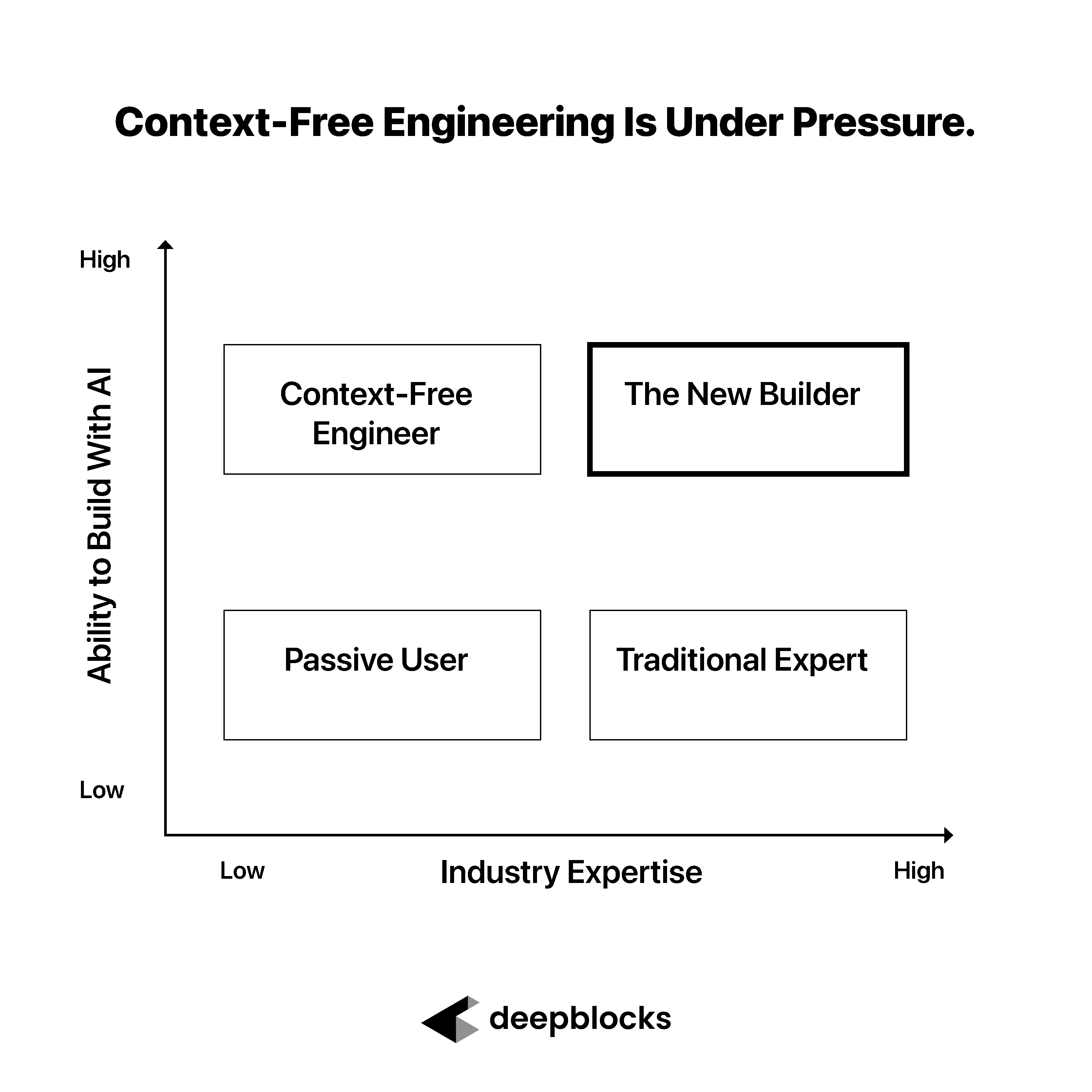
The better question is whether context-free engineering is becoming less valuable.
And I believe it is.
The Translation Gap in Real Estate Software Development
For years, one of the hardest parts of building industry software was the translation layer.
The expert knew the problem.
The engineer knew how to build.
Between them sat weeks or months of explanation.
In real estate software development, that translation can be expensive. The expert has to explain the workflow, the edge cases, the assumptions, the market logic, and what makes an output valuable.
That is not a small task.
A real estate feasibility tool is not just a calculator. A zoning workflow is not just a rules engine. A site selection platform is not just a map with filters. A lead generation system is not just a database query.
Each of these products depends on domain knowledge.
And when the engineer does not understand the domain, the expert has to spend a lot of time translating the industry before any useful software can be built.
Why Real Estate Context Is So Difficult to Translate
Real estate is not a generic software problem.
Land use codes may change from one county to another.
A zoning envelope can be defined differently at the municipality level.
A parking ratio can change across uses, districts, overlays, and project types.
A return-on-cost calculation is not just math. It depends on assumptions about rent, cost, vacancy, absorption, financing, construction timing, entitlement risk, and market appetite.
Even simple data fields can become complicated.
A land use category that means one thing in one county may mean something slightly different in another. A parcel that looks viable in a dataset may fail once local constraints are understood. A development yield that looks attractive in a model may not survive parking, setbacks, height limits, or market reality.
This is why context matters.
The code may work.
The output may still be wrong.
AI-Assisted Software Development Changes the Starting Point
AI coding tools change the starting point for industry experts.
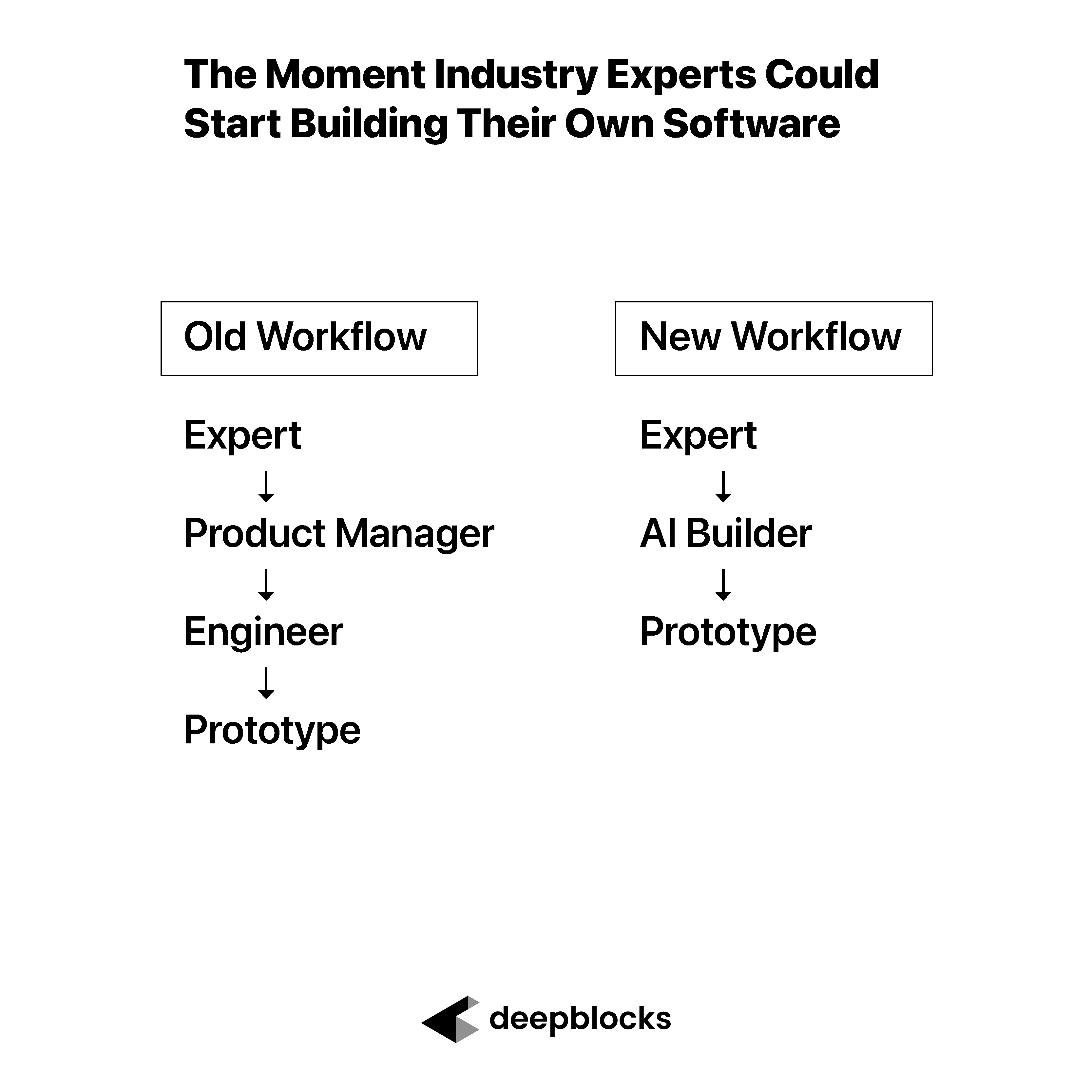
Before, a real estate expert with a software idea usually needed an engineer, a product manager, a budget, a team, and a long explanation process just to build a first version.
Now, the expert can start earlier.
They can describe a workflow to an AI coding tool.
They can prototype a simple interface.
They can test a calculation.
They can build an early version of a data pipeline.
They can validate whether the idea is worth more investment before committing to a full engineering process.
This does not mean the expert suddenly becomes a professional software engineer.
It means the expert can shape the first version of the tool.
That is a major shift.
The expert is no longer limited to describing the problem. The expert can now participate directly in forming the solution.
Engineers Are Still Essential, But Their Role Is Moving Upstream and Downstream
Engineers are not becoming obsolete.
In many ways, strong engineers are becoming more important.
But the work that makes them valuable is changing.
Engineers will still be needed for software architecture, scale, security, reliability, performance, infrastructure, integrations, testing, and long-term maintainability.
They will still be needed when a prototype becomes a real product.
They will still be needed when a workflow needs to support many users, handle sensitive data, connect to other systems, survive edge cases, or operate reliably over time.
But the engineer who only waits for requirements may become less valuable than the engineer who understands the industry well enough to challenge, improve, and shape those requirements.
That is the real pressure.
Not engineering itself.
Context-free engineering.
Domain Expertise Is Becoming a Technical Advantage
When an industry expert can use AI to generate the first version of a tool, the engineer without industry context can become a friction point.
Not because engineering is less valuable.
Because context is more valuable.
In real estate, the expert often knows what matters before the system does. They know which assumptions are dangerous. They know when a result feels unrealistic. They know when a model is technically correct but commercially useless.
That judgment is not easy to automate.
AI can make code easier to generate.
It cannot make good real estate judgment easier to fake.
This is why domain expertise is becoming a technical advantage.
The person who understands the problem deeply and can manage AI effectively can now move faster than before.
The New Builder Combines Expertise, AI Management, and Technical Judgment
The future is not “engineer versus expert.”
The future is the person who can move between both.
That person may be an engineer who learns the industry.
It may be a real estate expert who learns how to manage AI coding tools.
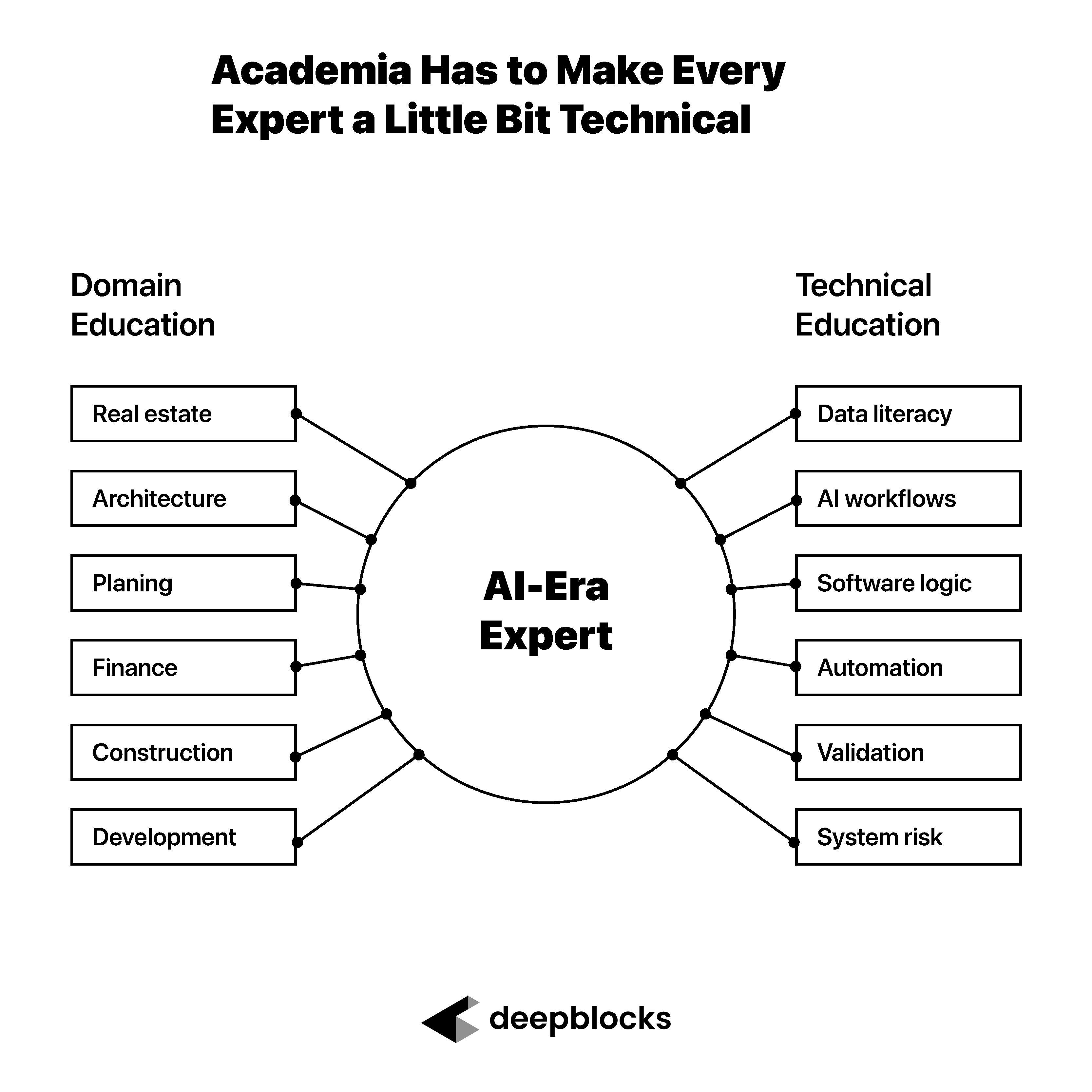
It may be a founder, analyst, architect, broker, developer, or planner who understands enough about software to guide the build, ask better questions, and validate the output.
The new builder does not necessarily need traditional engineering skills to begin.
But they do need three things.
They need domain expertise.
They need AI management ability.
They need enough technical judgment to know when something is wrong.
That combination is becoming extremely powerful.
What This Means for PropTech and Real Estate Teams
For PropTech companies and real estate teams, this shift changes how software can be created.
Internal tools can be prototyped faster.
Manual workflows can be tested for automation earlier.
Experts can experiment before committing to large budgets.
Engineers can spend less time translating vague requirements and more time hardening the systems that prove valuable.
The best teams will not treat AI coding tools as a replacement for engineers.
They will treat them as a way to bring experts and engineers closer together.
The expert can define the problem with more precision.
The AI can help generate early versions.
The engineer can improve the architecture, reliability, security, and scalability.
That is a much better workflow than the old model, where the expert explained the problem from a distance and waited for a technical team to interpret it.
The Opportunity for Engineers in the AI Era
The real opportunity for engineers is not to resist the expert.
It is to get closer to the expert.
Learn the workflows.
Learn the metrics.
Learn what makes an output valuable.
Learn what makes an answer dangerous.
Learn the difference between a technically functioning system and a commercially useful one.
In real estate, this means understanding how deals are evaluated, how zoning affects feasibility, how market assumptions shape returns, how local rules change development potential, and how users actually make decisions.
The engineer who understands that context will be far more valuable than the engineer who only knows how to execute a specification.
AI is making code easier to generate.
It is making context harder to ignore.
Conclusion: AI Is Not Replacing Engineers. It Is Repricing Context.
AI coding tools are not making engineers obsolete.
They are changing the value of engineering.
Basic code production is becoming easier to access. But judgment, architecture, reliability, security, scale, and domain understanding are becoming more important.
For real estate software, this is especially true.
The industry is too local, too fragmented, too assumption-heavy, and too dependent on expert judgment for generic software development to be enough.
The future belongs to people who can move between expertise and technology.
Not just the person who can code.
Not just the person who understands real estate.
But the person who can use AI to connect both.