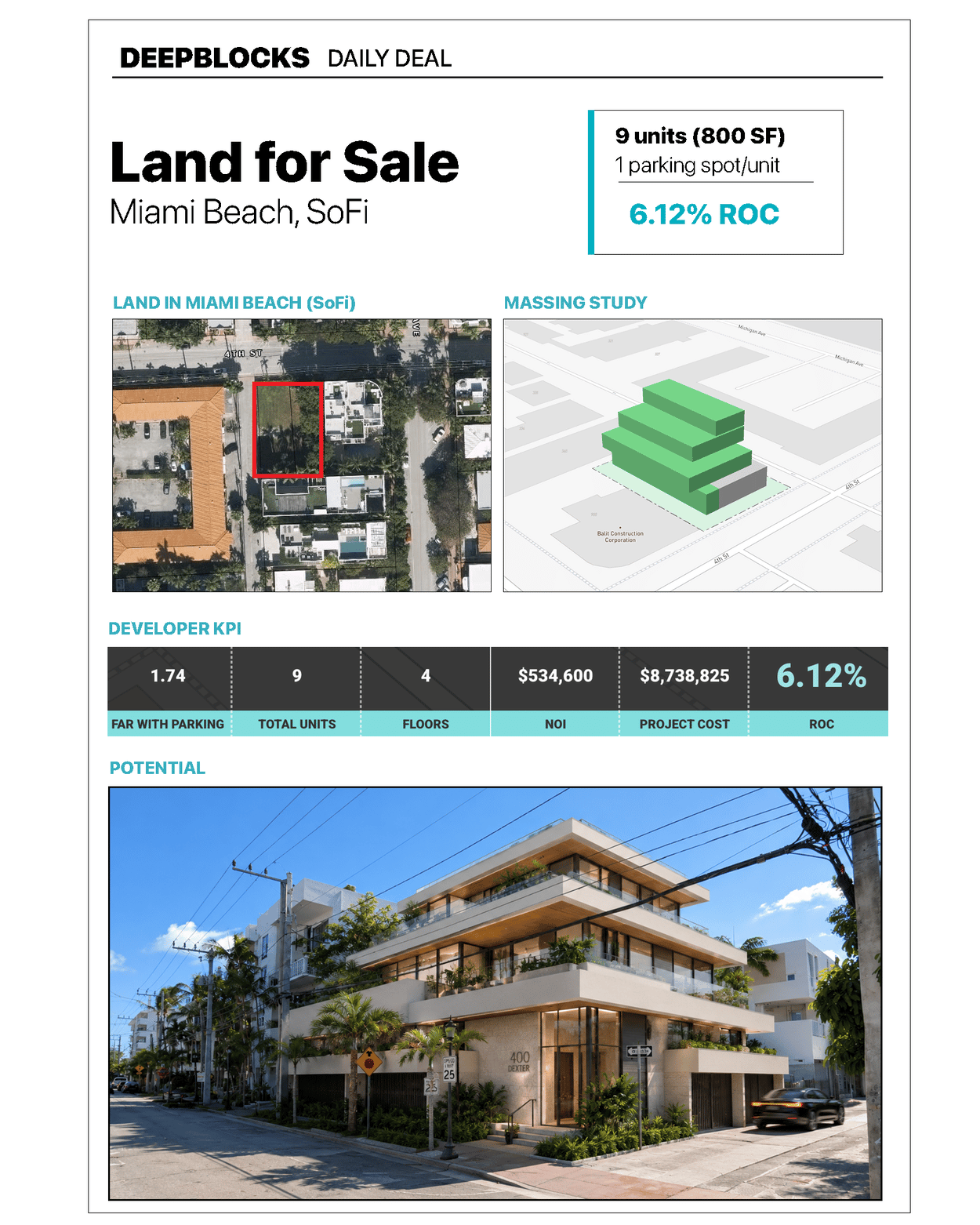
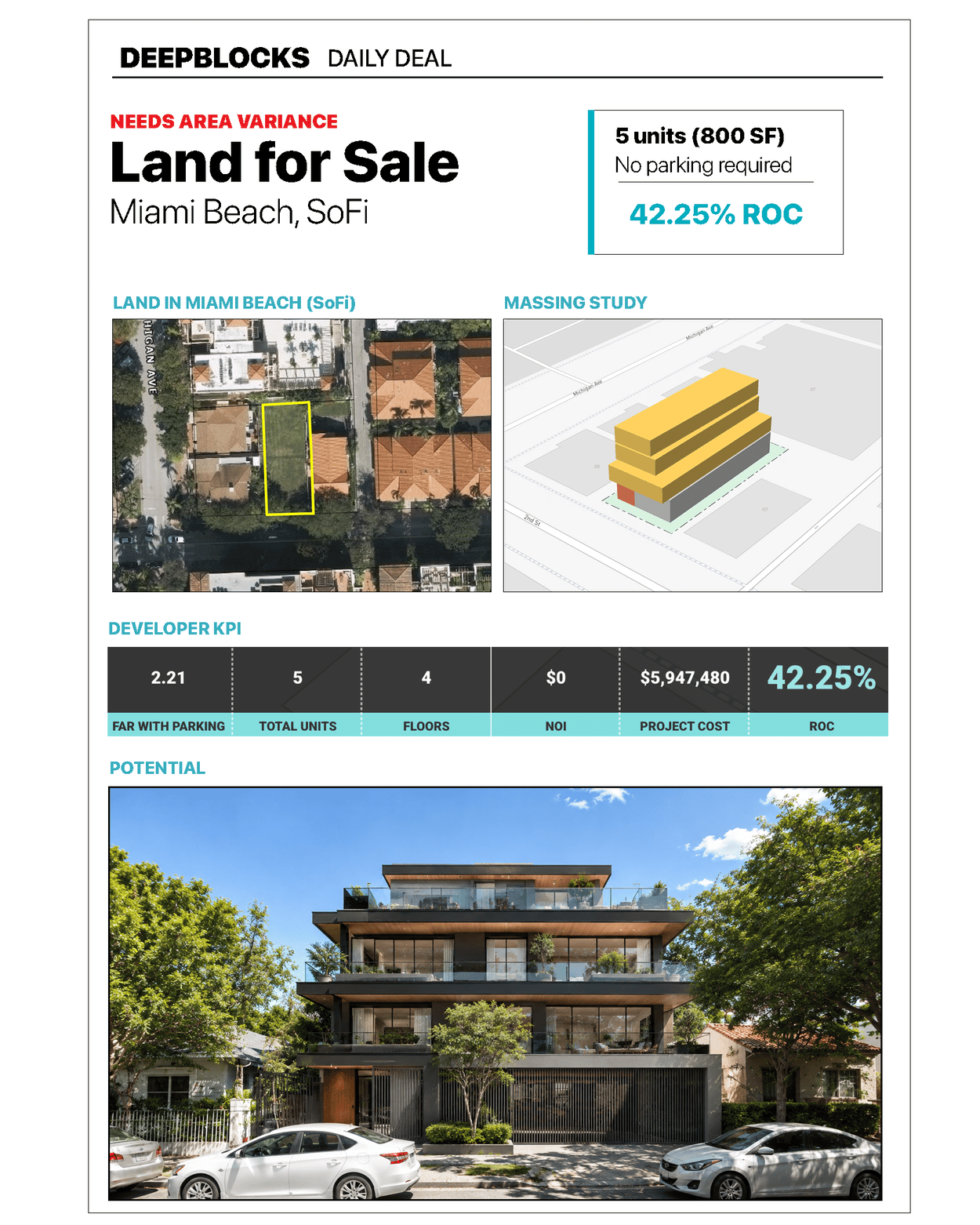
Another great site on Miami Beach.
This one is in South of Fifth and is already assembled, with a total lot size of approximately 6,990 square feet.
The zoning read allows 9 units.
That makes the project small, but not uninteresting. In South of Fifth, a 9-unit project can still matter if the product, pricing, and basis are right.
The listing says the site allows short-term rentals.
Our read is that this should not be underwritten as a short-term rental deal.
Miami Beach treats vacation or short-term rentals as rentals of less than six months and one day, and the city notes that these rentals are prohibited in all single-family homes and many multifamily buildings in certain zoning districts. The city also says approved short-term rentals need the proper authorization, zoning approval, business tax receipt, and resort tax account.
That does not kill the deal.
It just changes the underwriting.
Instead of relying on nightly or weekly rental income, the cleaner analysis is to test the site as conventional multifamily or as a boutique condominium development.
Explore Deal: Analyze this project in the Developer software.
The Base Multifamily Strategy
We modeled the site first as a standard multifamily project.
The land is listed at $4.2 million.
With only 9 units, the land basis per unit is high. That means the rents need to be strong.
In the model, the units need to achieve at least $7,500 per month.
In many neighborhoods, that would be aggressive.
In South of Fifth, it is at least worth testing.
This is one of the strongest residential submarkets in Miami Beach. A small, well-designed project with the right unit mix may be able to command premium rents, especially if the product feels more boutique and private than a typical rental building.
The construction cost assumption is $400 per square foot.
That may still need to be stress-tested, especially in Miami Beach, where construction complexity, finish expectations, insurance, resiliency requirements, and small-site logistics can all push costs higher.
Using that assumption, the model produces:
- Return on cost: 6.12%
- Levered IRR: 22%
- Equity multiple: 2.6x
For a small South of Fifth rental project, that is not bad.
Why Short-Term Rentals Are Not the Core Strategy
The short-term rental issue is important because it affects the buyer’s first instinct.
A listing that says “short-term rentals allowed” may attract investors thinking about hospitality-style income.
But if the zoning or operating rules do not support short-term rentals, then that income stream should not be the base case.
Miami Beach provides a short-term rental zoning map and authorized-building resources, but the city also states that the map is for reference only and that official information should come from the City of Miami Beach Planning Department.
That means the right approach is to verify the site directly, not rely only on the listing language.
For this deal, we would underwrite the project without short-term rental income.
That keeps the analysis cleaner.
If the deal works as conventional multifamily, then the project does not need the short-term rental story.
The Condominium Alternative
Even though we modeled multifamily, a condominium strategy may be even more interesting.
A 9-unit building in South of Fifth could work well as a boutique condo project.
- Small unit count
- Limited inventory
- Potentially smaller HOA
- More privacy
- A more exclusive ownership story
That can be attractive in a luxury submarket where buyers may prefer a boutique building over a larger condominium tower.
The condo strategy would change the entire underwriting.
Instead of asking whether the units can rent for $7,500 per month, the question becomes whether the units can sell at a premium price per square foot.
That may be a better fit for the location.
But it also changes the risk.
A rental project creates long-term income.
A condo project depends on absorption, sales pricing, buyer demand, construction timing, and exit execution.
Both paths are worth studying.
The point is that the site does not need to be forced into one strategy too early.
The Affordable Housing Question
The site also has another possible path.
It may allow 80% more units if developed as affordable or workforce housing.
Starting from 9 base units, an 80% unit increase could potentially move the project toward approximately 16 units, depending on how the bonus is calculated and approved.
Miami Beach materials identify several workforce and affordable housing incentives, including reduced parking, reduced minimum unit-size requirements, and an 80% density bonus for workforce and affordable units.
That is worth modeling.
But it is also complicated.
Affordable housing in South of Fifth raises a very different set of questions:
- What income band applies?
- What rent restrictions would control the units?
- How long is the affordability period?
- Can the restricted rents support the land cost?
- Does the additional unit count offset the lower revenue?
- Would the project need subsidy?
- Would the financing market understand the strategy?
This is where the phrase “80% more units” sounds simple, but the execution is not simple at all.
In a high-cost, high-rent submarket, affordable density can be powerful.
But the economics have to be tested carefully.
The Real Development Question
The central question is not whether the site can be developed.
It can.
The better question is which strategy creates the best risk-adjusted outcome.
A standard multifamily project appears to work if the rents reach approximately $7,500 per month and construction costs stay near $400 per square foot.
A boutique condo project may produce a stronger exit if the luxury sale pricing is there.
An affordable or workforce housing strategy could increase the unit count, but it also introduces income restrictions, compliance requirements, and a very different financial model.
Each path has a different buyer.
Each path has a different capital stack.
Each path has a different risk profile.
That is what makes the deal interesting.
The Takeaway
This is not a short-term rental deal.
At least, that is not how we would underwrite it.
The better read is that this is a small South of Fifth development site with multiple possible strategies.
The base case is 9 multifamily units.
At a $4.2 million land basis, the rental model needs roughly $7,500 per month in rent.
At $400/SF in construction cost, the model shows:
- Return on cost: 6.12%
- Levered IRR: 22%
- Equity multiple: 2.6x
That is a workable starting point.
But the condo strategy may be even stronger.
And the affordable-density strategy is worth testing because an 80% unit bonus could potentially move the project from 9 units to roughly 16 units.
The real question is not whether the listing says short-term rentals are allowed.
The real question is:
Which development strategy actually creates the most value on this site?
That is why we model deals like this in Deepblocks.
Because the best opportunity is rarely the headline.
It is usually in the assumptions.
Explore Deal: Analyze this project in the Developer software.


