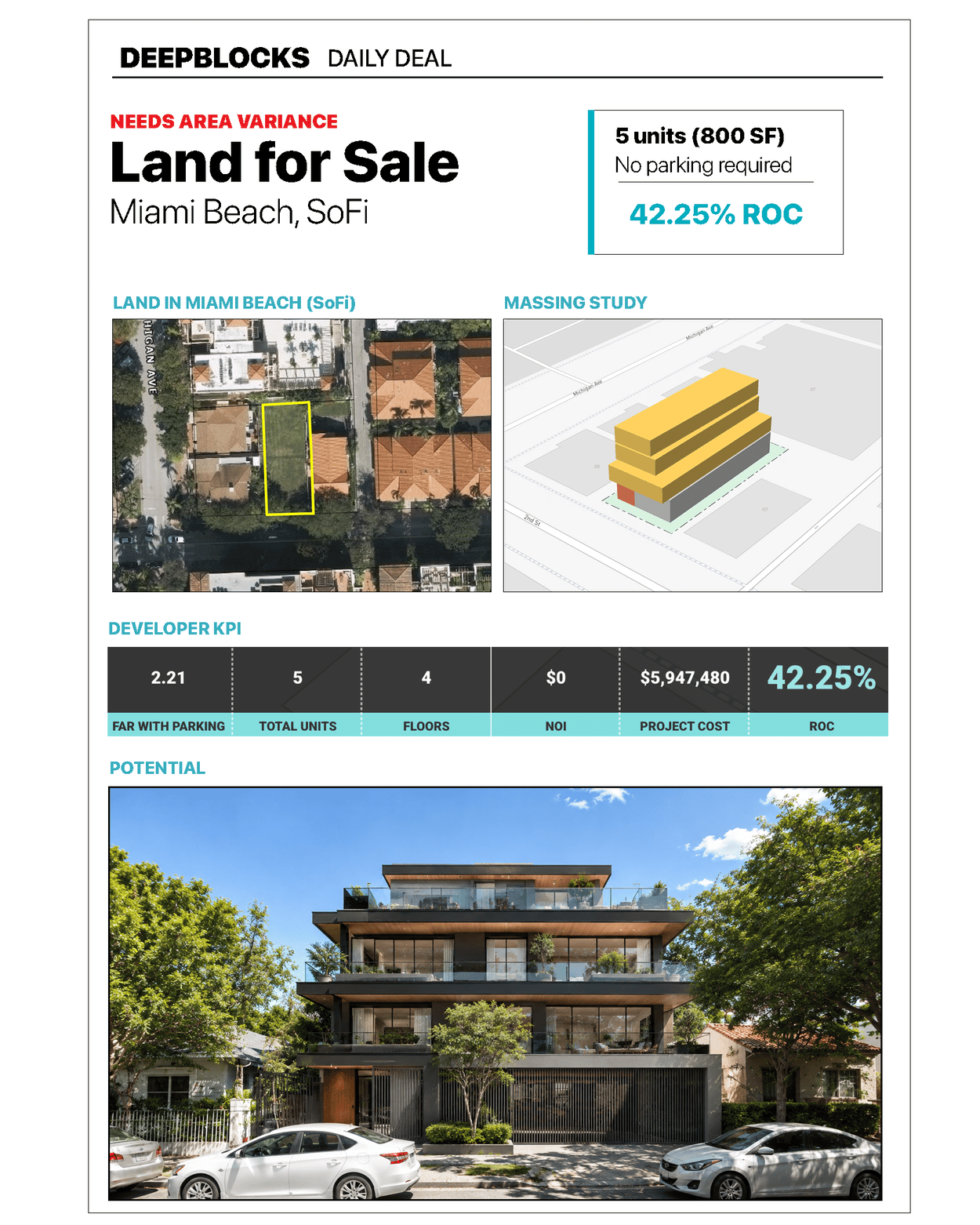
This is an exciting land listing in the heart of South of Fifth.
At first glance, it is a small site.
But in SoFi, small does not automatically mean uninteresting.
The zoning read suggests a potential path to a 5-unit boutique condominium project. The site’s narrow frontage may also create a favorable parking condition, which is a major unlock in Miami Beach. The important caveat is that the lot is only 4,000 square feet, which appears to be below the minimum lot size requirement.
That means this is not a clean, no-questions-asked development path.
It may require an area variance.
But in this location, it may still be worth studying.
Explore This Deal: Adjust assumptions in the Developer software.
The Zoning Opportunity
The first thing that makes this deal interesting is the unit count.
The site appears to allow for 5 residential units.
For a typical infill project, five units may not sound like much. But South of Fifth is not a typical market. A small number of well-designed luxury units can still create a meaningful development opportunity if the basis, layout, and sale prices work.
The second thing that makes the deal interesting is parking.
Based on the zoning read, parking may not be required because the site frontage is less than 65 feet. Miami Beach’s current parking code includes a no-parking requirement for apartment buildings in RM-1 or RM-2 zoning districts on lots that are 65 feet wide or less, provided secure bicycle storage is included. The exact applicability should still be confirmed against the parcel’s zoning district and final plan.
That is a major advantage.
Parking is often one of the biggest constraints on small urban sites. If parking is not required, the project can be designed around the building and the buyer experience instead of being forced around a parking ratio.
But we still modeled parking.
Why Include Parking If It Is Not Required?
Even if parking is not required, the project may benefit from including it.
In a luxury South of Fifth condominium, one parking space per unit can be a selling feature. It is not just about compliance. It is about marketability.
We modeled the project with ground-floor parking and a small lobby.
That does a few things:
- It gives the building a more complete luxury offering.
- It allows the residential units to begin on the second floor.
- It helps separate the private living spaces from the street level.
- It may make the project more attractive to buyers who expect convenience, privacy, and dedicated parking, even in a walkable neighborhood.
The question is not simply:
Is parking required?
The better question is:
Does parking improve the product enough to justify the design tradeoff?
In this case, it may.
The Lot Size Caveat
The major zoning issue is the lot size.
The site is approximately 4,000 square feet, which appears to be below the minimum lot size requirement.
That means the development path may require an area variance.
This is the real entitlement question.
Miami Beach’s Planning FAQ describes a zoning variance as a modification of specific land development requirements and notes that variances are generally considered for dimensional or measurable restrictions where hardship criteria or practical difficulty exist, including conditions such as a small lot or oddly shaped parcel. It also notes that use variances are prohibited, so the argument must stay within the permitted-use framework.
That is why this deal needs to be treated carefully.
The upside may be attractive, but the variance path is not automatic.
A buyer would need to understand whether the small-lot condition creates a credible argument, what the board process would look like, and whether the final design can be positioned as reasonable for the neighborhood.
In other words, the zoning question is not just whether five units fit.
It is whether the five-unit plan can be approved.
The Development Program
We modeled a simple boutique condominium concept.
The project includes 5 units, each approximately 800 square feet.
The assumed sale price is $1.8 million per unit.
That is a luxury price point, but the location supports the question. South of Fifth is one of the strongest luxury residential submarkets in Miami Beach, and a boutique product can appeal to buyers who want privacy, location, and scarcity rather than a large building with a traditional amenity package.
The assumed construction cost is $400 per square foot.
That may be low for this level of luxury.
A high-end boutique condominium in South of Fifth may require a more expensive construction budget, better finishes, more design attention, and higher soft costs than a typical small multifamily project.
So the cost assumption should be stress-tested.
But even with that caveat, the first version of the model is compelling.
The Return Profile
The model shows a 42.25% return on cost.
It also shows roughly a $6 million total investment and approximately $2.5 million in profit.
That is why the deal is worth studying.
The project is small, but the profit can still be meaningful because the product is high-value.
This is the advantage of a boutique luxury condo strategy.
You do not need 50 units for the project to matter.
You need the right five units.
The return depends on the major assumptions holding together: entitlement, construction cost, parking layout, unit sizing, sale price, and buyer demand.
If construction costs move up materially, the return changes.
If the variance is denied, the deal changes.
If parking takes too much space or complicates the lobby and circulation, the design changes.
But if the plan works, the project has a clean story:
- Small site
- Scarce location
- Boutique luxury product
- Limited unit count
- Potentially strong return
The Product Strategy
The most interesting part of this deal is that it is not trying to be a big project.
It is trying to be a focused project.
A 5-unit condominium in South of Fifth can be positioned differently from a larger building.
It can feel more private.
It can have a smaller HOA.
It can appeal to buyers who want the neighborhood but do not want the scale, traffic, or complexity of a large condominium building.
Ground-floor parking also helps the product feel more complete.
If each unit can have a dedicated parking space, the building may deliver a boutique experience without sacrificing a key luxury expectation.
That is the product thesis.
The zoning and financial thesis need to support it.
The Key Risks
The first risk is entitlement.
The site’s 4,000 SF lot size appears to be the central issue. If the minimum lot size requirement cannot be addressed through a credible variance path, then the five-unit plan may not move forward.
The second risk is cost.
The model assumes $400/SF in construction cost. For a luxury South of Fifth condominium, that may be conservative. The project should be tested at higher cost levels to understand how much margin remains.
The third risk is design efficiency.
On a small site, every square foot matters. The ground-floor parking, lobby, stairs, elevator, mechanical space, trash, and access all need to work without damaging the residential layouts above.
The fourth risk is pricing.
The assumed sale price is $1.8 million per unit. That may be achievable if the design, finish level, parking, and location story are strong. But the project needs to be positioned as a luxury boutique product, not just a small condo building.
The Takeaway
This deal is compelling because it is small but high-leverage.
The site appears to have a path to 5 boutique condominium units in one of Miami Beach’s strongest neighborhoods.
Parking may not be required, which helps the feasibility. But including one space per unit could make the project more attractive to luxury buyers.
The big caveat is the lot size.
At 4,000 SF, the site appears to fall below the minimum lot size requirement, which means the development path may depend on a successful area variance.
That is the deal.
Not simply land in SoFi.
A small-site luxury condo play with a zoning caveat and a potentially strong return.
If the variance path works, if the parking layout fits, and if the construction cost can be controlled, the model shows a compelling result:
- Return on cost: 42.25%
- Total investment: Roughly $6 million
- Estimated profit: Approximately $2.5 million
That is why we model deals like this in Deepblocks.
Because small sites can still create big opportunities when the zoning, product, and pricing align.
Explore This Deal: Adjust assumptions in the Developer software.