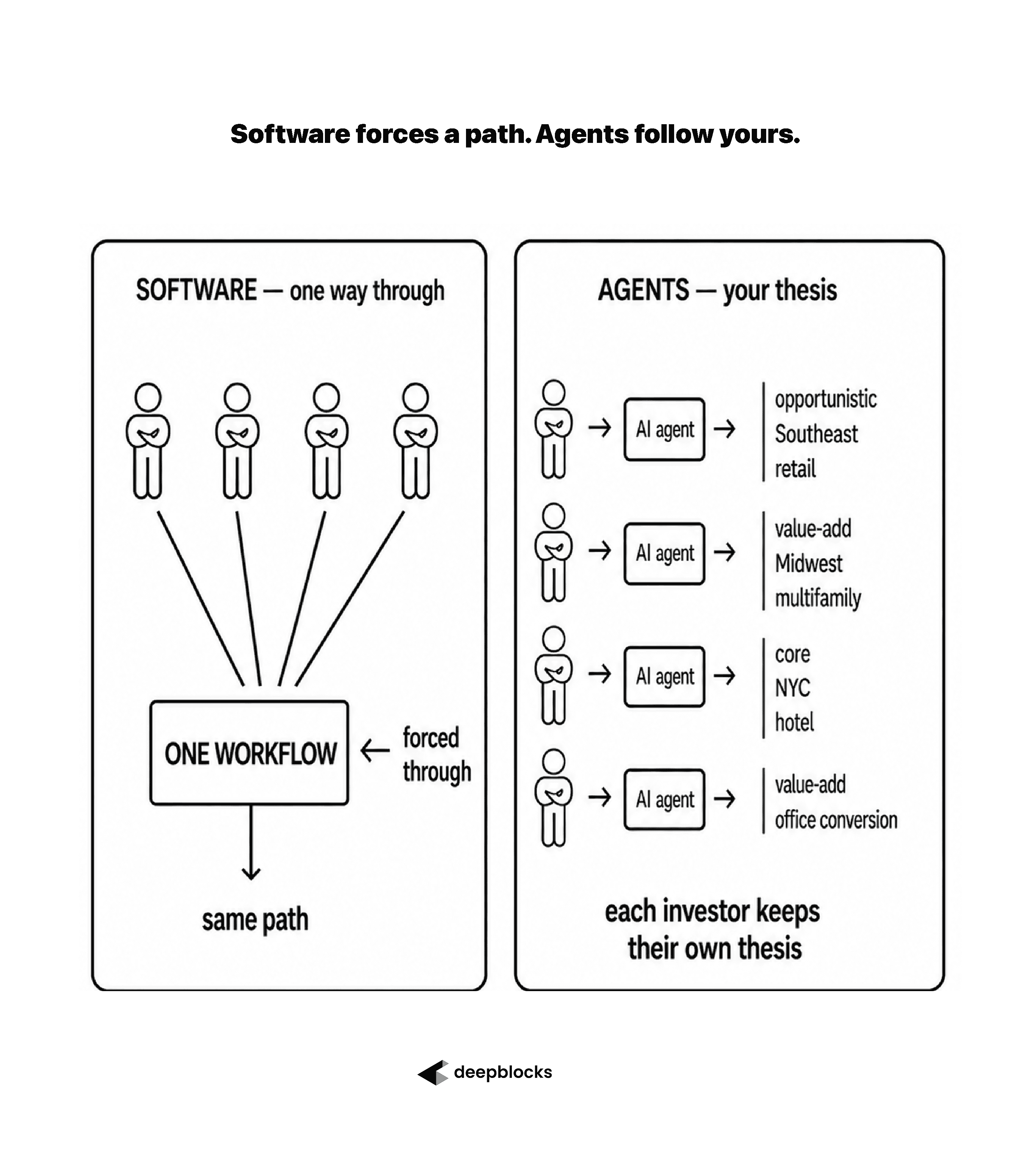
Every real estate search begins with a simple sentence:
“Find properties in these markets that fit this thesis.”
Everything underneath that sentence is messy.
Every county publishes parcel data differently. Every municipality defines zoning and land use differently. Development capacity depends on local rules. Evidence that a property is actively listed may be scattered across multiple sources.
The request is simple.
The work required to answer it is not.
For years, our approach was to standardize everything before the analysis could begin. We tried to translate every source into one consistent structure so the same software workflow could run everywhere.
That created a bottleneck.
Adding a single county could require days of studying fields, interpreting definitions, mapping local terminology, and rebuilding the data into our format.
Before we could search for an opportunity, we first had to make the underlying data conform to the system.
Agents gave us a different way to approach the problem.
Explore Deal Flow: Deepblocks customized AI agent workflows
The Limits of Standardizing Everything
Traditional real estate software depends heavily on standardized data.
That makes sense. Software needs predictable fields, consistent categories, and repeatable structures. If one county calls a parcel identifier one thing and another county calls it something else, the system needs a common definition before it can work across both.
The challenge is that real estate data is deeply local.
One jurisdiction may describe land use through a detailed code. Another may rely on broad categories. Parcel datasets may contain similar information under completely different field names. Measurements, classifications, and update schedules can vary from one source to the next.
Trying to translate every available field into one permanent schema creates an enormous amount of work.
It also forces the team to solve problems that may not matter for the study at hand.
A customer searching for industrial redevelopment opportunities may need a specific set of parcel, zoning, transaction, and physical-site concepts. A customer searching for multifamily development sites may need a different set.
They do not need every possible field standardized before the analysis begins.
They need the concepts relevant to their investment thesis.
Translate What the Study Requires
An agentic workflow allows us to translate information when it is needed rather than rebuilding every source in advance.
First, an agent refreshes the relevant source data and identifies what has changed.
Then another agent maps the local fields and definitions required for that specific study.
The source data can remain in its native format. Instead of forcing every field into one permanent schema, the system translates only the concepts needed to complete the analysis.
That is an important change.
The workflow no longer begins with:
“How do we make this county look like every other county?”
It begins with:
“What information does this investment thesis require, and where does that information live in this market?”
This reduces the amount of unnecessary transformation while making it easier to adapt the analysis to different property types, geographies, and investment criteria.
Agents Interpret. Algorithms Calculate.
Not every part of the workflow should be handled by a language model.
Once the required fields and concepts have been identified, deterministic algorithms perform the work that should remain predictable and repeatable.
They filter parcels.
They join spatial datasets.
They apply numerical thresholds.
They compare site characteristics.
They calculate preliminary development capacity once the relevant zoning rules have been established.
These tasks are well suited to traditional computation. The same inputs should produce the same outputs, and the calculations should be inspectable.
The agent’s role is different.
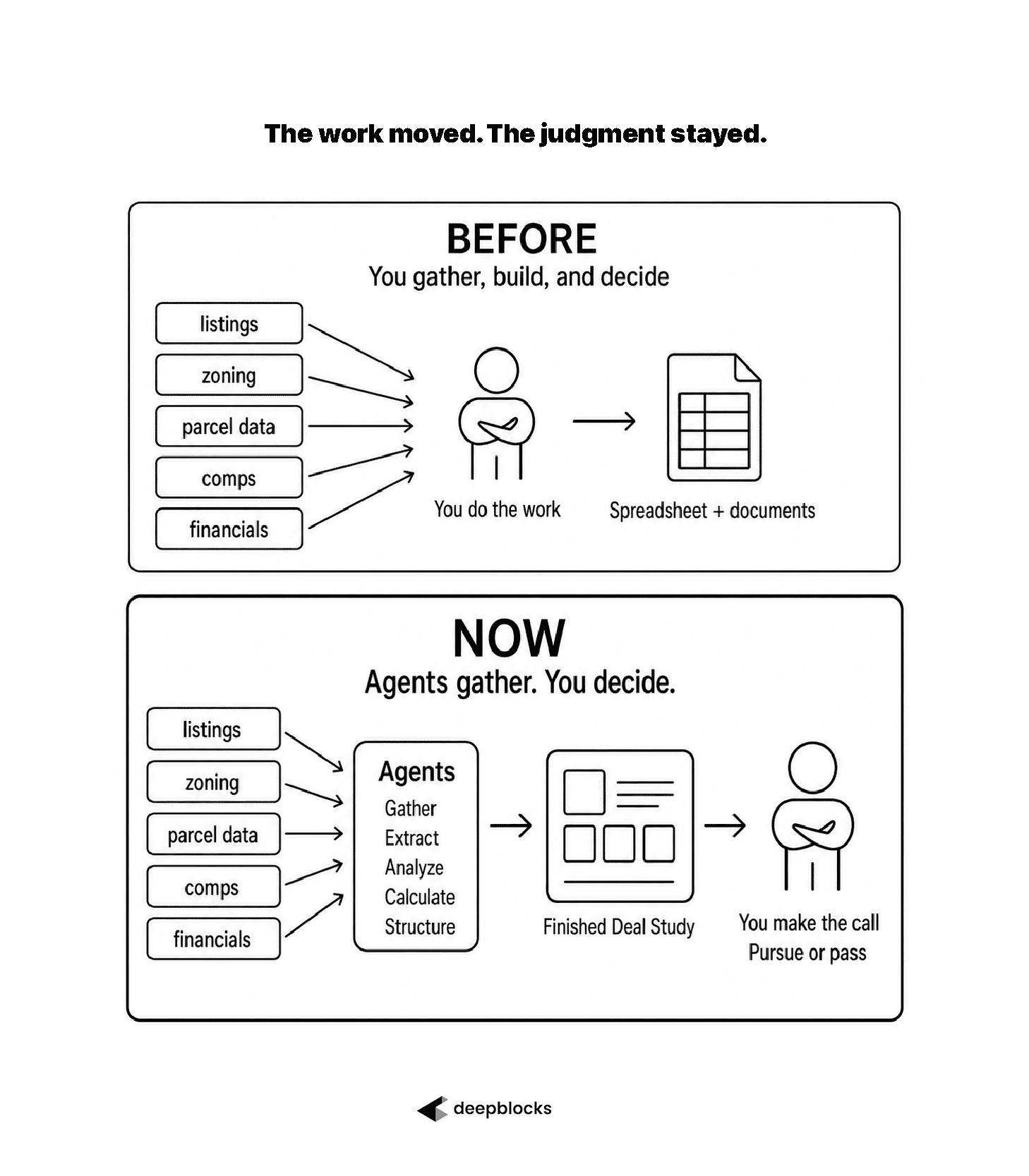
Agents interpret source structures, coordinate the steps, gather supporting evidence, and determine which tools or calculations the workflow requires.
The algorithm performs the calculation.
The agent orchestrates the process.
That division of labor matters because a reliable real estate workflow should not ask a language model to improvise calculations that can be handled deterministically.
Why Zoning Requires a Different Approach
Zoning is where the workflow becomes less generic.
It is tempting to point an agent at an entire municipal code and ask it to determine what can be built. But that is not a process we trust today.
A municipal code may contain thousands of pages. Its rules can be cross-referenced across multiple chapters, amended over time, and qualified by overlays, exceptions, definitions, special approvals, and provisions that govern other provisions.
A section may appear to permit a use while another section limits it.
A dimensional standard may apply differently depending on the district, frontage, lot condition, or approval path.
A generic retrieval-augmented generation system may find a section that mentions the right term while missing the provision that ultimately controls the outcome.
Retrieval is useful, but regulatory analysis requires more than finding a relevant paragraph.
It requires identifying the governing sections and understanding how they relate to one another.
Starting With Structured Zoning References
Deepblocks has digitized zoning information for more than 300 cities across the United States and identified the sections governing uses, density, and other development standards.
When a city is already in our database, the agent does not search the entire municipal code blindly.
It begins with direct references to the sections most likely to govern the question.
Using those references, the agent can produce a preliminary classification, cite the supporting sections, and flag conflicts or unclear cases for human review.
This creates a more constrained and auditable workflow.
The agent is not being asked to discover the entire zoning logic from scratch. It is starting from a structured body of work that identifies where the relevant rules are likely to be found.
When a city is not yet covered, a human reviews and maps the jurisdiction first.
That step is important.
When the governing rules have not been reliably identified, the answer is not to let the agent guess. The answer is to introduce human review before the analysis continues.
Finding Evidence of Market Status
After the parcel and zoning screening, the workflow can evaluate market status.
Agents search for evidence that a property is actively listed or otherwise available.
That evidence may appear across multiple sources and may not always be represented by one clean field. The system can gather the available signals, preserve the supporting evidence, and distinguish between confirmed information and preliminary indications.
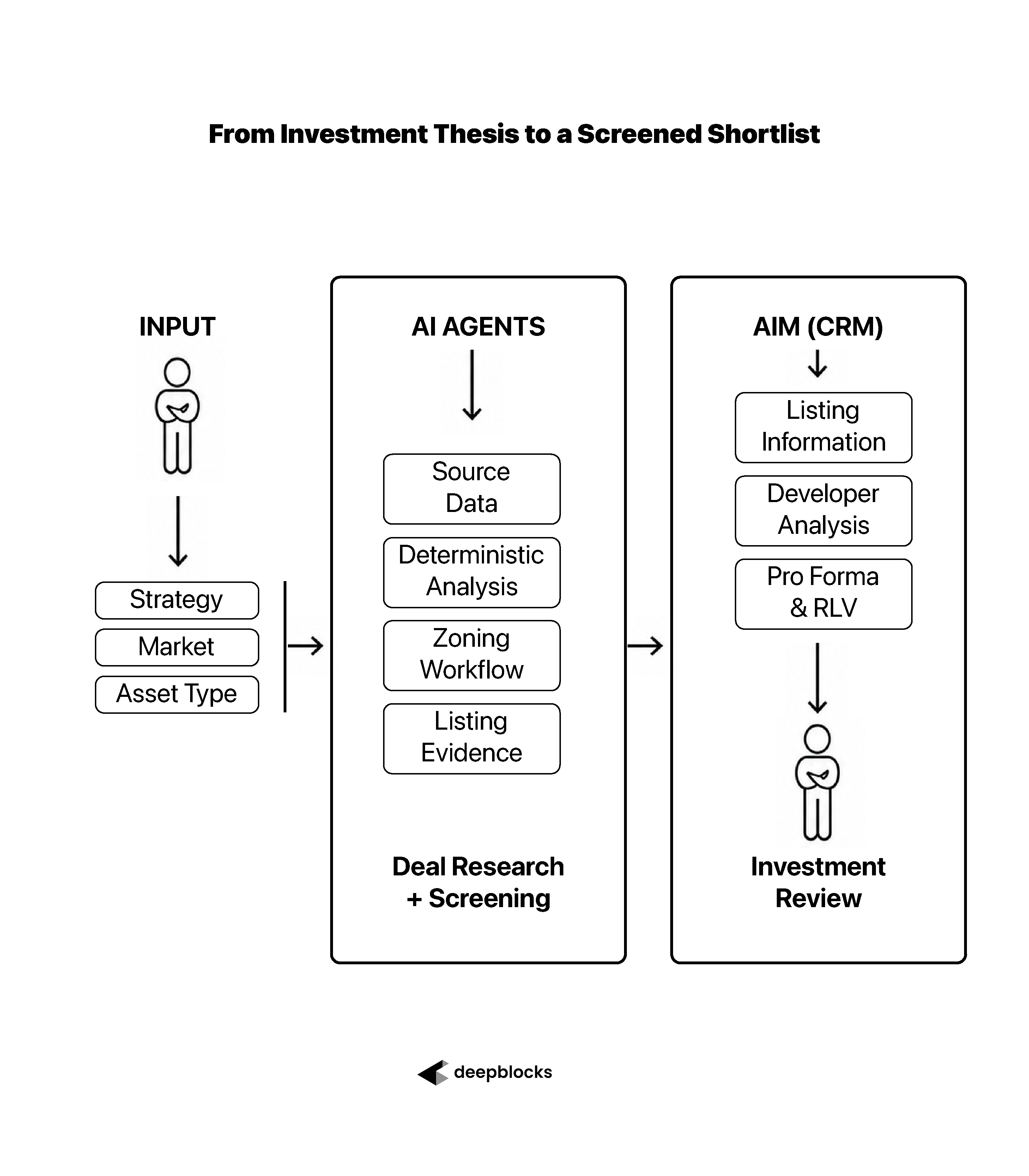
Qualified candidates can then be loaded into AIM and DEVELOPER with the customer’s assumptions for costs, income, and expenses.
At that point, the investment team is not starting with a blank search interface.
It is starting with a screened set of properties, the evidence supporting their inclusion, and a preliminary analysis based on the team’s own criteria.
A Clear Operating Model
The operating model is straightforward:
- Agents interpret and orchestrate.
- Algorithms calculate.
- Humans resolve ambiguity and make the investment decision.
Each part of the system handles the work it is best suited to perform.
Agents are useful when the workflow requires interpretation, coordination, or gathering information from inconsistent sources.
Algorithms are useful when the work requires precise filtering, spatial operations, thresholds, or financial calculations.
Humans remain essential when the information is ambiguous, the rules conflict, or the decision requires professional judgment.
The goal is not to remove people from the investment process.
It is to focus their time where their judgment has the most value.
A Screened Shortlist, Not a Final Entitlement Conclusion
The output of this process is not a final entitlement opinion.
It is not a replacement for legal review, professional due diligence, or jurisdictional confirmation.
It is a screened shortlist with supporting evidence, stated assumptions, and preliminary development capacity.
That distinction matters.
Real estate investment decisions often begin with incomplete information. The purpose of the workflow is to help teams identify which opportunities deserve deeper investigation.
Instead of manually reviewing every property in a market, the team can concentrate on a smaller group of candidates that appear to fit the investment thesis.
The system accelerates the first stages of discovery and evaluation.
The investment team still owns the final decision.
One Reusable Workflow, Many Investment Strategies
The property type can change.
The geography can change.
The criteria can change.
The underlying workflow remains reusable.
A customer may be searching for multifamily development sites in one market and industrial redevelopment opportunities in another. The required fields, zoning rules, thresholds, and assumptions will differ.
But the structure of the process remains consistent:
- Start with the investment thesis.
- Identify the data and definitions required for that thesis.
- Refresh the relevant sources.
- Map the local concepts.
- Apply deterministic screening and calculations.
- Gather supporting market evidence.
- Flag uncertainty.
- Deliver the qualified candidates for human review.
That is how a plain-English request becomes a repeatable deal-sourcing process.
The system does not force every customer into the same software interface or search sequence. It adapts the analysis to the strategy.
The request may begin with one sentence:
“Find properties in these markets that fit this thesis.”
Behind that sentence is a coordinated workflow of agents, algorithms, structured data, and human judgment.
The result is not another dashboard.
It is a defensible starting point for an investment decision.