A short list of deals feels manageable.
Six months of short lists does not.
Once we had a repeatable pipeline for finding potential real estate opportunities, the next question became obvious:
Where should all those deals live?
Our first version seemed simple.
We sent customers an email notification with links to the listing, the deal analysis in DEVELOPER, and the pro forma.
For the first few opportunities, that worked.
Then the pipeline grew.
By month six, some customers were tracking as many as 48 leads, with more arriving the following month.
Email became the new bottleneck.
Explore Deal Flow: Deepblocks customized AI agent workflows
Finding Deals Created a New Problem
The original challenge was discovery.
How could we find properties that matched a customer’s investment thesis? How could we screen markets, evaluate zoning, estimate preliminary capacity, and identify opportunities worth reviewing?
Once that workflow started producing results, it created a second challenge: continuity.
A deal may look interesting when it first arrives. But investment teams rarely make a decision based on one notification.
They return to the opportunity.
They compare it with other deals.
They update assumptions.
They add notes.
They track conversations.
They move it through internal review.
They decide whether to pursue it, pause it, or pass.
A property is not useful simply because the team discovered it. It becomes useful when the team can continue working with it.
Email was good at announcing that a new deal existed.
It was not good at managing what happened next.
Why Email Breaks at Pipeline Scale
Email works well when the volume is low and the action is immediate.
A message arrives. Someone opens the listing, reviews the analysis, and decides what to do.
But real estate opportunities do not usually move through such a clean sequence.
One deal may need further zoning research. Another may depend on revised construction costs. Another may look promising but be priced too aggressively. Another may be worth revisiting when market conditions change.
As the number of opportunities grows, important context becomes distributed across inboxes and individual team members.
- Which deals have already been reviewed?
- Which assumptions were changed?
- Why did the team pass on a property three months ago?
- Which opportunities are still waiting for follow-up?
- Which deals are similar enough to compare?
- Where is the latest pro forma?
The answers may exist, but finding them becomes work.
That is when the delivery mechanism becomes part of the product.
Building AIM
We built AIM to solve that problem.
Not as a general-purpose CRM.
AIM was designed as one centralized place for every opportunity and everything connected to it.
Instead of sending a series of disconnected links through email, Deal Flow can deliver opportunities into a workspace where the investment team can organize, review, compare, and advance them.
AIM brings together:
- A map showing where the deals are located
- A spreadsheet-style view of the pipeline
- A residual land value calculator
- Notes and color coding
- Deal-stage and progress tracking
- Links to listings, analyses, and pro formas
Each feature supports a different part of the investment workflow.
The map provides geographic context.
The table makes it easier to sort and compare opportunities.
The calculator helps teams test value assumptions.
Notes preserve the reasoning behind a decision.
Stages show what has happened and what needs to happen next.
The supporting links keep the original evidence and analysis connected to the deal.
The goal is not simply to store properties.
It is to preserve the full working context around each opportunity.
A Deal Is More Than a Record
A traditional database can tell you that a property exists.
An investment pipeline needs to tell you much more.
It needs to show why the property was identified, how it fits the investment thesis, what assumptions were used, what the team learned, and where the opportunity stands today.
That history matters.
A deal that was unattractive six months ago may become relevant after a price reduction.
A site that appeared constrained may deserve another look after a zoning change.
A property that did not fit one strategy may fit another.
Without a centralized record, those opportunities are easily forgotten.
A deal is not as useful if the team cannot find it again, compare it with other opportunities, understand its history, or decide what happens next.
That is why AIM is not just a repository.
It is a working layer between discovery and action.
From Individual Deals to a Portfolio View
Reviewing one opportunity is different from managing an entire pipeline.
At the individual-deal level, the team wants detail: zoning, capacity, pricing, costs, income, expenses, and supporting evidence.
At the pipeline level, the team needs perspective.
- How many deals are in each stage?
- Where are opportunities concentrated?
- Which markets are producing the strongest candidates?
- Which deals require follow-up?
- Which assumptions are causing opportunities to fail?
- Are there patterns across the properties the team is advancing or rejecting?
A centralized pipeline makes those questions easier to answer.
Instead of treating each deal as an isolated analysis, the team can begin to understand the portfolio of opportunities as a whole.
That improves more than organization.
It can improve the investment process itself.
When teams can compare deals consistently, they can refine their criteria, identify recurring risks, and become clearer about what makes an opportunity worth pursuing.
Designed for a Broader Workflow
The architecture behind AIM can also support additional data and services.
That may include owner contact information, permitting lookups, external APIs, and an LLM capable of working across the customer’s broader deal pipeline.
The important idea is that these capabilities would not exist as disconnected tools.
They would be connected to the opportunity being evaluated.
An owner lookup becomes more useful when it is attached to the relevant parcel.
A permitting record becomes more useful when it appears alongside the deal analysis.
An AI assistant becomes more useful when it can work across the team’s actual pipeline rather than answering questions about one isolated document.
A team could eventually ask questions such as:
- Which active opportunities have the most unused zoning capacity?
- Which deals are waiting for owner outreach?
- Which properties were rejected because of pricing rather than development potential?
- Which opportunities should be revisited based on updated assumptions?
The pipeline itself becomes a source of intelligence.
But that is only possible when the opportunities, evidence, decisions, and history live in one place.
The Delivery Layer for Deal Flow
Finding opportunities is only part of the job.
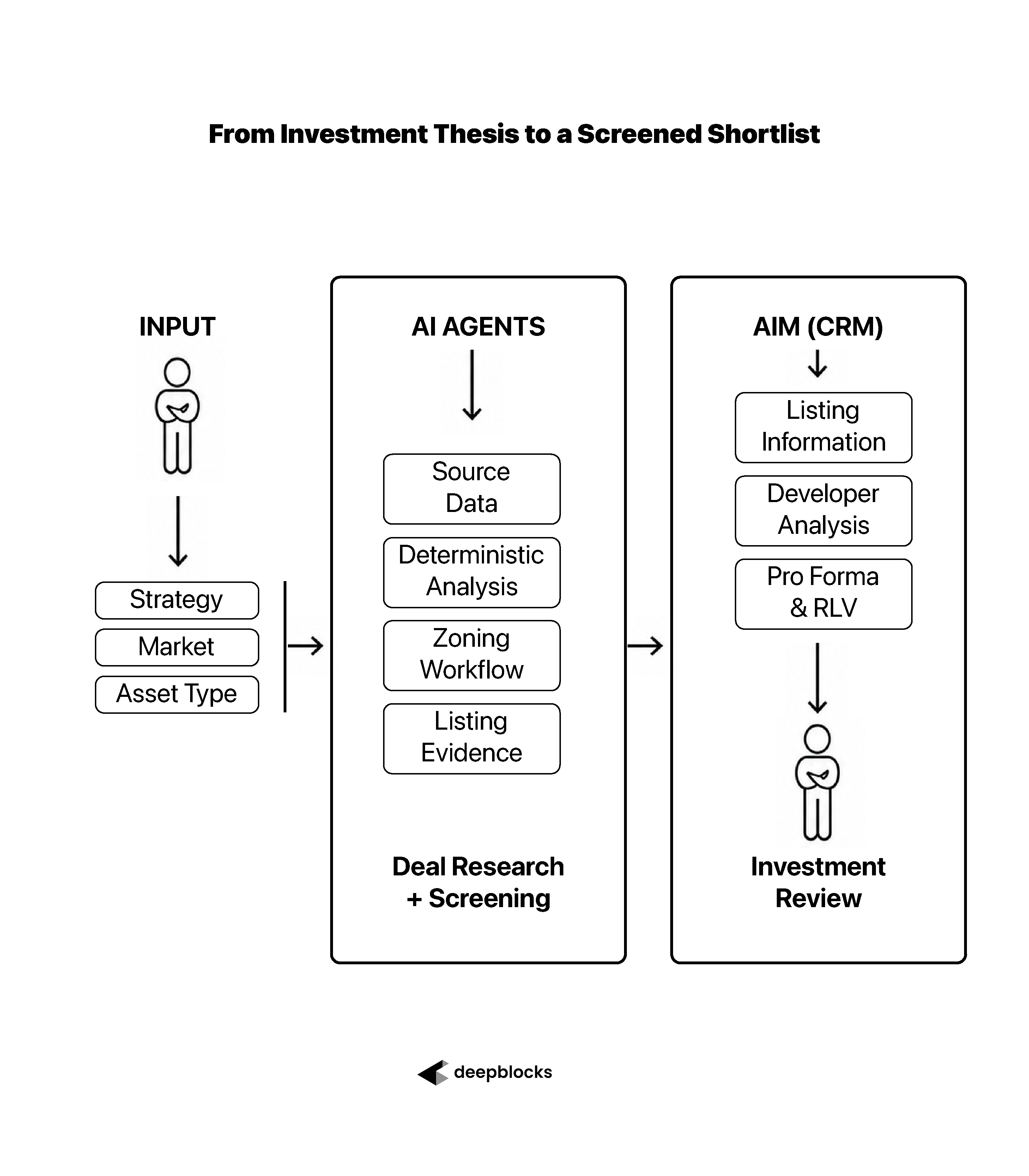
The agents help identify properties that match the customer’s strategy. They gather the relevant information, apply the screening criteria, and help produce a preliminary study.
But the workflow cannot end when the opportunity is found.
The investment team needs somewhere to receive the deal, review it, organize it, and move it forward.
That is the role of AIM.
AIM is the delivery layer for Deal Flow.
The agents find the opportunities.
DEVELOPER provides the environment for detailed analysis.
AIM gives the investment team a centralized pipeline for managing what happens next.
Together, those layers turn deal discovery into an operating process rather than a stream of notifications.
From More Leads to Better Decisions
A larger pipeline is not automatically a better pipeline.
More leads can create more noise, more duplication, and more administrative work.
The value comes from helping the team understand which opportunities matter and what should happen next.
That requires more than sending another email.
It requires a system that preserves context, supports comparison, and makes the team’s decisions visible over time.
The first few deals may fit comfortably in an inbox.
The next 48 probably will not.
And six months later, when the team wants to know why a property was considered, what changed, or whether it deserves another look, the answer should not depend on finding an old email thread.
Finding opportunities begins the workflow.
Organizing and advancing them is what turns those opportunities into a real deal pipeline.
Where does your team keep track of potential deals today: email, spreadsheets, a CRM, or some combination of all three?