Part two of a series. Part one argued that zoning capacity is a mispriced economic asset. This one asks how much of it there actually is.
Most people assume upzoning is something that happens to a neighborhood eventually.
In a lot of urban cores, it already happened.
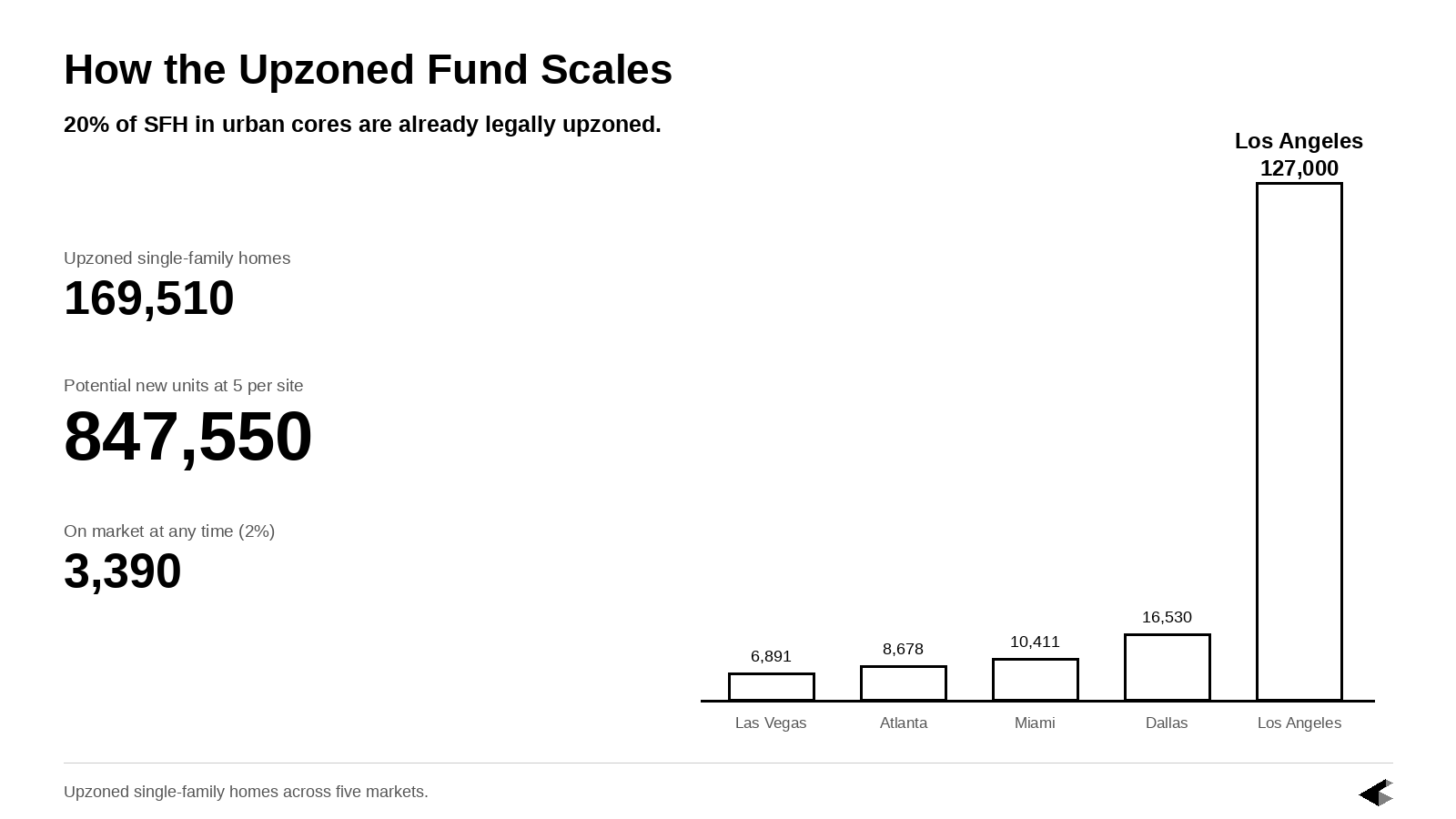
On average, about 20% of single-family homes in urban markets have already been upzoned. These are houses sitting on land that is legally developable for considerably more than a house.
The question part one left open was whether that is a curiosity or a category.
It is a category.
Explore Deal Flow: Deepblocks customized AI agent workflows
The Inventory Across Five Markets
We measured upzoned single-family homes in five markets:
- Las Vegas: 6,891
- Atlanta: 8,678
- Miami: 10,411
- Dallas: 16,530
- Los Angeles: 127,000
That is 169,510 upzoned single-family homes.
Los Angeles is the outlier, and by a wide margin. Approximately 127,000 single-family homes there sit on land that could yield small multifamily projects.
That number does not account for state legislation like SB-9.
The other four markets matter for a different reason. They establish that this is not a California phenomenon produced by one unusual regulatory environment. Dallas has 16,530. Miami has 10,411. Las Vegas, the smallest of the five, still has 6,891.
Five markets. 169,510 homes.
What "Upzoned" Actually Permits
The allowable projects are not all large.
Some allow duplexes, which simply double the existing unit. We have seen sites that support as many as 78 units, though at that scale the site constraints usually mean it only works as part of an assemblage.
That range is worth sitting with, because it is where most of the misunderstanding lives.
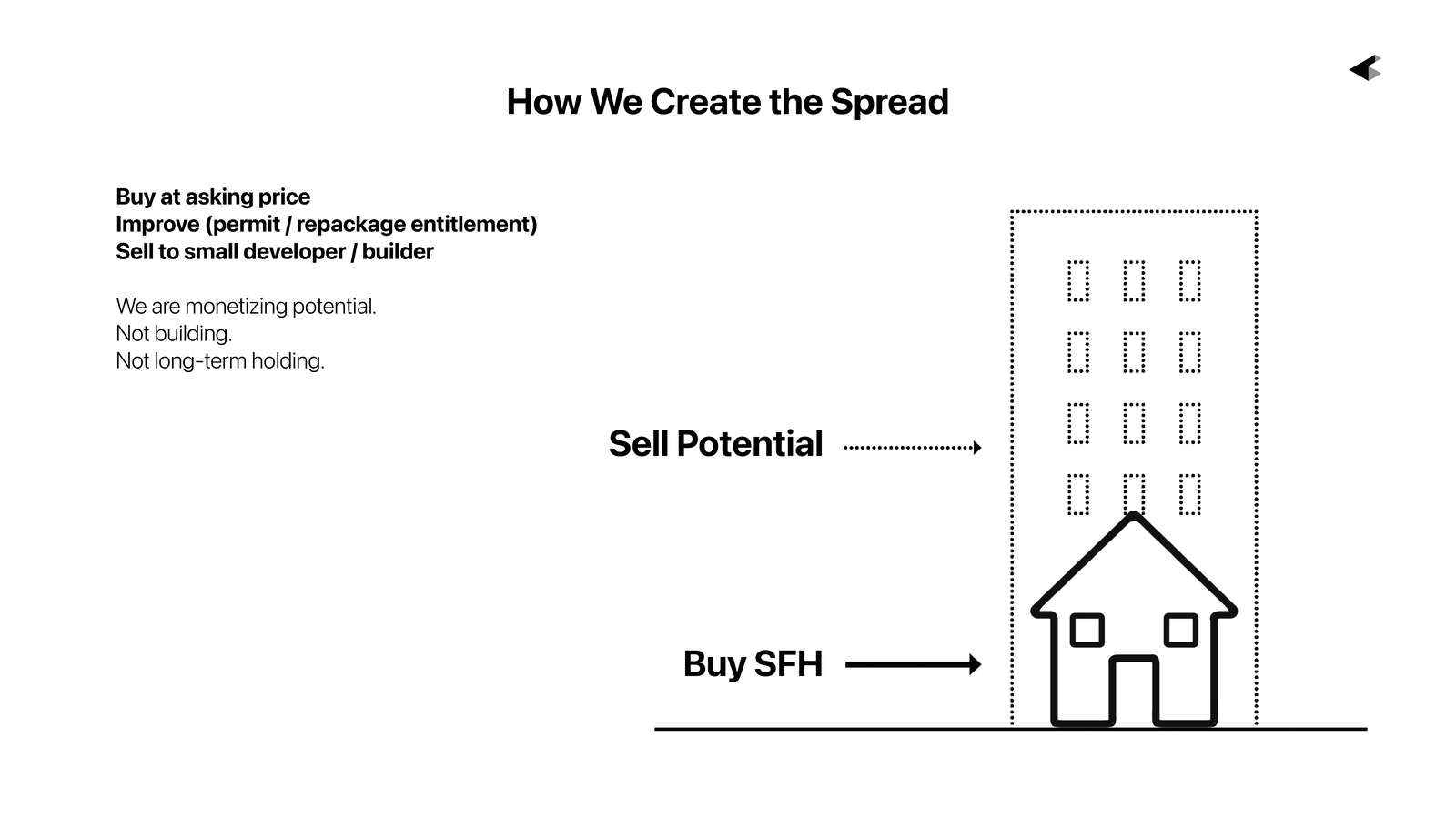
A duplex is not a development deal in the way the industry normally uses that phrase. Nobody is raising a fund to build one duplex. But the parcel that permits a duplex is priced as a house, and a house that can legally become two units is worth more than a house that cannot.
The value is in the permission, not the construction.
At the other end, a site that supports 78 units is a real project, but usually only if it is assembled with its neighbors. Site constraints tend to make the theoretical maximum unreachable on the parcel alone.
Both ends of that range are real. Neither is what a conventional acquisitions pipeline is built to find.
Scaling the Count Into Stakes
A count of parcels is not by itself interesting. What matters is what the count implies.
If these sites yield an average of five units each, 169,510 parcels represent 847,550 potential new units.
That is across five markets.
It is worth being precise about what that number is and is not. It is not a forecast. It is not entitled, financed, or under construction. It is an estimate of what current zoning already permits on land that currently holds one house.
Almost none of it looks impressive one site at a time. That is exactly why it goes unnoticed.
The housing conversation tends to focus on large projects, because large projects are visible and legible and get written about. This inventory is the opposite. It is enormous in aggregate and unremarkable in every individual instance.
The Number That Actually Constrains the Strategy
You cannot buy a parcel that is not for sale.
So the operative number is not 169,510. It is how many of those homes are on the market at any given time.
In Miami, we can observe this directly: of roughly 10,411 upzoned single-family homes, about 198 are currently listed. That is a little under 2%.
Applying 2% across all five markets gives roughly 3,390 on-market opportunities at any given moment.
We could have assumed a higher turnover rate and produced a larger headline number. Two percent is what the one market we can actually observe supports, so 2% is what we used.
3,390 is also the more useful figure. It is not a statistic. It is a list.
Why 3,390 Is Still Too Many
No acquisitions team reviews 3,390 parcels by hand.
And the list turns over every month.
That combination is what makes this a different kind of problem. It is not simply large. It is large and perishable. A shortlist assembled in January describes a market that no longer exists in March.
Every one of those 3,390 properties has to be checked against:
- Local zoning and what it permits on this specific parcel
- The existing improvement and how much of the allowable capacity it uses
- Site geometry, setbacks, parking, and whether the permitted capacity is physically achievable
- What the land can actually support once those constraints are applied
- The asking price, and whether it reflects the house or the land
Do that once and it is an afternoon. Do it 3,390 times and repeat monthly, and it stops being a research task.
That Volume Can Only Be Worked Algorithmically
This is where the thesis stops being an investment argument and becomes an infrastructure argument.
Finding mispriced zoning capacity at scale requires canvassing millions of properties in order to surface the handful worth transacting on now.
Every county publishes parcel data differently. Every municipality defines zoning and land use differently. Development capacity depends on local rules that do not generalize from one jurisdiction to the next.
Making that comparable across markets is most of the work. It is also the part that does not show up in the output.
That is what our Deal Flow service does.
Not a list of everything. A short list of what is worth a phone call this month.
The Constraint Is Not Capacity
The capacity is already legal.
That is the part worth repeating, because it inverts how most people think about the housing supply problem. This inventory does not require a rezoning, a variance, a political fight, or a new statute. The permission already exists, granted by decisions municipalities already made.
What is missing is the ability to see it.
169,510 parcels across five markets. 847,550 units of permitted capacity. Roughly 3,390 of them buyable in any given month, and a different 3,390 next month.
The capacity is already legal.
The constraint is finding it.
If you are underwriting in these markets, how are you currently identifying parcels where the zoning has moved but the price has not?


