
If Deepblocks Started a Fund, It Would Buy Mispriced Zoning Capacity
If Deepblocks started a fund, it would buy mispriced zoning capacity.
Not buildings.
Not cash flow.
Not a bet on rents rising.
The asset would be the gap between what a parcel is worth as what it is, and what it is worth as what it is legally allowed to become.
That gap is measurable. It is also, often, ignored.
Explore DEV to prove if a site pencils: Drop a pin, model in 3D, and watch returns move.
Two Markets, One Parcel
The strategy begins with a very specific asset: single-family homes on land where current zoning already allows materially more housing than what exists today.
A parcel like that sits at the intersection of two markets.
The first is the residential housing market. Prices there are set by comparable home sales. Three bedrooms, two baths, a certain age, a certain condition, a certain street. An appraiser finds recent sales that look like it and works from those.
The second is the development market. Prices there are set by what the land can support. Not what is standing on it. What is permitted to replace it.
Most of the time those two markets produce a similar number, and nobody notices there are two of them.
Sometimes they do not.
Why the Two Prices Drift Apart
Zoning changes. The market does not always notice.
A municipality adopts a new land use plan. A state passes a housing bill that preempts local density limits. A corridor is upzoned as part of a transit plan.
On the day that happens, the legal development capacity of thousands of parcels changes at once.
The residential market does not reprice on that day.
Comparable sales are backward-looking by construction. They describe what buyers paid for houses that looked like this one, recently, under the old rules. If no comparable parcel has traded on its development potential yet, nothing in the comp set reflects the new capacity.
So the house keeps trading like a house.
Meanwhile the land underneath it has quietly become something else.
That gap is the opportunity.
It is not permanent. Once a few parcels on a corridor trade at development pricing, the comps catch up and the gap closes.
The window is the period between the rule changing and the market pricing the rule.
Residual Land Value, Plainly
The metric that measures the gap is residual land value.
Developers use it to determine what they can pay for land. It works backward from the finished project.
Start with the legal buildable area. Estimate the value of the completed project. Subtract construction costs, soft costs, financing, the required return, and a margin for risk.
What is left is the amount that can be paid for the site.
In simple terms:
Completed project value − development costs − required return = land value
That is the whole calculation. The arithmetic is not the hard part.
It is difficult for a different reason: almost every input requires knowing something specific about this parcel and these local rules.
Buildable area depends on the zoning district, lot dimensions, setbacks, height limits, floor area ratio, lot coverage, parking requirements, and whatever overlays and bonus programs apply.
Completed value depends on the local market for the product type the zoning actually permits.
Costs depend on construction type, which depends on height, which depends on zoning again.
Get the buildable area wrong and every number after it is wrong.
If the residual land value is meaningfully higher than the current market price, the parcel may be mispriced.
What Makes a Parcel a Candidate
Not every parcel with excess capacity is a candidate. The interesting ones tend to share a few characteristics.
- The existing structure is a small fraction of what the zoning allows
- The improvement is old enough that its remaining economic life is short
- The parcel is priced against residential comps, not land comps
- The permitted product type has a real market nearby, not a theoretical one
- Nothing about the site blocks the capacity in practice: no easement, no historic designation, no unusable geometry, no assemblage requirement
That last one matters more than it sounds.
Zoning describes what is permitted. It does not promise that the permitted thing is physically or economically buildable.
A parcel can be legally entitled to twelve units and shaped so that nine is the honest number once parking and setbacks are resolved.
The math is only as good as the reading of the site.
We Are Monetizing Potential, Not Building
There is a version of this strategy that ends with construction.
This is not that version.
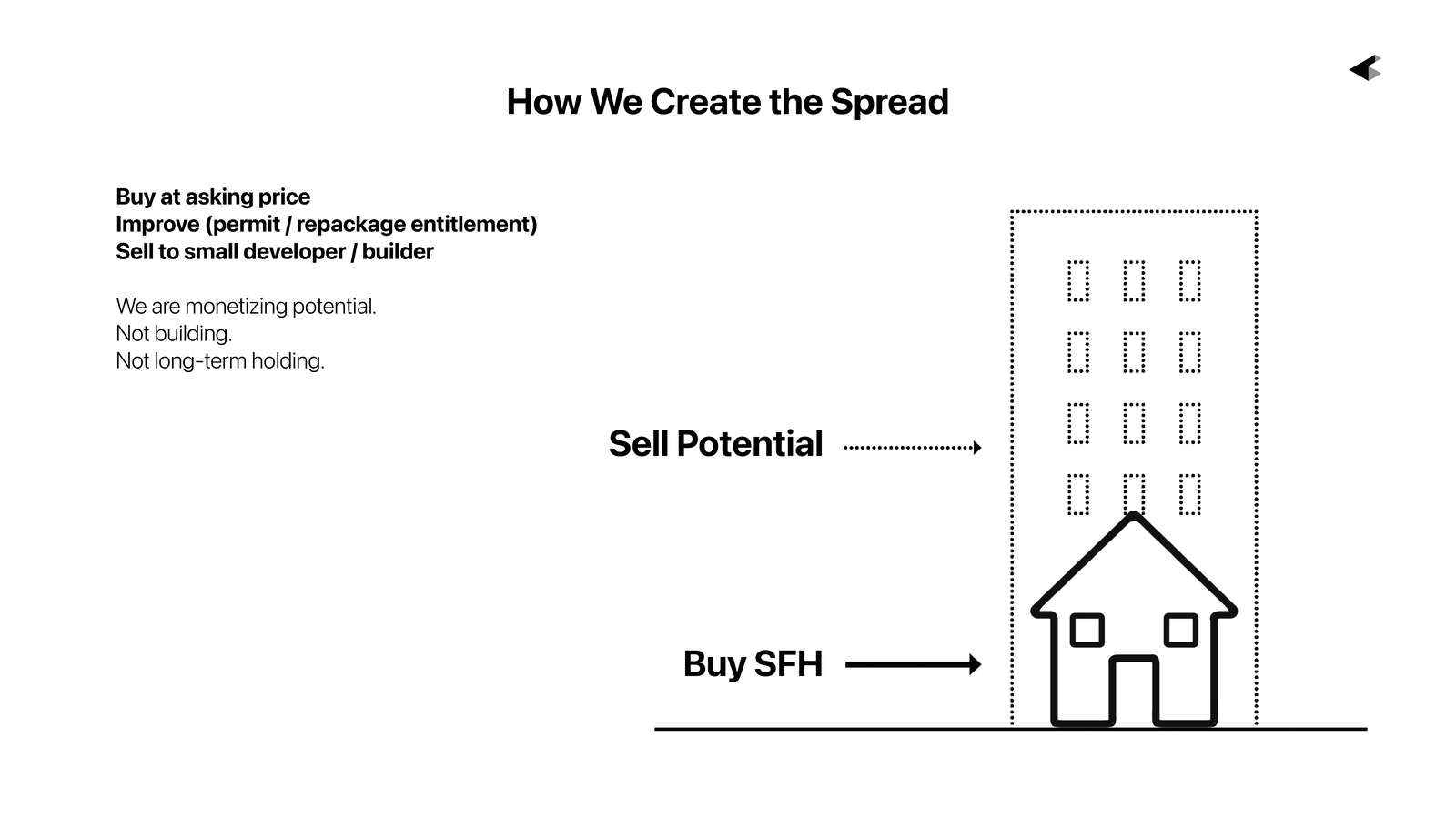
The idea is to buy at asking price, improve the parcel by taking the entitlement from theoretical to documented, and sell to a small developer or builder who wants a site that is ready to work.
Buy the house.
Establish the capacity.
Sell the potential.
Not building. Not long-term holding.
That distinction changes the risk profile substantially.
A fund that builds carries construction risk, lease-up risk, and multi-year exposure to rates and rents. A fund that monetizes potential is exposed to a much shorter question: can the capacity be documented, and is there a buyer who values it?
The work in the middle is entitlement work. Permits, studies, a defensible zoning read, a package a builder can underwrite without starting from scratch.
That work is what converts a claim about capacity into a price a developer will pay.
Where the Strategy Can Break
An honest thesis includes the ways it fails.
The gap closes before you can act. If a corridor has already traded, the comps reflect development pricing and there is no spread left.
The capacity is not real. A zoning read that looks clean on paper can collapse against a site condition, a concurrency requirement, or a review board with discretion.
The entitlement takes longer than the model assumes. Time is the quiet cost. Every additional month of carry comes directly out of the spread.
There is no buyer at the price. Residual land value describes what a developer could pay under a set of assumptions. It does not guarantee one will. If construction costs move or debt gets expensive, the residual falls and the bid disappears with it.
The rules change back. Upzoning is a political act. So is downzoning.
None of these make the strategy wrong.
They make it a strategy that requires being right about specific parcels rather than right about a category.
Why This Is a Data Problem Before It Is an Investment Problem
Here is the part that makes this a Deepblocks thesis rather than a general observation.
To find mispriced zoning capacity at any scale, you have to answer, for a very large number of parcels at once:
- What does current zoning allow here?
- What is standing on the site today?
- How large is the gap between those two?
- What is the completed value of what the zoning permits?
- What does it cost to build?
- What is the residual land value?
- What is the parcel listed at?
Answering that for one property is an afternoon of work.
Answering it for a market is a different kind of problem. Every county publishes parcel data differently. Every municipality defines zoning and land use differently. Development capacity depends on local rules that do not generalize.
That is the same problem we have been working on from the beginning, described from the investor's side of the table instead of the software's.
Zoning capacity is an economic asset. It is often priced slowly, unevenly, and with incomplete information.
Slow, uneven, and incomplete is what a data layer is for.
Testing This in Public
A thesis stated in the abstract is easy to agree with and impossible to evaluate.
So over the next few months we are going to test this one publicly, using real parcels and real math.
Each example will start with one site: its current zoning, the housing it can legally support, and the residual land value implied by that capacity. Then the asking price, and whether the two numbers actually diverge.
Some of them will not. That is part of the exercise.
A thesis that produces a hit on every parcel is not a thesis. It is a marketing claim.
Those worked examples run alongside this series as Deepblocks Daily Deals, one site at a time, with the zoning read, the modeled strategy, and the numbers we used to get there.
The series is the argument. The deals are the evidence.
That is where Deepblocks would start.
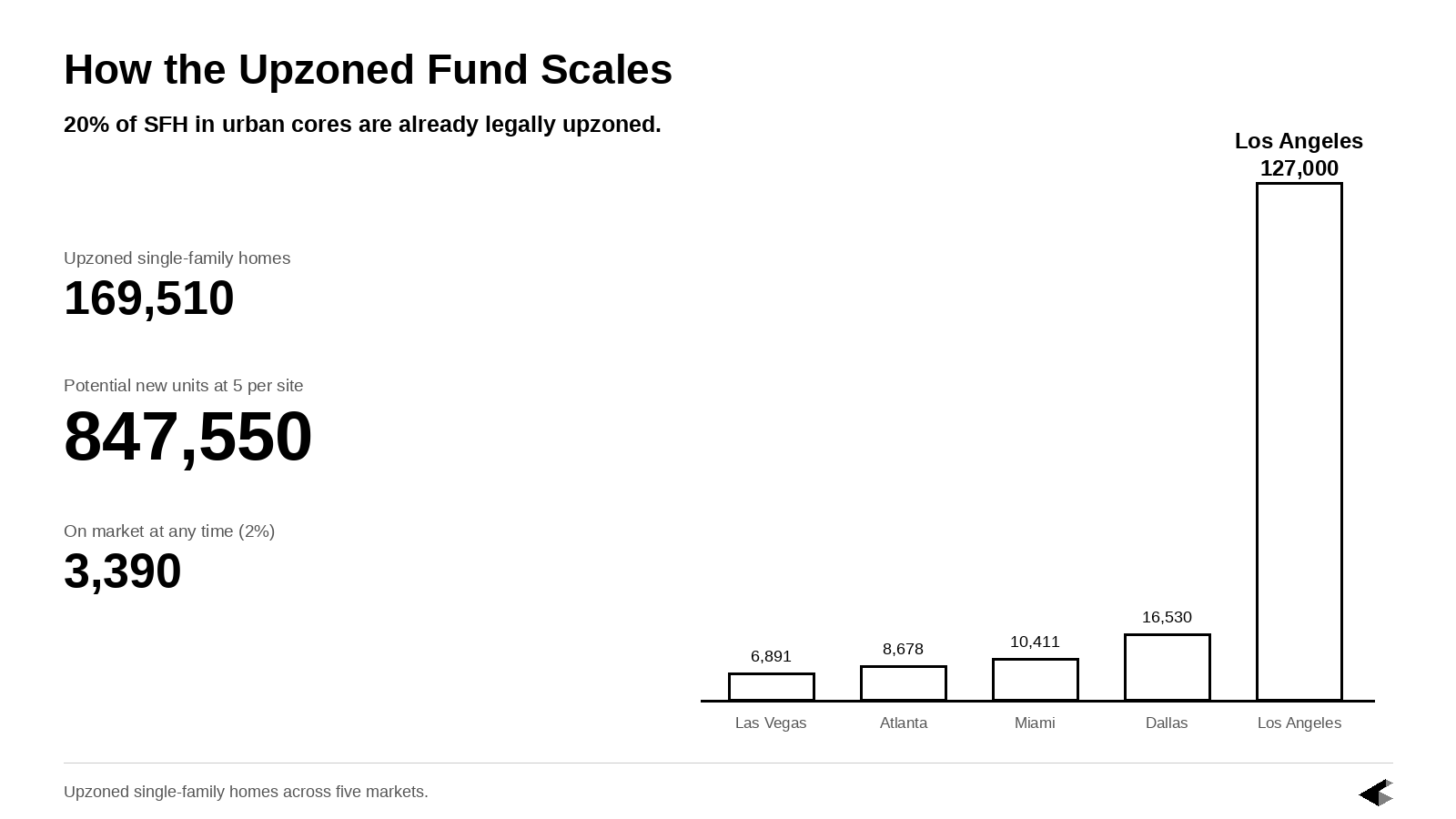
This is the first piece in a series. The second measures how much of this inventory exists across five markets.
Where would you look first: a corridor that was recently upzoned, or a market where the comps have not caught up yet?
Explore DEV to prove if a site pencils: Drop a pin, model in 3D, and watch returns move.