Why This Site Is Interesting
Small sites are often dismissed quickly.
They can be tight, inefficient, and difficult to park. But sometimes the location is strong enough that the constraints are worth testing.
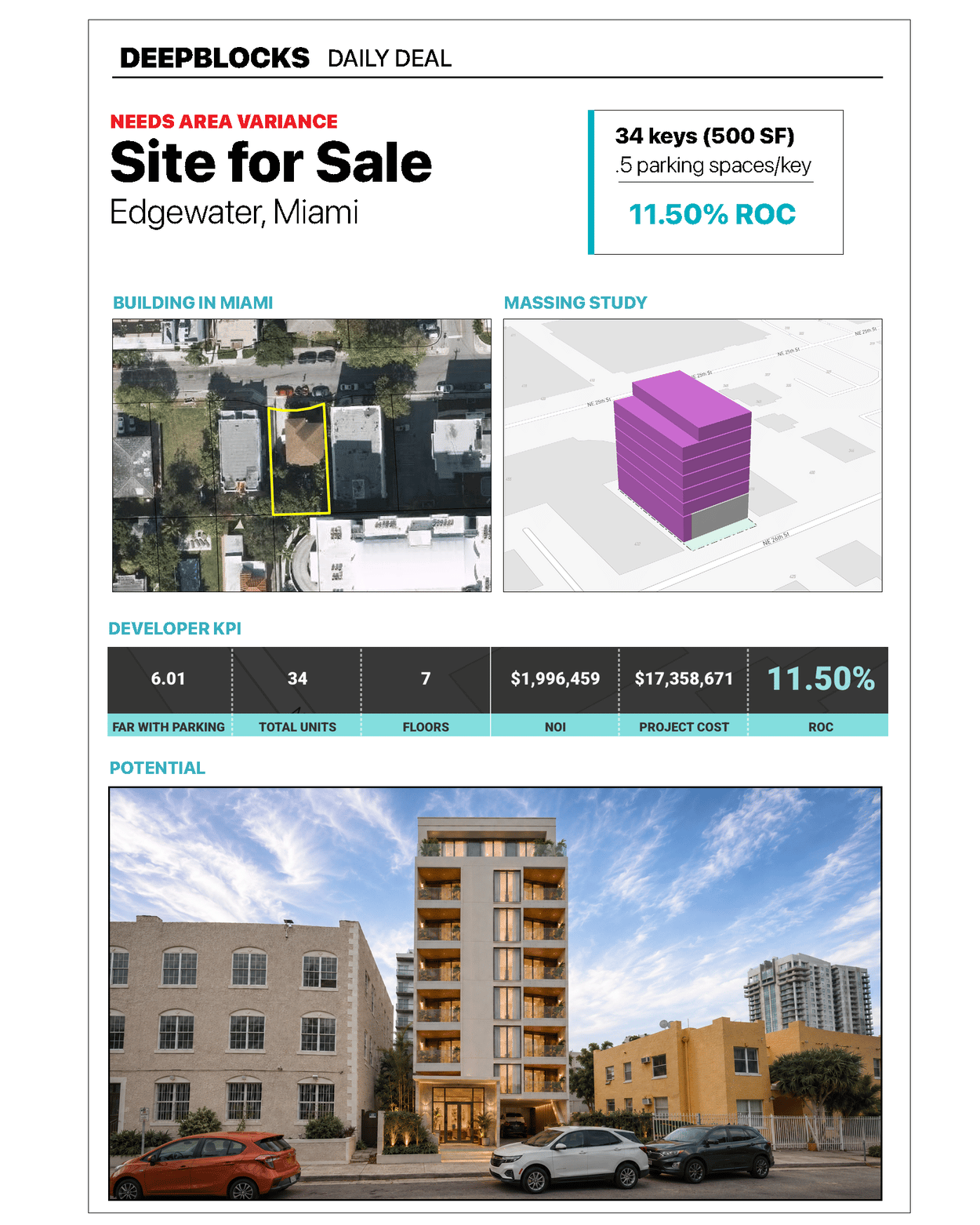
For this Deepblocks Daily Deal, we looked at a small parcel in Edgewater that feels like a compelling location for a hotel. The site has access to Metromover, is a quick bike ride across the Venetian Causeway to the beach, sits a few blocks from the bay, and is close to restaurants, Wynwood, and the Design District.
The location has a lot working in its favor.
The challenge is the lot size.
The site is 4,950 SF, which is 50 SF short of the required 5,000 SF minimum lot size. That means the project would need a lot-area variance.
That is a real entitlement issue, but it is also a very small gap.
Just 50 SF.
So rather than dismissing the site immediately, we wanted to test whether the deal could work if the geometry, parking, and hotel program were pushed efficiently.
Explore the live Edgewater hotel study here:
View the Deal Study
The Hotel Concept
For this sketch, we modeled a hotel with 34 rooms, which maximizes the allowable density on the site.
Each room is assumed to be 500 SF.
That is larger than a standard hotel room, and that is intentional. At that size, the rooms start to feel more like spacious studios, which opens up a more flexible hospitality concept.
The product could potentially support short-term stays, long-term stays, or something in between.
That matters in Edgewater.
This is a neighborhood where guests could use the hotel as a base for Downtown Miami, the beach, Wynwood, Midtown, the Design District, and the bayfront. A larger room format may also appeal to guests who want more space than a typical hotel room but do not necessarily need a full apartment.
In other words, the concept is not just about fitting hotel keys on the site.
It is about testing whether a small parcel can support a more residential-feeling hospitality product in a walkable, well-connected neighborhood.
The Parking Constraint
The main issue was parking.
On a site this small, conventional parking can quickly consume the ground floor and reduce the amount of usable program above it. If each parking space requires too much area, the site can lose feasibility before the building even gets off the ground.
To address that, we modeled the project with a stacked parking system.
That allowed all required parking to fit on the ground floor while reducing the parking allocation from approximately 350 SF per space to 215 SF per space.
That reduction is significant.
On a 4,950 SF parcel, every square foot matters. Reducing the space required per parking stall creates more room for circulation, structure, access, and the building logic above.
This is the key design move in the study.
Without the stacked parking system, the site is much harder to make work. With it, the hotel program becomes much more interesting.
The Development Assumptions
For this initial deal sketch, we used the following assumptions:
- Hotel rooms: 34
- Room size: 500 SF
- Hotel hard cost: $400/SF
- Parking system cost: $300/SF
- Soft costs: 15%
- Contingency: 6%
- Amenities: None
- Average daily rate: $550/night
- Stabilized occupancy: 75%
- Operating expenses: 70%
These are working assumptions, not final underwriting.
The goal at this stage is to test whether the project has enough logic to justify deeper diligence.
On a small site, this early pass is especially important. A deal can look interesting from the street, but once parking, setbacks, circulation, room count, and construction costs are modeled together, the answer can change quickly.
Why the No-Amenity Assumption Matters
One important assumption in this sketch is that the hotel has no amenities.
That may sound like a limitation, but it is also part of the strategy.
On a site this small, amenities compete directly with revenue-producing area, parking, circulation, and back-of-house needs. Every square foot allocated to amenities is a square foot that cannot support a room, a parking function, or an operational requirement.
The question is whether the location and room size can carry the product without a traditional amenity package.
In this case, the surrounding neighborhood becomes part of the value proposition. The bay, restaurants, transit access, the beach, Wynwood, and the Design District all help support the guest experience outside the building.
That does not mean amenities are irrelevant. It means the deal needs to be tested around a sharper question:
Can large rooms in a strong location offset the lack of on-site amenities?
That is exactly the kind of assumption hotel developers and operators will have a strong opinion on.
What We Would Want Feedback On
This is where market expertise matters.
The study raises several important questions:
- Is $550/night realistic for 500 SF rooms in this Edgewater location?
- Is 75% stabilized occupancy reasonable?
- Is 70% OpEx appropriate for a no-amenity hotel product with larger rooms?
- Would the market respond better to short-term stays, extended stays, or a hybrid model?
- Does the stacked parking system create operational friction, or is it acceptable for this type of hotel?
- How much concern should we assign to a lot-area variance when the site is only 50 SF short of the minimum requirement?
These are the assumptions that determine whether the project is just interesting on paper or actually worth pursuing.
The Takeaway
This site is small, but the feasibility question is interesting.
At 4,950 SF, the parcel is just shy of the minimum lot size. That creates entitlement risk, but the gap is minor enough to justify a closer look.
The hotel program maximizes the allowable density with 34 large rooms at 500 SF each. The stacked parking system solves one of the biggest physical constraints by reducing the parking allocation from 350 SF per space to 215 SF per space and keeping all required parking on the ground floor.
The result is a deal sketch that is not obvious, but worth testing.
That is the purpose of Deepblocks Daily Deal.
Not to declare that every site works.
But to quickly understand which constraints matter, which assumptions drive the outcome, and whether there is a real development path hiding inside a difficult parcel.
For this Edgewater hotel study, the key question is simple:
Can a small, variance-dependent site become feasible through the right combination of location, room strategy, and parking efficiency?
We’d love to hear from hotel developers and operators.
Explore the live Edgewater hotel study here:
View the Deal Study


