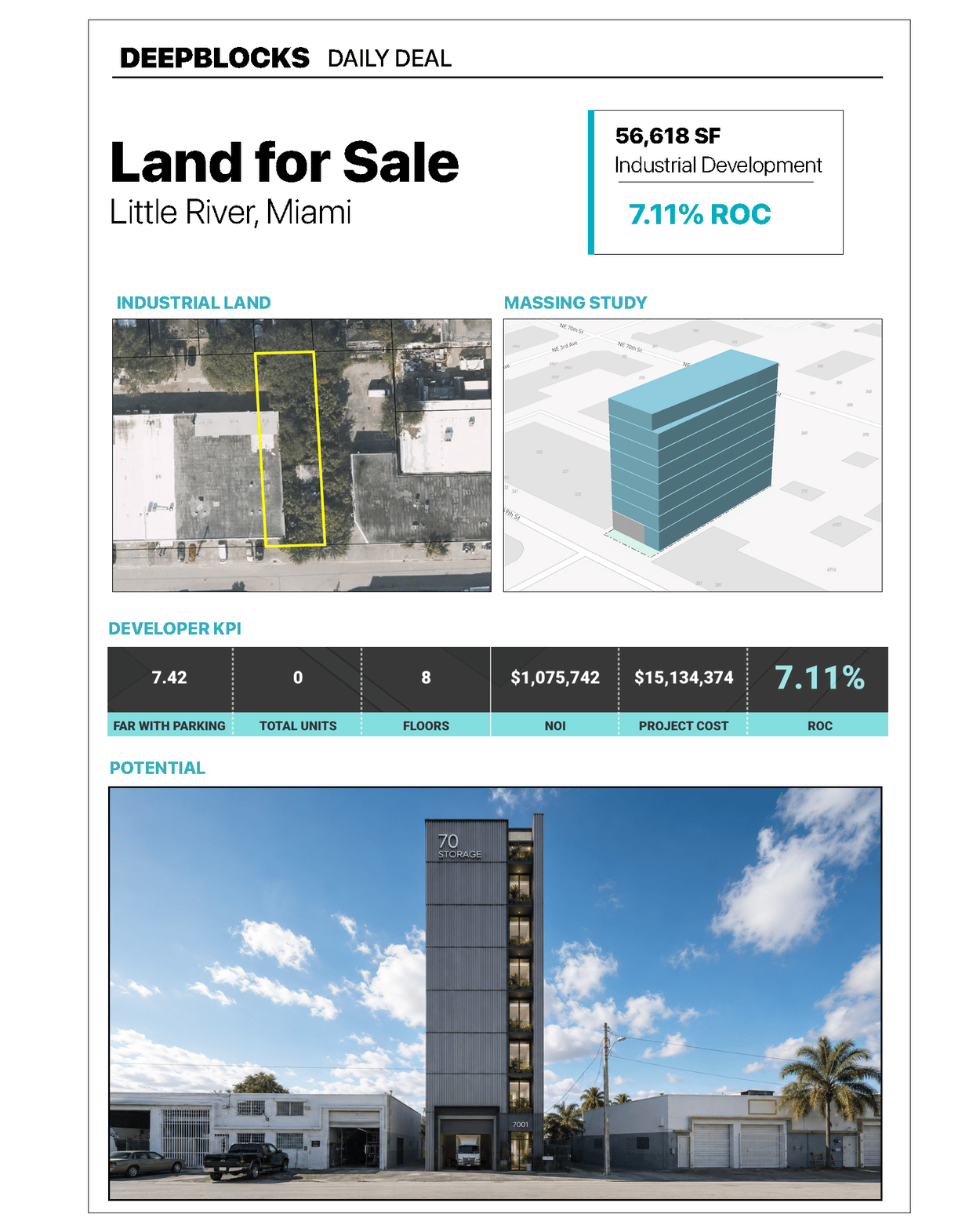
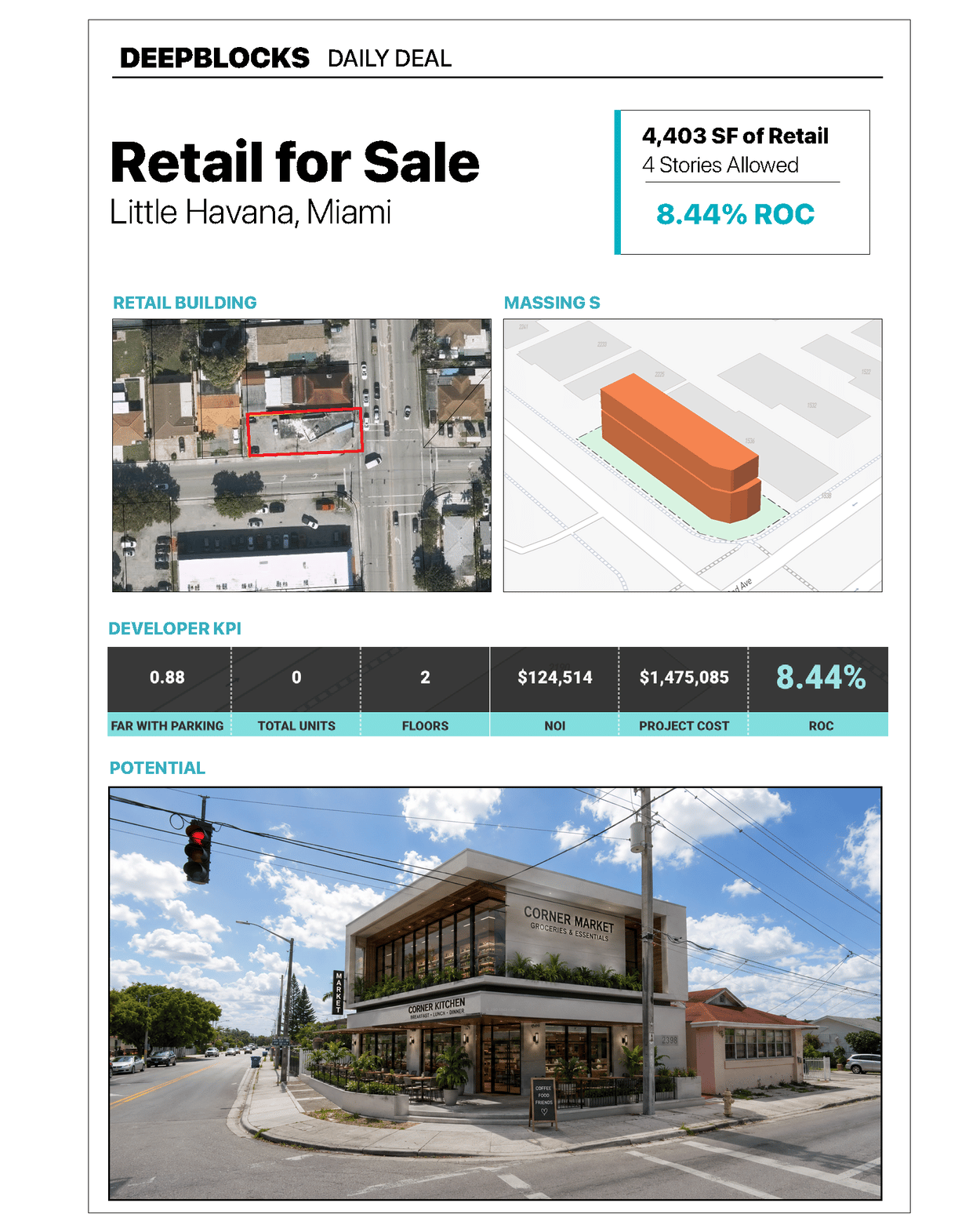
A narrow industrial site in Little River offers an interesting test case for storage, distribution, or self-storage, but the real question is whether the site can operate efficiently.
Why This Site Is Interesting
Little River is becoming one of Miami’s more interesting commercial neighborhoods.
The area has been attracting more attention from developers, operators, and investors looking for industrial, creative commercial, adaptive reuse, and neighborhood-scale commercial opportunities.
It also has another characteristic that has become more relevant in Miami: relative elevation. For investors thinking about long-term climate risk, that can become part of the site selection conversation.
For this Deepblocks Daily Deal, we looked at a narrow industrial site for sale in Little River. The property sits in a D2 zoning district, where industrial uses are primarily allowed by right.
That makes the first development question relatively clear:
Can this site support a functional industrial storage or distribution facility?
The answer depends less on whether the use is conceptually allowed and more on whether the site can actually operate efficiently.
Explore the live Developer study here:
Little River Industrial Storage and Distribution Study
The Industrial Concept
For the initial deal sketch, we modeled a 56,000 SF storage/distribution facility.
The idea is not to create a truck yard or long-term truck parking facility. Trucks would not be stored overnight as the primary use. Instead, this is imagined as a facility where trucks enter the site, load or unload, and leave.
The operating assumption is that the site could potentially handle four to five delivery trucks at a time.
That distinction matters.
A storage/distribution facility has different physical and operational requirements than a truck terminal. The project needs truck access, loading functionality, circulation, and adequate space for operations, but it is not being underwritten as a facility where trucks remain on-site long term.
On a narrow site, that operational logic is critical.
The building may work on paper, but the real question is whether truck movement, loading, access, and tenant operations can function without creating bottlenecks.
Why D2 Zoning Matters
The site’s D2 zoning is one of the reasons the industrial program is worth testing.
In many urban neighborhoods, industrial uses can become difficult to entitle or justify as surrounding areas evolve. But here, the zoning already points toward industrial activity.
That gives the project a clearer starting point.
Rather than forcing a residential or mixed-use concept onto a constrained site, the deal sketch leans into the zoning and tests a use that fits the district’s industrial character.
That does not eliminate all risk. The site still needs to function physically, lease competitively, and support the construction cost. But it does mean the program is aligned with the basic zoning direction.
For a narrow site, that alignment matters.
The Development Assumptions
For this initial study, we used the following assumptions:
- Program: Storage/distribution facility
- Total storage space: 56,000 SF
- Hard construction cost: $200/SF
- Soft costs: 12%
- Contingency: 5%
- Lease rate: $20/SF
- Target user: Large distributor or industrial operator
The construction cost assumption is intentionally lower than a more polished commercial or office product.
The building is assumed to be functional industrial space, with limited windows, fewer expensive exterior materials, and a more utilitarian design. At $200/SF, the hard cost for 56,000 SF would be approximately $11.2M.
If soft costs and contingency are applied to hard costs, the combined development cost before land, financing, leasing costs, and other project-level assumptions would be approximately $13.1M.
On the revenue side, leasing 56,000 SF at $20/SF would generate approximately $1.12M in annual gross rent before vacancy, operating expenses, tenant improvements, concessions, and other underwriting assumptions.
These numbers are not a final pro forma. They are first-pass assumptions that help determine whether the deal deserves deeper diligence.
The Tenant Question
The main tenant concept is a large distributor.
That type of user may value Little River for its Miami location, industrial zoning, access to surrounding neighborhoods, and proximity to commercial demand. A 56,000 SF facility could potentially serve as a last-mile or urban distribution location, depending on the tenant’s logistics needs.
But the site’s narrow shape creates an important question:
Can the building support the tenant’s operation efficiently?
For a distributor, the answer depends on truck access, loading depth, turning movements, staging, clear heights, door locations, and the ability to move goods through the building without friction.
The model assumes trucks come in to load and leave, with only four to five trucks on-site at a time. That may make the site more manageable, but it still needs to be tested operationally.
A tenant may like the location and the zoning, but if the truck movements are awkward, the lease value could be limited.
The Self-Storage Alternative
Another possible path is self-storage.
A narrow industrial site with a large storage program may be attractive to a self-storage operator, depending on visibility, access, local demand, competition, and achievable rents. In that scenario, the developer could either build and operate the facility directly or lease the site or building to an operator.
Self-storage changes the underwriting.
It may reduce some truck-loading intensity compared with a distribution tenant, but it introduces different questions around unit mix, climate control, access, security, management, customer demand, and revenue per square foot.
It may also change the building design.
A distributor wants efficient loading and large functional areas. A self-storage operator wants rentable unit layouts, circulation, customer access, security systems, and potentially climate-controlled space.
So the alternative is not just a different tenant.
It may be a different building.
What We Would Want Feedback On
This study raises several questions for industrial developers, brokers, operators, and self-storage groups:
- Is $20/SF a reasonable lease assumption for this type of Little River industrial product?
- Is $200/SF a realistic hard cost for a functional storage/distribution building of this scale?
- Can a narrow site efficiently support loading for four to five trucks at a time?
- Would a large distributor value this location enough to accept the site constraints?
- Would self-storage produce a better risk-adjusted outcome?
- Should the project be designed around one large user, or should it be flexible enough for multiple industrial tenants?
These are the assumptions that would decide whether this is a simple industrial deal, a self-storage opportunity, or a site that looks better on paper than it operates in reality.
The Takeaway
This Little River site is interesting because it is not trying to be something it is not.
It is an industrial site in an industrial zoning district, located in a neighborhood that continues to gain commercial attention. The narrow shape creates constraints, but the zoning and location make the storage/distribution concept worth testing.
The initial model shows 56,000 SF of storage space, with a functional loading concept for trucks coming in and out rather than staying overnight. At $20/SF, the project could generate approximately $1.12M in annual gross rent. At $200/SF hard cost, the construction assumption reflects a practical industrial building rather than a high-finish commercial product.
The open question is which path creates the strongest development logic:
- A large distributor?
- A self-storage facility?
- A lease to an operator?
- A more flexible industrial building that can adapt to multiple users?
That is why we run the deal sketch.
The goal is not to force a conclusion. It is to quickly expose the operational, zoning, cost, and leasing assumptions that determine whether a site has a real path.
For this Little River industrial site, the next layer of diligence is clear:
Test the truck movements, validate the rent, and compare distributor demand against the self-storage alternative.
Explore the live Developer study here:
Little River Industrial Storage and Distribution Study