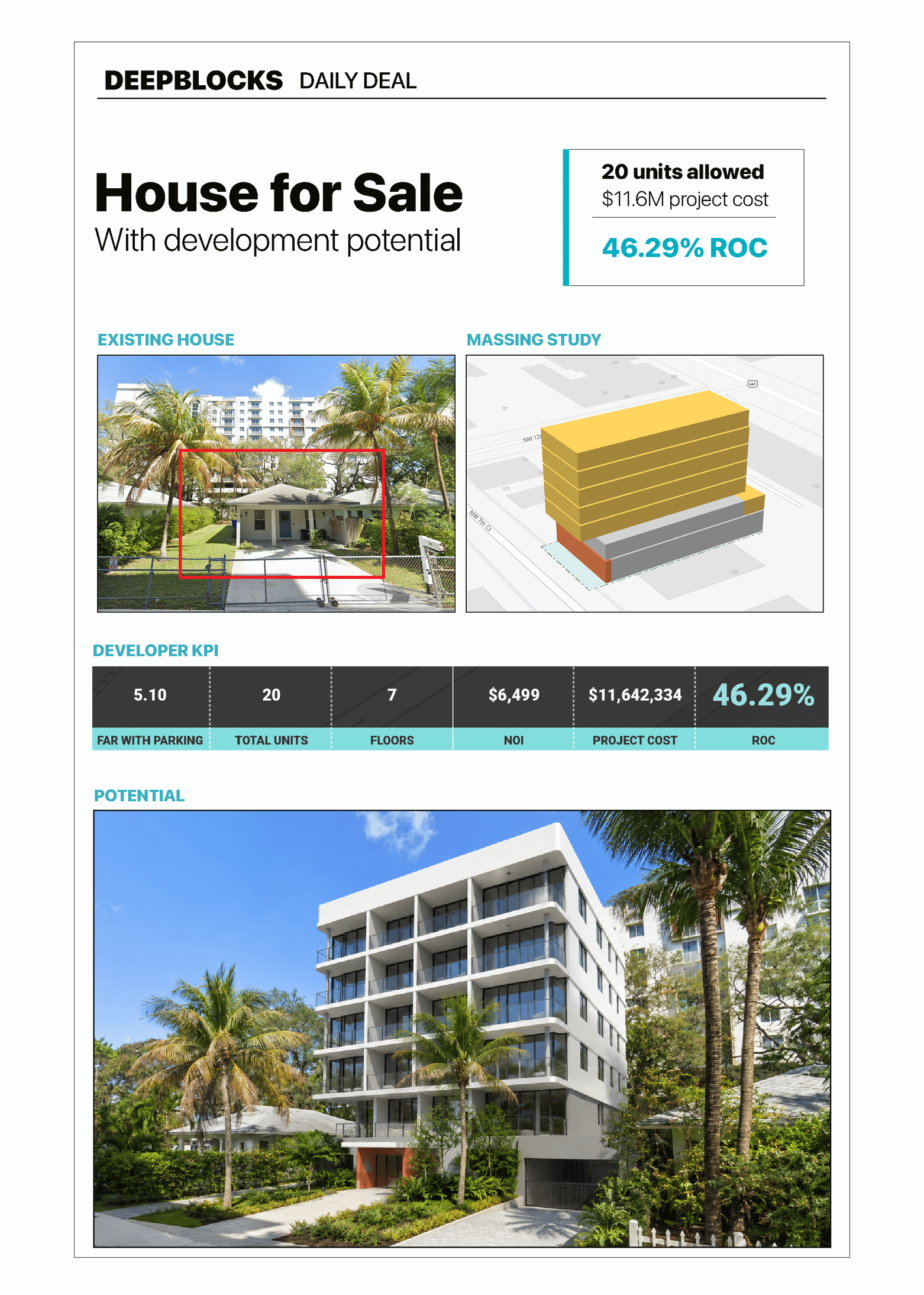
Today’s deal is a single-family home with redevelopment potential.
At first glance, that may not sound like a major development opportunity. But this is exactly the kind of site where the strategy can be more interesting than the existing structure.
The property has been on the market for more than 270 days, which may signal that the market has not fully agreed on the right use, the right buyer, or the right execution path.
That is where the opportunity may be.
On its own, the site appears to have potential for a 20-unit condominium project. With two adjacent properties, there may also be a larger assemblage opportunity that could support a project closer to 60 units.
That creates a classic development question:
Is the highest-value strategy to build small, assemble bigger, or create the vision and resell?
You can explore the project stacking plan here:
Open the Deepblocks Developer Explorer
The Small-Site Condo Strategy
The standalone site is roughly 6,000 square feet.
The key feasibility question is parking.
If two floors of parking can be solved on the site, there may be a case for developing approximately 20 condominium units directly.
That strategy has a few advantages.
A smaller building can be easier to understand, easier to market, and potentially easier to execute than a larger assemblage project. It may also create a more attractive ownership structure for buyers who prefer a smaller condominium building with a smaller HOA.
This is especially relevant in urban infill locations where buyers may value convenience, transit access, and proximity to employment more than large-building amenities.
The project does not necessarily need to be the biggest possible building.
It needs to be the right product for the location.
The Assemblage Strategy
The second strategy is to think bigger.
Two adjacent properties may create an assemblage opportunity that could support a project closer to 60 units.
That could make the site more attractive to a larger developer. A larger footprint may improve design flexibility, parking efficiency, unit mix, and overall project scale.
But assemblage also adds risk.
It requires site control, coordination with multiple owners, a longer timeline, and a buyer or developer willing to pursue a larger project. The upside may be higher, but the execution path is more complex.
For an investor, the question becomes:
Can this property be acquired as the first piece of a larger development puzzle?
If yes, the strategy may be to hold the property and resell it to a developer pursuing the full assemblage.
The Entitlement-and-Resale Strategy
There is also a middle path.
A buyer could acquire the property, create preliminary renderings, test massing, prepare a conceptual site plan, and package the opportunity for resale.
That strategy is not full development.
It is value creation through clarity.
Many small and mid-size developers do not want to start with a blank page. They want to see what can fit, what the likely unit count is, where the parking goes, how the building could look, and whether the project has a credible path.
A simple feasibility package can help turn a stale single-family listing into a more legible development opportunity.
That could make the property easier to resell to a developer who wants a smaller condo project but does not want to do the earliest feasibility work.
Why the Location Matters
The location strengthens the redevelopment thesis.
The property is one block from a metro station, which should support future market-rate residential demand. Transit access can matter for both renters and buyers, especially in neighborhoods where parking, commuting, and access to employment are major considerations.
The site also sits within the Health District, near Jackson Memorial Hospital and other major medical employers.
That matters because the demand base is not abstract.
Hospitals, medical offices, universities, and related employers can create a steady pool of potential buyers and renters who value proximity. A boutique condominium product near major employment and transit may appeal to medical professionals, staff, students, and investors looking for housing tied to durable local demand.
The site has two location advantages working together:
Transit proximity and employment density.
That combination is often what makes a small infill project worth studying.
The Key Development Question
The core question is not simply whether the site can be redeveloped.
The better question is:
Which strategy creates the most value relative to risk?
There are three realistic paths:
- Path 1: Hold for assemblage
Acquire the property and position it as part of a larger 60-unit assemblage opportunity. - Path 2: Create the development package
Produce renderings, preliminary plans, and a feasibility narrative, then resell the opportunity to a small or mid-size developer. - Path 3: Develop the condo project directly
Solve the parking, test the unit mix, and pursue a boutique 20-unit condominium project.
Each path has a different buyer, timeline, capital requirement, and risk profile.
The assemblage strategy may create the largest project.
The entitlement-and-resale strategy may create value without taking full construction risk.
The direct development strategy may be the cleanest if the 20-unit plan works physically and financially.
The Takeaway
This deal is interesting because it has optionality.
It is a single-family home today, but it may become a boutique condo project, a development package, or part of a larger assemblage.
The site’s long time on market may suggest friction, but it may also create room for a buyer who can see the redevelopment path more clearly than the market has so far.
The biggest question is whether the 20-unit strategy works on its own.
If two floors of parking can be solved on a 6,000 SF site, the boutique condo path may be compelling. If the adjacent parcels can be assembled, the larger 60-unit strategy may create another layer of upside.
That is why we model deals like this in Deepblocks.
Because the value is not always obvious from the listing.
Sometimes it is hidden in the strategy.
You can explore the project stacking plan here:
Open the Deepblocks Developer Explorer


