Intuition Does Not Come From One Field
My intuition did not come from one field.
It came from moving between fields.
I spent 11 years in architecture and real estate academia. I also worked across architecture, brokerage, construction, and development. That gave me one kind of intuition: how to look at a property and understand its potential, its constraints, its financial logic, and the process required to move it forward.
That kind of intuition is difficult to explain because it becomes almost automatic over time.
You look at a site and start seeing possibilities.
You see constraints before they are fully documented.
You understand that the numbers, the zoning, the design, the market, and the execution process are all connected.
You know when a project has potential.
You also know when something looks good on paper but will probably fail in reality.
That was one foundation.
Then I founded Deepblocks.
And over time, I developed a different kind of intuition.
Real Estate Data Created a New Kind of Pattern Recognition
Building Deepblocks forced me to understand real estate data at scale.
That is very different from understanding one site, one deal, one model, or one market.
At scale, real estate data behaves differently.
You start to see where public data is inconsistent.
You see how land use categories vary across jurisdictions.
You see how parcel data can look clean but still produce misleading results.
You see which workflows can be automated and which ones still need human judgment.
You learn that a rule that works in one city may fail in another.
You learn that a data field can be technically correct but commercially useless.
That changed how I thought about software.
I was no longer only thinking like a real estate expert. I was learning how real estate expertise needed to be translated into systems, workflows, assumptions, outputs, and validation checks.
That is a different skill.
It is not pure real estate intuition.
It is not pure technical intuition.
It is the intuition that forms when market knowledge meets software.
Getting Close to Engineering Changed How I Think
This did not happen passively.
I did not develop technical intuition by standing outside the engineering process and waiting for updates.
I asked engineers to explain major code decisions.
I joined engineering standups.
I paid attention even when I did not understand everything.
I asked questions until the decisions started to make sense.
That mattered.
Over time, I learned how software architecture decisions affect product speed. I learned how engineering teams think. I learned why certain decisions create flexibility and others create future constraints. I learned that the way a system is built can determine how quickly a company can respond to new ideas.
At first, many of those conversations were difficult to follow.
But that is how intuition starts.
You hear the same kinds of decisions repeatedly.
You see what breaks.
You see what slows the team down.
You see which shortcuts become expensive later.
You start to understand the difference between a small feature request and a structural product decision.
You do not learn that by reading about software from a distance.
You learn it by being in the room.
AI Should Be Managed Like a Very Fast Team Member
That experience matters now.
When I build software with AI, I do not treat the AI like magic.
I treat it like a very fast team member that still needs management.
I ask what it is changing.
I ask why it is making that decision.
I ask what assumptions it is using.
I ask how we will test the result.
I ask what could break.
That is the same discipline I used with human engineering teams.
The difference is speed.
AI can move very quickly. It can generate code, structure workflows, suggest architecture, write prompts, produce outputs, and revise ideas in minutes. That speed is powerful, but it also creates risk.
A fast system can create value quickly.
It can also create confusion quickly.
That is why the expert still has to stay involved.
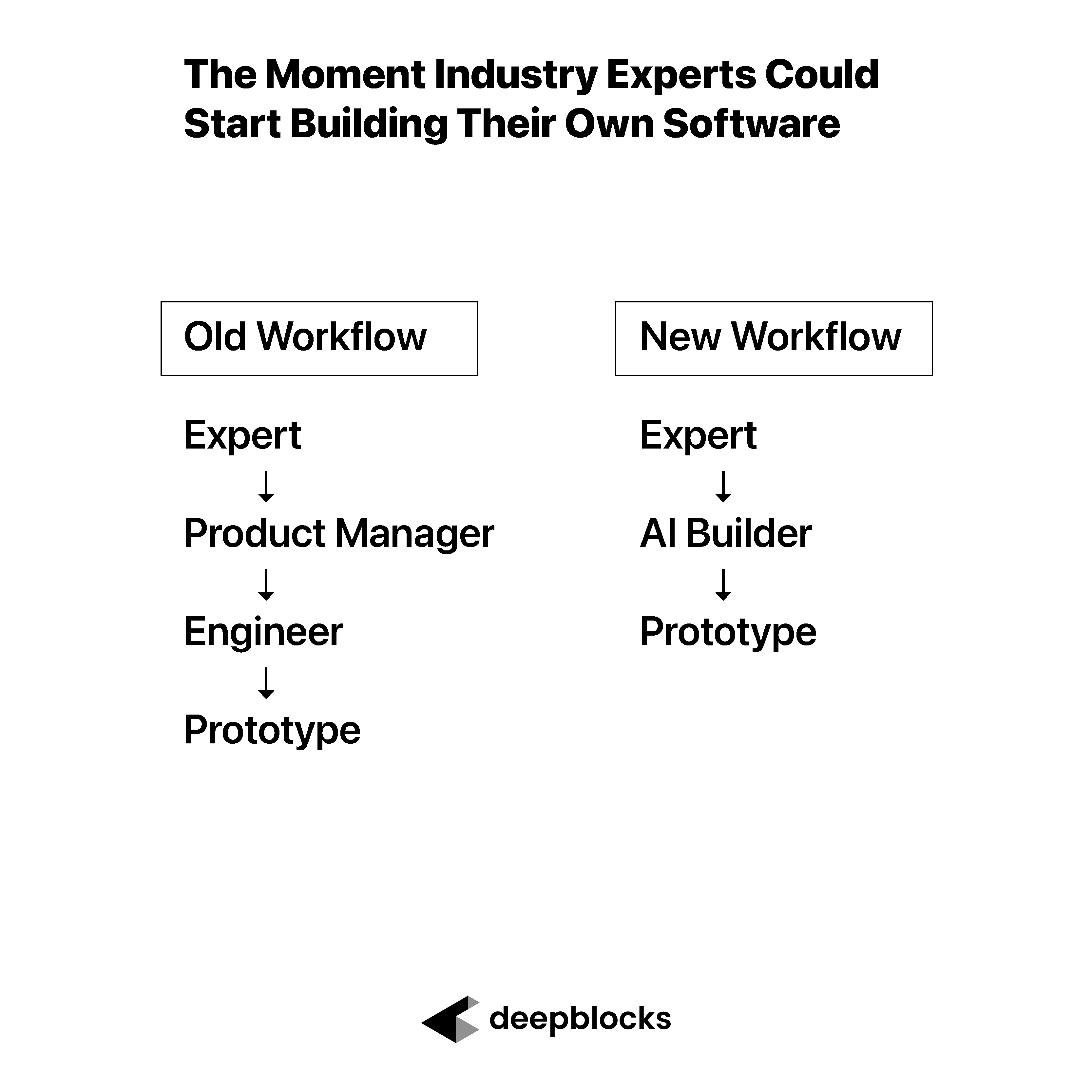
The role of the expert is not to know every technical detail before starting. The role of the expert is to stay close enough to the work to ask better questions, notice patterns, and build judgment over time.
Prompt Design Was My First AI Build Discipline
When ChatGPT came out, we immediately built software around it.
My role was to design the prompts.
That may sound simple now, but at the time it was a new kind of product design. The prompt was not just a question. It was a way of turning expertise into repeatable instructions.
We built automated article infrastructure.
Later, we built a 30-plus-model infrastructure.
Every iteration taught me something.
I learned what kinds of instructions produced useful outputs.
I learned where models were impressive.
I learned where they were fragile.
I learned how small changes in context could change the quality of the result.
I learned that AI systems need structure, examples, validation, and review.
Most importantly, I learned that AI workflows are not finished when they produce an answer.
They are finished when the answer can be trusted.
That is a much higher standard.
The Expert Does Not Need to Know Everything Before Starting
One of the biggest misconceptions about building with AI is that you need to understand everything before you begin.
You do not.
In fact, waiting until you feel fully ready may be the worst strategy.
The intuition comes from doing.
It comes from trying to build something and watching where the process breaks.
It comes from asking the AI to explain a decision.
It comes from reviewing the output and realizing that something does not match reality.
It comes from asking a better question the second time.
It comes from documenting what worked and what failed.
It comes from repeating the process until the patterns become familiar.
That is how experts build confidence with AI.
Not by becoming engineers overnight.
Not by outsourcing all technical thinking.
But by staying close enough to the process that the work starts teaching them.
Why Hands-On AI Work Builds Better Judgment
Hands-on work creates a different kind of understanding.
When you only read about AI, it can seem abstract.
When you actually build with it, the strengths and weaknesses become obvious.
You see how quickly it can draft a workflow.
You see how confidently it can make a mistake.
You see how much better it performs when the documentation is clear.
You see how often your own assumptions were not explicit enough.
You see that AI is not just a tool for producing outputs. It is also a mirror that shows you how well you understand your own process.
That is uncomfortable, but useful.
If you cannot explain a workflow clearly, AI will expose that.
If your assumptions are vague, AI will expose that.
If you do not know what a good output looks like, AI will expose that.
This is why getting your hands dirty matters.
The process does not only teach you about AI.
It teaches you about your own expertise.
Real Estate Experts Need a New Kind of Intuition
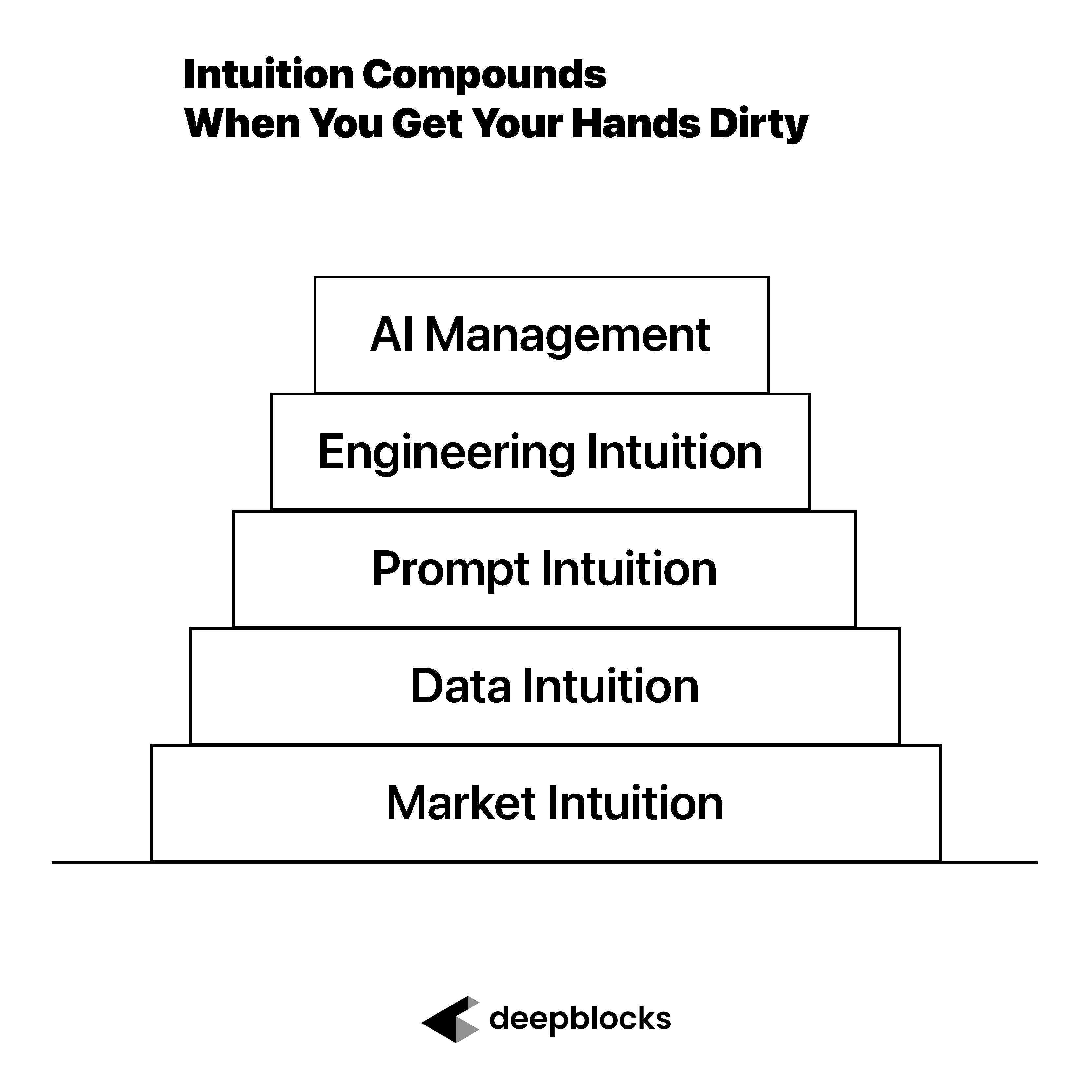
For real estate experts, the new intuition is not only market intuition.
Market intuition still matters. It tells you when a site feels wrong, when a yield is unrealistic, when a rent assumption is too aggressive, or when a development concept will not survive local constraints.
But AI requires another layer.
You need workflow intuition.
You need data intuition.
You need prompt intuition.
You need software intuition.
You need validation intuition.
You need to understand how your expertise becomes instructions, how those instructions become outputs, and how those outputs are tested against reality.
This does not mean you need to become a professional engineer.
It means you need to participate enough to understand the shape of the system.
That is where confidence comes from.
The More You Participate, the More Your Intuition Compounds
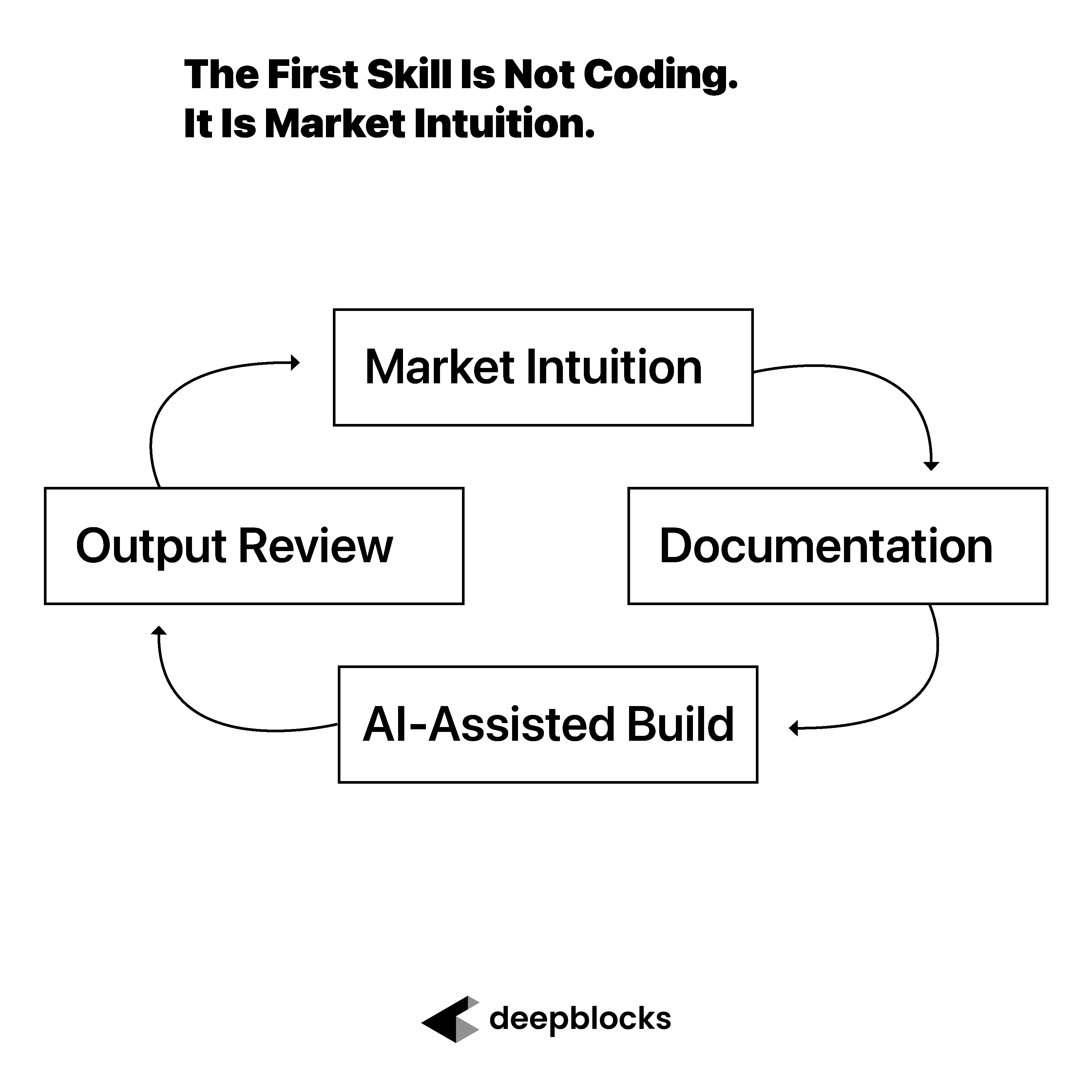
Intuition compounds when you participate across the full process.
You bring market knowledge into the workflow.
You turn that knowledge into documentation.
You use AI to build or test something.
You review the output.
You notice what failed.
You improve the instructions.
You try again.
Each cycle adds something.
You understand the market better.
You understand the data better.
You understand the AI better.
You understand the workflow better.
You understand your own assumptions better.
That compounding effect is the real advantage.
The expert who stays close to the process becomes stronger with each iteration. They do not only get a better tool. They become a better manager of intelligent systems.
Conclusion: The Intuition Comes From Doing
The lesson is simple.
If you are an expert and you want to build with AI, you have to get your hands dirty.
That does not mean you need to know everything.
It does not mean you need to become an engineer.
It does not mean you need to understand every line of code.
It means you need to participate.
Ask questions.
Review outputs.
Challenge assumptions.
Pay attention when something breaks.
Document what you learn.
Try again.
That is how intuition compounds.
You do not need to know everything before you start.
The intuition comes from doing, not from waiting until you feel ready.