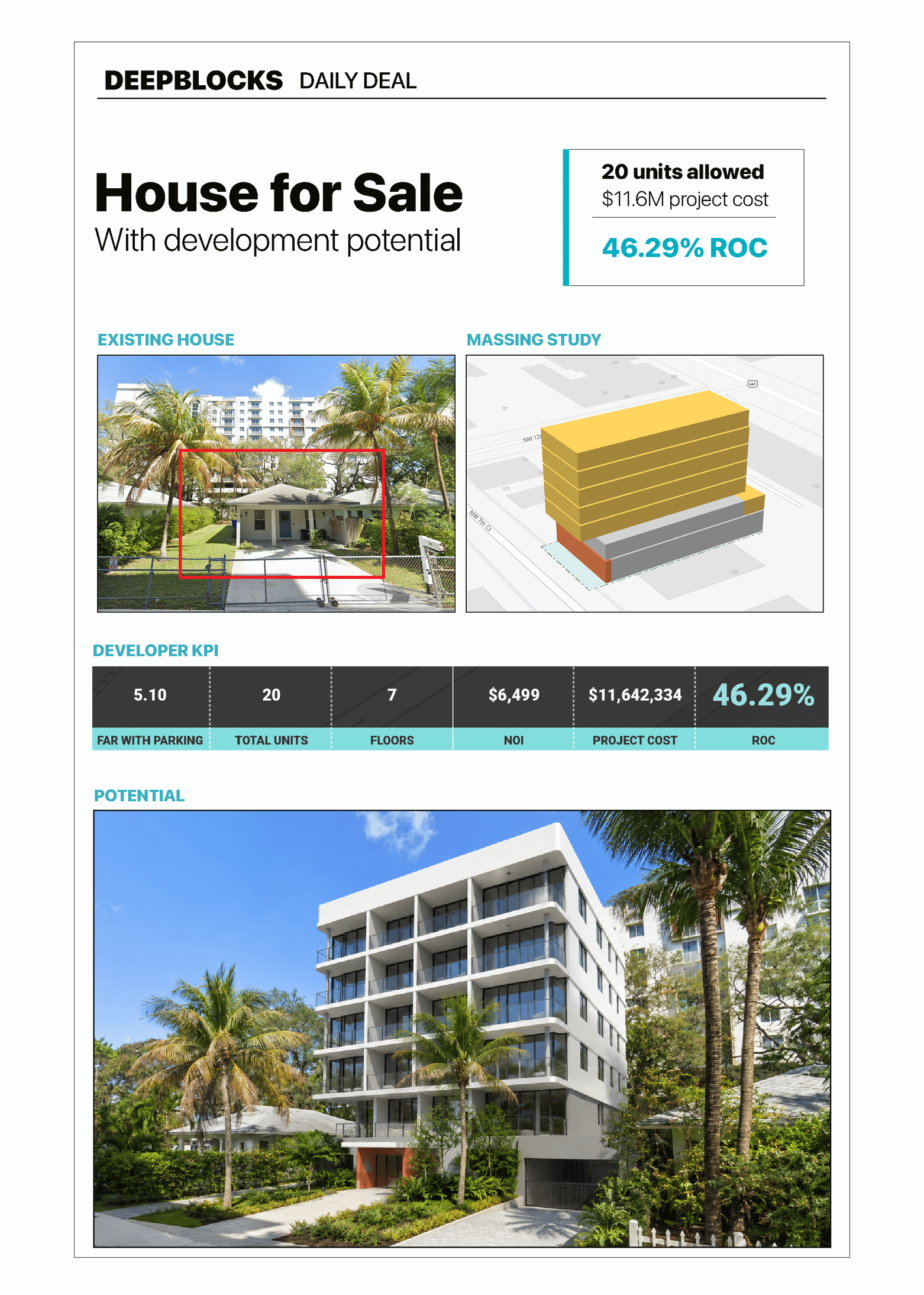
I love this deal because it is not just a zoning exercise.
It is a strategy exercise.
The immediate question people keep bringing up is parking. I keep hearing that the standalone site cannot solve the parking requirement for a boutique 20-unit condominium project.
I do not fully buy that.
Parking may be difficult. It may require creativity. It may require two levels. It may affect the unit mix, the building layout, and the economics.
But I am not ready to assume it is impossible.
That said, even if parking becomes the constraint on the standalone site, the assemblage story is still worth studying.
The Half-Block Assemblage
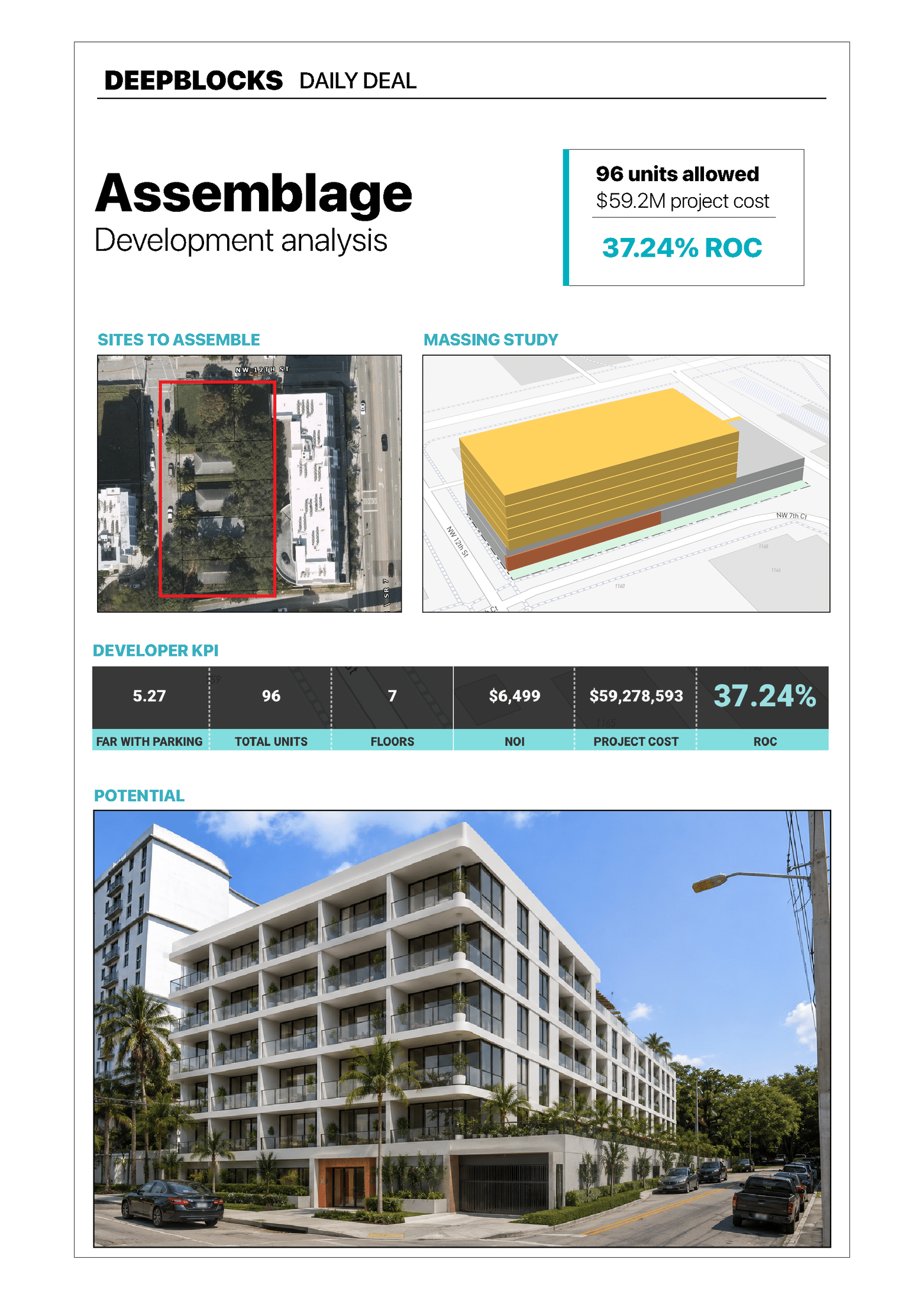
I modeled what the project could look like if all six lots on that half block were combined.
The result is roughly 100 units.
That is a meaningful increase from the standalone 20-unit strategy. The larger assemblage creates more scale, more design flexibility, and potentially a more institutional development opportunity.
You can explore the project stacking plan here:
Open the Deepblocks Developer Explorer
On paper, the assemblage is compelling.
But the unit count is only one part of the story.
Bigger Project, Different Deal
The issue is that the deal stops looking like a $12 million boutique project and starts looking more like a $60 million development.
That changes almost everything.
The buyer pool changes.
The capital stack changes.
The construction risk changes.
The financing strategy changes.
The timeline changes.
The exit changes.
A 20-unit project and a 100-unit project may be connected by the same land, but they are not really the same deal.
One is a small or mid-size developer opportunity.
The other starts to look much more institutional.
That does not make the assemblage wrong. It just means the strategy needs to be evaluated differently.
The Case for Iterating 20 Units at a Time
This is why I still like the idea of iterating 20 units at a time.
A smaller project may be easier to execute.
It may have a smaller HOA.
It may require a simpler capital stack.
It may allow a developer to move faster, reduce exposure, and avoid turning a focused infill opportunity into a much larger balance-sheet decision.
In some cases, the highest unit count is not the best business plan.
The better plan may be the one that matches the developer’s capital, risk tolerance, and ability to execute.
That is what makes the boutique condo strategy interesting.
It may not be the biggest version of the site, but it may be the cleanest version.
The Real Tradeoff
The assemblage may be the bigger play.
The 20-unit strategy may be the more executable one.
That is the core tradeoff.
A 100-unit project creates more scale, but it also requires more coordination, more capital, more patience, and a larger buyer or developer profile.
A 20-unit project creates less scale, but it may offer a clearer path to execution.
Neither strategy is automatically better.
The question is which strategy creates the best risk-adjusted outcome.
The Takeaway
This deal is interesting because it shows why development analysis cannot stop at maximum unit count.
Yes, the full half-block assemblage may support roughly 100 units.
But if that turns a $12 million project into a $60 million project, the opportunity has changed completely.
Sometimes the best strategy is to assemble.
Sometimes the best strategy is to stay small.
And sometimes the smartest move is to understand both paths before deciding which one to pursue.
That is why I like modeling these deals in Deepblocks.
The value is not just in seeing what can be built.
It is in understanding what should be built.
You can explore the project stacking plan here:
Open the Deepblocks Developer Explorer