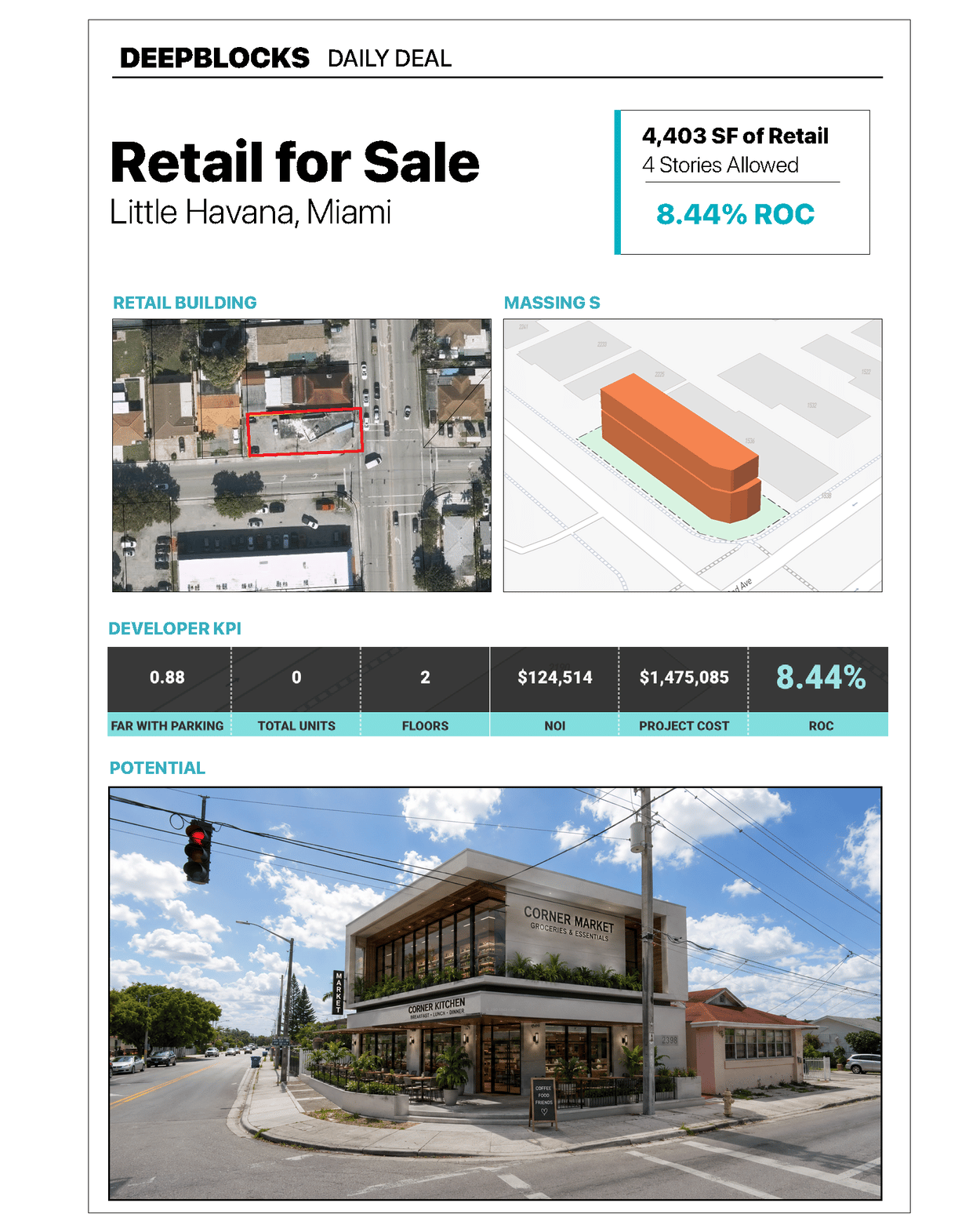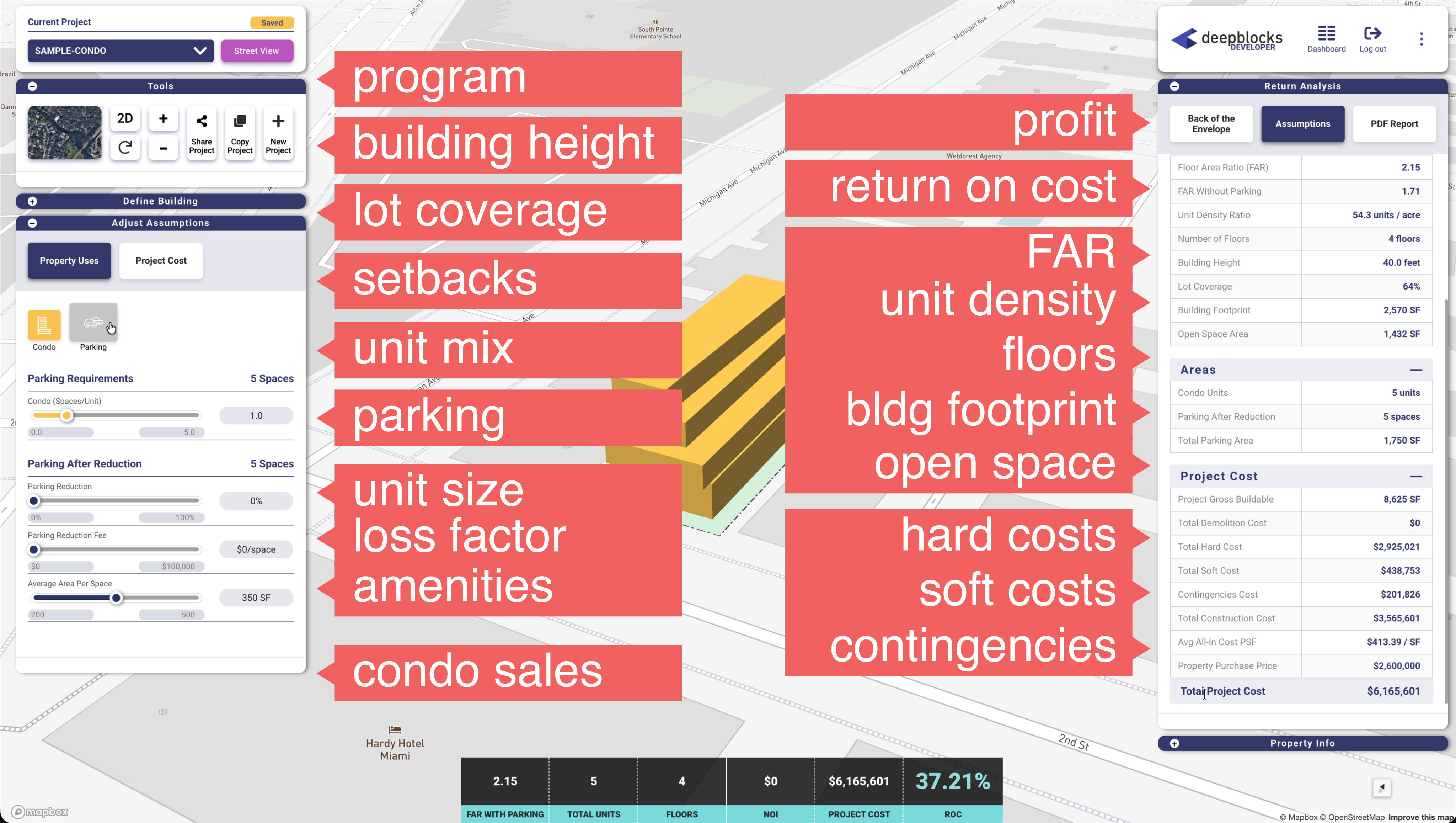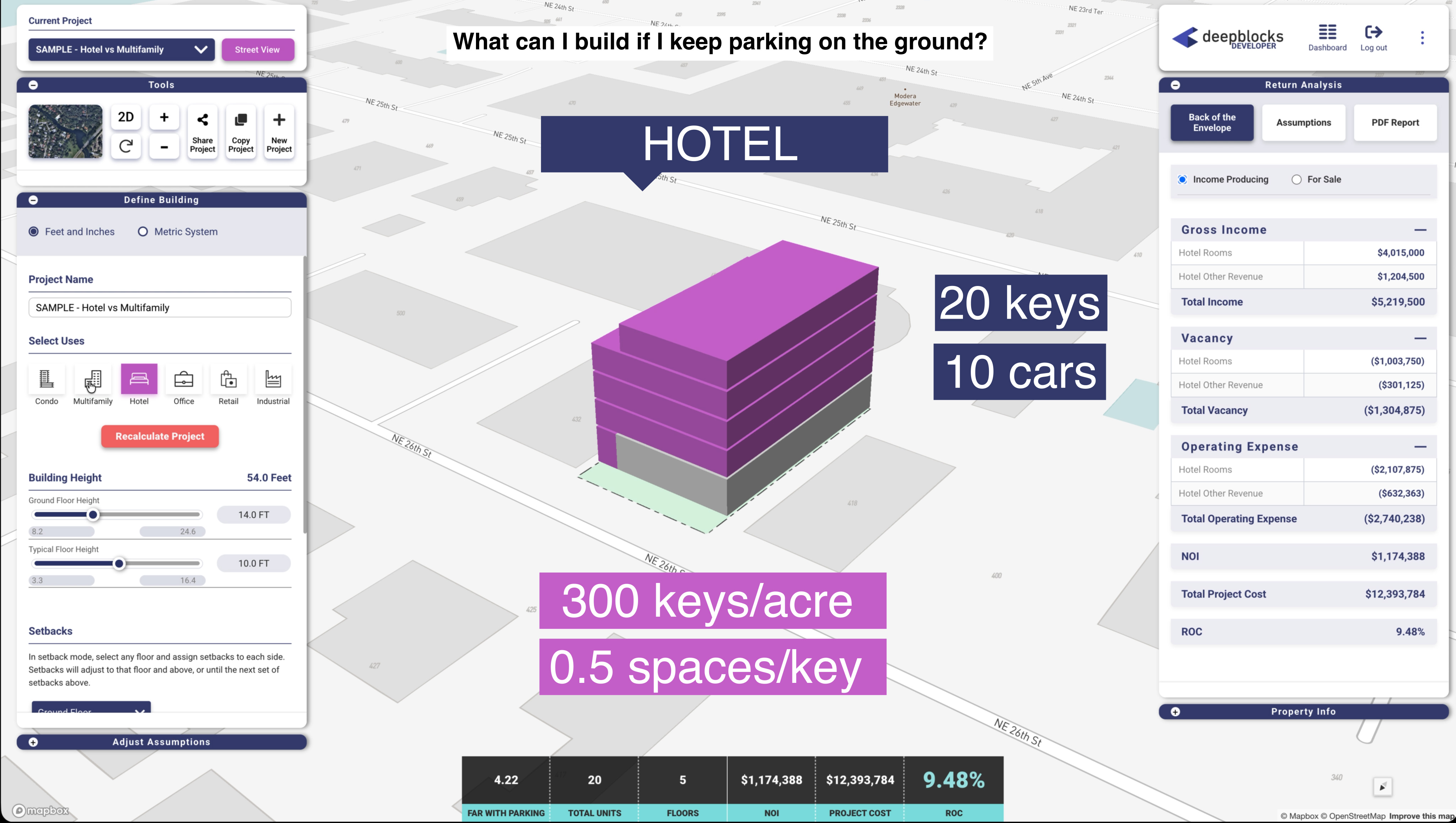
A single parcel can support many different investment strategies. The key is being able to study those strategies early, quickly, and clearly enough to understand which paths deserve more attention.
Every site tells more than one story.
A single parcel can support multiple strategies, and being able to study them quickly at a high level is often what helps shape the investment narrative before committing serious time or capital.
Before getting too deep into design, financing, entitlement strategy, or construction pricing, I like to start with one simple question:
What are my options?
That question may sound basic, but it is often where the most important work begins.
Explore the live experiment here:
New Development: Mixed-Use Condominium
A Recent Wynwood Example
I recently looked at a site for sale in Wynwood that was being marketed as commercial space. Whatever the ultimate plan may be, the property will need work.
The interesting part was a courtyard-like space wrapped by a thin layer of retail, totaling roughly 4,100 square feet. At first glance, the site could be interpreted in several different ways. It was not immediately obvious whether the best path was to improve what existed, add density, or start over entirely.
That is where scenario planning becomes useful.
For this site, I saw five potential paths:
- Renovate the existing building into retail or commercial space.
- Keep the existing retail and build condo units in the courtyard.
- Demolish and build new retail.
- Demolish and build new mixed-use multifamily.
- Demolish and build new mixed-use condos.
Each option tells a different story. Each requires a different amount of capital. Each has a different risk profile, timeline, and potential exit.
Options Are Only Half the Work
Identifying the options is important, but it is only half the work.
The next step is understanding the return on cost for each scenario. That is what allows you to eliminate weaker paths with confidence instead of getting lost in hypotheticals.
In early-stage analysis, the goal is not to answer every question perfectly. The goal is to create enough clarity to know where to spend more time.
When I ran the first-pass numbers on this site, two options stood out.
Renovating the existing retail looked like roughly a $6 million project cost.
Building new condos looked closer to a $21 million project cost.
Those two paths represent very different strategies. One is a lighter lift with less capital exposure. The other is a larger development play with potentially more upside, but also more complexity, more risk, and a heavier capital requirement.
The Real Decision Is About Timing
The long-term goal seems to point toward a mixed-use condo project. But knowing the long-term direction does not automatically answer the timing question.
Timing depends on at least two major factors:
- Access to capital
- Market saturation
That leads to a different set of questions:
- Do we renovate now and build condos later?
- Do we have the capital to create condos today?
- Should we wait until current inventory is absorbed?
- Or should we assume Wynwood will continue attracting new development for years to come?
These are not easy questions, and I do not pretend to have all the answers. But they are the right questions to ask before capital is on the line.
Why Early Analysis Matters
What I have learned is that the speed and clarity of early analysis matter almost as much as the final decision.
The faster I can model scenarios side by side, the sharper the investment narrative becomes. It becomes easier to understand what the site wants to be, what the market may support, and what level of risk is actually worth taking.
Early analysis does not eliminate uncertainty. It does, however, make uncertainty more visible.
And when capital is on the line, visibility matters.
Highest Return or Lowest Risk?
Every site has more than one possible future. The work is figuring out which future is worth pursuing.
Some investors may start with the highest return. Others may start with the lowest risk. In practice, the best answer often depends on capital structure, timing, conviction in the market, and the ability to execute.
For this Wynwood site, the analysis is still evolving. But the exercise itself reinforced something important: a strong investment narrative does not come from forcing one answer too early. It comes from understanding the available paths, comparing them honestly, and knowing which questions matter most.
Explore the live experiment here:
New Development: Mixed-Use Condominium