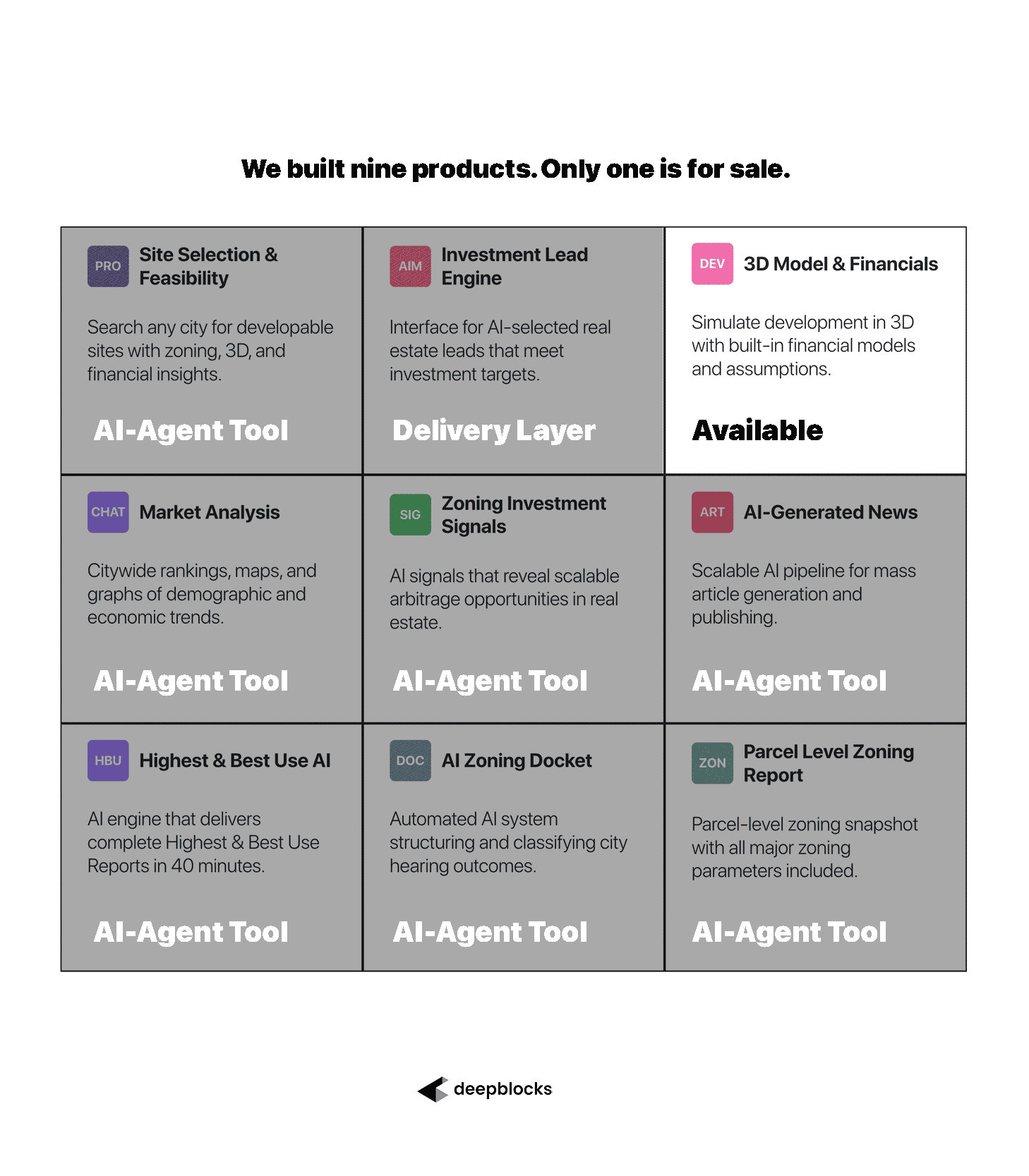
We built nine products.
Today, only one is sold as standalone software.
That was not the plan.
When we started Deepblocks, we were trying to solve every major question in real estate investment. We wanted to help investors, developers, brokers, and analysts move faster from raw information to confident decisions.
The questions were clear.
- Where should I build?
- What does zoning allow?
- What actually fits on the site?
- What is the highest and best use?
- Where are demographics growing?
- How is this city transitioning?
- What has the city approved before?
- How do we turn market data into useful insights?
- How do we organize the leads we find?
Each question became a product.
That work eventually turned into nine different products: PRO, Zoning Report, DEVELOPER, AI-HBU, CHAT, Zoning Signal, Zoning Docket, AI-Articles, and AIM CRM.
At the time, that structure made sense. Each product solved a specific problem. Each one gave customers a sharper tool for a specific part of the real estate investment process.
Then our customers taught us something uncomfortable.
They did not want to pay for tools they did not use.
That is why we split the functionality across nine products in the first place. We wanted customers to buy only what they needed.
But they also did not want to jump between multiple software products.
That was the contradiction.
Customers wanted exactly what they needed. But they did not want fragmentation. They did not want more logins, more dashboards, more interfaces, more workflows, or more steps.
Most importantly, they did not want to do the work.
They wanted the answer.
Explore Deal Flow: Deepblocks customized AI agent workflows
The Problem With Better Tools
For a long time, software companies have operated under a simple assumption: if we build better tools, customers will create better outcomes.
That assumption is only partly true.
A better tool is useful when the customer wants to stay in control of the full process. But in many workflows, especially complex analytical workflows, the customer is not actually looking for another tool.
They are looking for a finished result.
In real estate investment, that distinction matters.
A platform may contain the zoning data, demographic trends, market signals, site constraints, entitlement history, and financial assumptions needed to identify an opportunity. But if the customer still has to dig through all of that information, connect the dots, and decide what matters, then the software is only part of the solution.
A product that contains the answer but still makes the customer search for it is less valuable than a system that delivers the answer directly.
That realization changed everything for us.
From Products to Agentic Workflows
With the rise of agentic workflows, seven of our nine products quietly changed jobs.
They are no longer customer-facing products.
They are now tools our AI agents use behind the scenes.
Instead of asking customers to open separate products for zoning, site analysis, highest and best use, market research, article generation, permitting history, and lead discovery, we use those capabilities internally to power a more complete workflow.
The customer does not need to see every step.
They need the output.
They need real estate investment opportunities that match their exact criteria.
They need to know why those opportunities matter.
They need the supporting analysis.
They need a place to review, organize, and act on the deals.
That is the shift.
The products did not disappear. They became infrastructure.
What Remains Customer-Facing
Today, only two products remain customer-facing.
The first is AIM, the CRM where we deliver the deals.
This is where customers receive and manage real estate investment opportunities that match their strategy. AIM is not just a place to store leads. It is the delivery layer for a more complete investment workflow.
The second is DEVELOPER, the live environment where customers analyze those opportunities.
DEVELOPER remains available as standalone software because there are still customers who want direct access to the analysis environment. They want to test sites, study zoning, understand development potential, and interact with the underlying assumptions themselves.
But the larger shift is clear.
Seven of the nine products are no longer positioned as standalone tools. They now support the agents that perform the work.
We Did Not Set Out to Build an Agent Company
We did not set out to build an agent company.
The work kept pointing there.
Every product we built taught us something about what customers actually wanted. Every workflow showed us where the friction was. Every customer conversation made the pattern clearer.
The future was not simply about giving users more powerful software.
It was about delivering the completed workflow.
That is where SaaS is moving.
Not everywhere, and not for every product. There will always be software categories where the user wants deep control, customization, and direct manipulation.
But in many industries, especially industries filled with fragmented data, repetitive analysis, and high-value decisions, customers are asking for something different.
They are not asking for another dashboard.
They are not asking for another search tool.
They are not asking for another database.
They are asking for finished answers.
The Next Shift in SaaS
For us, this is the next major shift in SaaS.
The first generation of SaaS digitized workflows.
The next generation made those workflows more collaborative, connected, and data-rich.
Now agentic systems are beginning to complete the workflows themselves.
That changes the role of software.
Software is no longer just the interface where work happens. It becomes the system that performs the work, checks the work, and delivers the result in a form the customer can use immediately.
For Deepblocks, that means moving from separate tools to a more integrated investment workflow.
It means using our products behind the scenes to find, evaluate, and deliver real estate opportunities that match each customer’s criteria.
It means giving customers fewer places to click and more answers they can act on.
Nine products got us here.
Only one remains for sale as standalone software.
That was not the plan.
But it is where the work led us.