Every investor finds arbitrage differently.
That is the problem with traditional software.
When we built Deepblocks PRO, we had the data investors needed.
Parcel data. Zoning data. Demographics. Development potential. Market context.
The idea was simple: put it all in software and let customers search.
It worked.
But only up to a point.
Because every customer had a different definition of opportunity.
For one investor, the signal was proximity. For another, it was recent sales activity. For another, it was zoning capacity. For another, it was underbuilt land.
For another, the opportunity came from existing building conditions, topography, parcel assembly, municipal momentum, or some combination of all of it.
That is where the limits of traditional software started to show.
Explore Custom Deal-Flow: The ai-agent workflow by Deepblocks
Every Strategy Has Its Own Signal
Real estate investors do not all search the same way.
A land investor may care most about parcels with unused zoning capacity.
A developer may care about sites where the existing structure no longer matches the market potential.
A broker may look for ownership patterns, transaction activity, or signs that a property is likely to trade.
An acquisitions team may combine dozens of factors: zoning, demographics, rents, sales comps, construction costs, entitlement risk, and local political momentum.
Each strategy has its own logic.
Each team has its own process.
Each market has its own quirks.
That means the same dataset can produce completely different answers depending on who is asking the question.
This is where traditional software struggles.
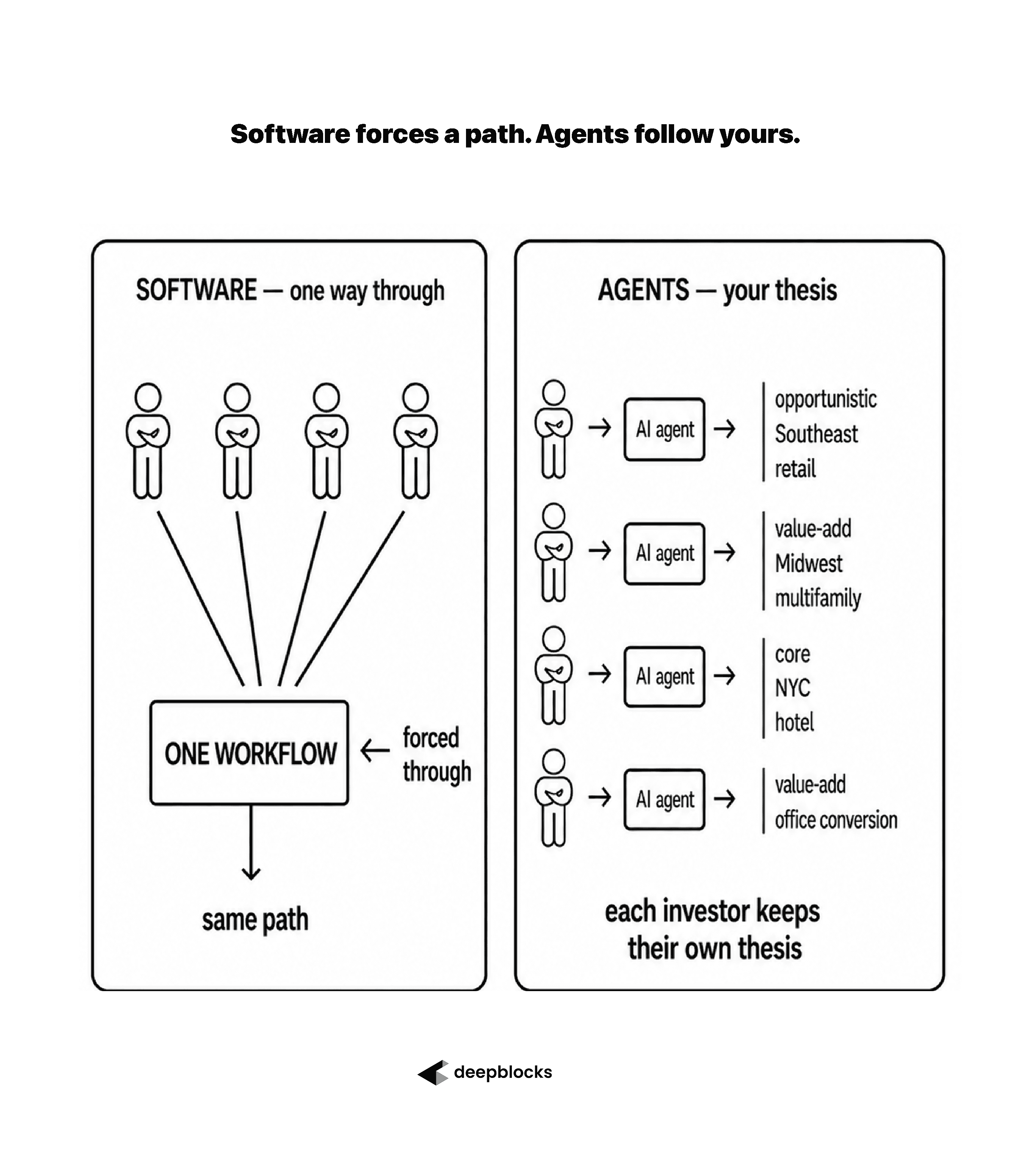
Software usually starts with a fixed interface. It has one layout, one set of filters, one default workflow, and one way it wants the user to think.
But real estate investors do not think in one workflow.
They think in strategies.
Geography Made the Problem Harder
The workflow problem became even more obvious when we looked at geography.
Local investors wanted deep context in a few neighborhoods. They cared about the details that do not always show up cleanly in a dataset: which blocks are changing, which corridors are gaining momentum, which owners might sell, and which municipalities are becoming more receptive to new development.
Regional and national investors had a different problem.
They wanted to scan entire markets, sometimes across hundreds of municipalities. They needed broader coverage, faster filtering, and a way to compare opportunities across places that each had different zoning rules, parcel patterns, approval histories, and market dynamics.
Those are very different workflows.
One customer wanted depth.
Another wanted scale.
Another wanted both.
Trying to serve all of that in one traditional software product created a difficult choice.
We could build custom algorithms for every customer.
Or we could make the product flexible enough to behave like GIS software.
The first path would not scale.
The second path would create a steep learning curve.
Neither felt right.
The Interface Became the Constraint
For years, software companies have assumed that the interface is the product.
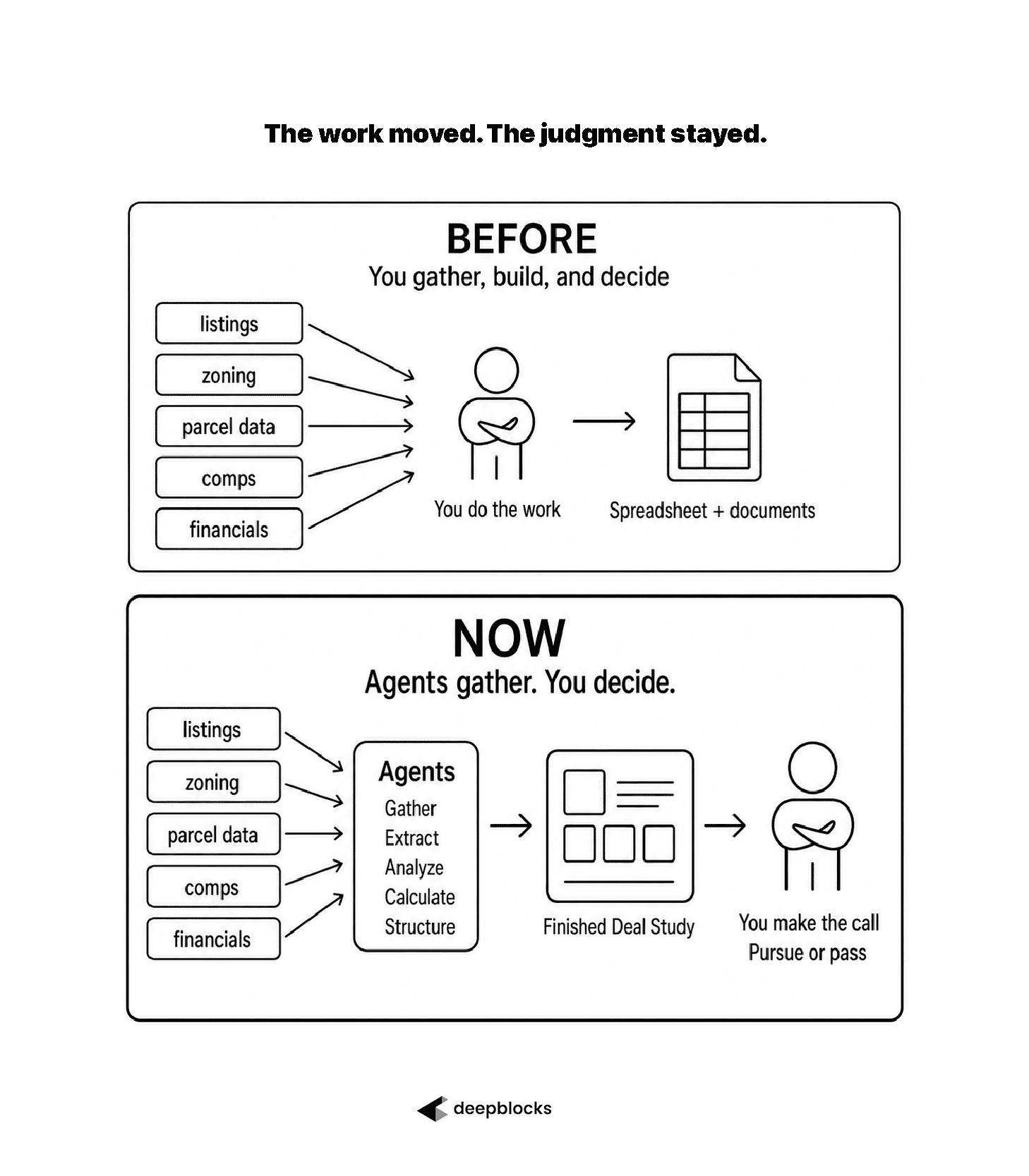
The user logs in, clicks through the system, adjusts filters, views layers, exports results, and builds their own answer.
That model can be powerful. But it also forces the customer to adapt their process to the product.
The software decides what is easy.
The software decides what is visible.
The software decides the order of operations.
The software decides which questions can be asked quickly and which ones require workarounds.
That was the constraint.
Even when we had the right data, the interface could still get in the way.
A software product has to make decisions about how users search. It has to define categories, filters, views, defaults, and workflows. But every decision that makes the product simpler for one user can make it less useful for another.
For real estate investment, that matters because proprietary search processes are often the edge.
The way a team finds opportunity is not generic.
It is part of how they compete.
AI Changed the Constraint
AI changed what the product could be.
Once the analysis no longer had to live inside a single interface, the data could be freed from the software.
Instead of asking every customer to search the same way, an agent can follow the process the customer would have run by hand.
Not our workflow.
Theirs.
That is the important shift.
The agent can search differently for a land investor, a developer, a broker, or an acquisitions team.
It can combine parcel, zoning, demographic, transaction, and physical-site signals in whatever order the strategy requires.
It can start with zoning capacity, then check ownership patterns.
Or start with recent sales activity, then look for underbuilt land.
Or start with demographic growth, then identify parcels where the built environment no longer matches the market.
Or search across hundreds of municipalities while adjusting for local rules and local context.
The workflow no longer has to be hardcoded into the interface.
The workflow can adapt to the investor.
From Dashboard to Finished Study
The result is not another dashboard.
It is a finished study that feels like it was done in-house.
The customer does not need to learn a new software workflow before getting value. They do not need to translate their strategy into someone else’s filters. They do not need to force a proprietary process into a generic interface.
They can define what they are looking for.
Then the system can gather the relevant data, apply the right logic, evaluate the opportunity, and deliver the study.
That is very different from traditional software.
Traditional software gives the user a place to work.
Agentic workflows complete more of the work.
Traditional software asks the customer to search.
Agentic workflows return the analysis.
Traditional software forces one workflow.
Agentic workflows adapt to the strategy.
What Deal Flow Is Building Toward
That is the shift we are building toward with Deal Flow.
Not forcing investors into one software workflow.
Letting the analysis adapt to the investor.
For us, this is not just a product change. It is a change in how real estate software should work.
The value is not in making every customer click through the same interface.
The value is in understanding how each customer defines opportunity, then running the analysis that matches that definition.
Some teams are looking for land.
Some are looking for redevelopment.
Some are looking for acquisitions targets.
Some are looking for zoning arbitrage.
Some are looking for early signs of neighborhood transition.
Some are looking for sites that match a highly specific investment thesis.
A single dashboard cannot naturally serve all of those workflows without becoming either too rigid or too complicated.
An agentic system can.
The Investor’s Process Is the Product
Every real estate team has a search process.
Sometimes it lives in software.
Sometimes it lives in spreadsheets.
Sometimes it lives in a set of saved searches, market notes, broker relationships, zoning checks, and underwriting templates.
And sometimes, the most valuable part of the process lives in someone’s head.
That is the part traditional software often fails to capture.
The judgment behind the search.
The sequence of questions.
The local knowledge.
The pattern recognition.
The reason one site matters and another does not.
Deal Flow is built around the idea that the investor’s process should not be forced into a generic product workflow. The product should adapt to the process.
Because in real estate investment, opportunity is not found one way.
It is found through a strategy.
The future of software in this space is not one more dashboard with more filters.
It is analysis that understands what the investor is trying to do, follows the strategy, and delivers the finished study.
For real estate teams, the question is simple:
Where does your proprietary search process live today — in software, in spreadsheets, or in someone’s head?
Explore Custom Deal-Flow: The ai-agent workflow by Deepblocks


