AI Is Changing What It Means to Prepare Students for Work
Every school will have to rethink what it means to prepare students for work.
Not because every student needs to become a software engineer.
Because every student will need to understand how to work with intelligent systems.
That is different.
In architecture, real estate, planning, construction, finance, and development, students have traditionally been trained to use the tools of their profession. They learn spreadsheets, financial models, drawings, GIS platforms, reports, zoning codes, presentations, market research, and project workflows.
That still matters.
But it is no longer enough.
The next generation of professionals will not only use the tools that already exist. They will increasingly be expected to understand how workflows are built, how AI systems produce outputs, and how to improve processes when the existing tool stack breaks down.
That is the new academic challenge.
Schools do not need to turn every student into an engineer.
They need to make every expert a little more technical.
Technical Literacy Is Not the Same as Learning to Code
When I say every expert needs to become more technical, I do not mean every architecture student, real estate student, planner, analyst, or developer needs to become a full-time programmer.
That is not the point.
The point is technical literacy.
Technical literacy means understanding how systems work well enough to ask better questions, validate outputs, and participate in building better workflows.
A technically literate real estate expert should be able to describe a process clearly.
They should understand how data is structured.
They should know how to test whether an AI-generated output is correct.
They should know how to validate assumptions.
They should know the difference between automation, analysis, and decision-making.
They should know when a workflow needs AI, when it needs deterministic software, and when it needs human judgment.
That skillset is not traditional coding.
It is the ability to work intelligently with technical systems.
And in the AI era, that may become one of the most important skills an expert can have.
Why AI Literacy Matters in Real Estate Education
This is especially important in real estate.
Real estate is full of fragmented workflows, manual analysis, inconsistent data, local rules, and high-stakes decisions.
A development decision may depend on zoning rules, land use categories, parking requirements, construction costs, rent assumptions, entitlement risk, financing terms, market demand, and local political constraints.
None of that is simple.
And none of it becomes simple just because AI enters the workflow.
A student who asks AI to summarize a zoning code still needs to know whether the summary is correct.
A student who uses AI to analyze a site still needs to know whether the assumptions are realistic.
A student who uses AI to build a feasibility tool still needs to know whether the output makes sense in the real world.
AI can accelerate analysis.
It can also accelerate mistakes.
That is why real estate education needs to teach students not only how to use AI, but how to question it.
Students Need to Learn Workflow Design, Not Just Software Tools
For decades, professional education has often focused on tool fluency.
Learn the spreadsheet.
Learn the drawing software.
Learn the GIS platform.
Learn the financial model.
Learn the presentation format.
Those tools still matter. But the more important skill is becoming workflow fluency.
A workflow is the process behind the work.
How does information move from one step to another?
Where does judgment enter the process?
Which steps are repetitive?
Which steps depend on weak data?
Which outputs need to be checked?
Which decisions should never be fully automated?
These are the questions students need to learn how to ask.
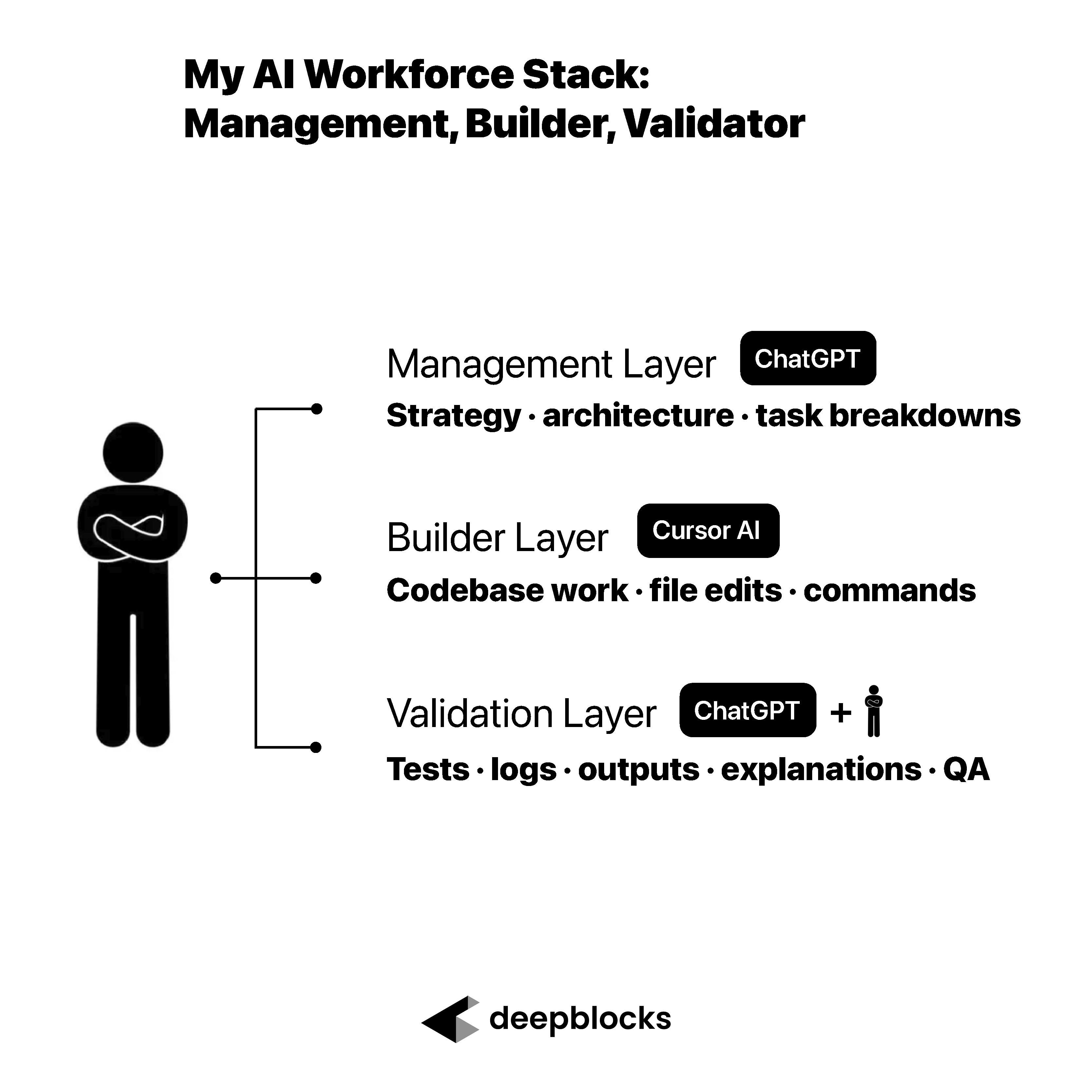
Because when AI can help generate code, summarize documents, structure data, and automate tasks, the expert’s advantage is no longer just knowing which button to press inside a tool.
The advantage is knowing how the work should happen in the first place.
The Future Expert Needs to Know When Not to Use AI
One of the most important lessons schools should teach is when not to use AI.
That may sound strange in a world where everyone is trying to add AI to everything.
But it is essential.
The future expert does not need to blindly automate every process. The future expert needs to understand where judgment is required, where data is weak, where a workflow is risky, and where a simple deterministic process is better than an AI agent.
Not every workflow needs autonomy.
Not every decision should be delegated.
Not every output should be trusted.
Sometimes the best solution is a checklist.
Sometimes it is a spreadsheet.
Sometimes it is a rules-based tool.
Sometimes it is a human review.
Sometimes AI belongs in the middle of the workflow, not at the end of the decision.
This kind of judgment is what separates an AI user from an AI-literate expert.
What Real Estate, Architecture, and Planning Programs Should Teach
The next generation of real estate, architecture, planning, finance, construction, and development programs should include a new layer of technical education.
Not full software engineering for everyone.
But enough technical literacy to help students understand, manage, and improve AI-assisted workflows.
A modern curriculum should teach students how to:
- describe a professional workflow clearly
- structure and clean basic data
- understand how AI systems generate outputs
- test whether an AI-generated result is correct
- validate assumptions in financial, spatial, and market analysis
- distinguish between automation, analysis, and decision-making
- prototype simple tools or workflows with AI assistance
- identify when AI is unnecessary or risky
- collaborate more effectively with technical teams
- question software instead of accepting it blindly
This would prepare students for a world where professional work is increasingly shaped by intelligent systems.
The goal is not to make every student a software engineer.
The goal is to make every student a better expert in an AI-enabled environment.
Engineering Schools Also Have to Evolve
Engineering schools also have to rethink their role.
If more people can generate code with AI, then engineering education has to emphasize what AI does not automatically solve.
That includes system design, security, complexity, infrastructure, performance, reliability, ethics, maintainability, and judgment under constraints.
In other words, engineering becomes more serious, not less.
The engineer of the future will still matter deeply. But the value of engineering will shift away from simply producing code and toward designing systems that are safe, scalable, reliable, and useful in the real world.
Engineers will also need more context.
They will need to understand the industries they serve.
They will need to know how users make decisions.
They will need to understand the workflows their systems are supposed to support.
They will need to work more closely with domain experts who now have the ability to prototype, test, and challenge technical solutions earlier in the process.
The expert becomes more technical.
The engineer becomes more contextual.
The best schools will teach both groups how to meet in the middle.
The New Academic Bridge: Domain Expertise Plus Technical Judgment
The future of professional education is not about turning every expert into an engineer or every engineer into a real estate developer.
It is about building a bridge.
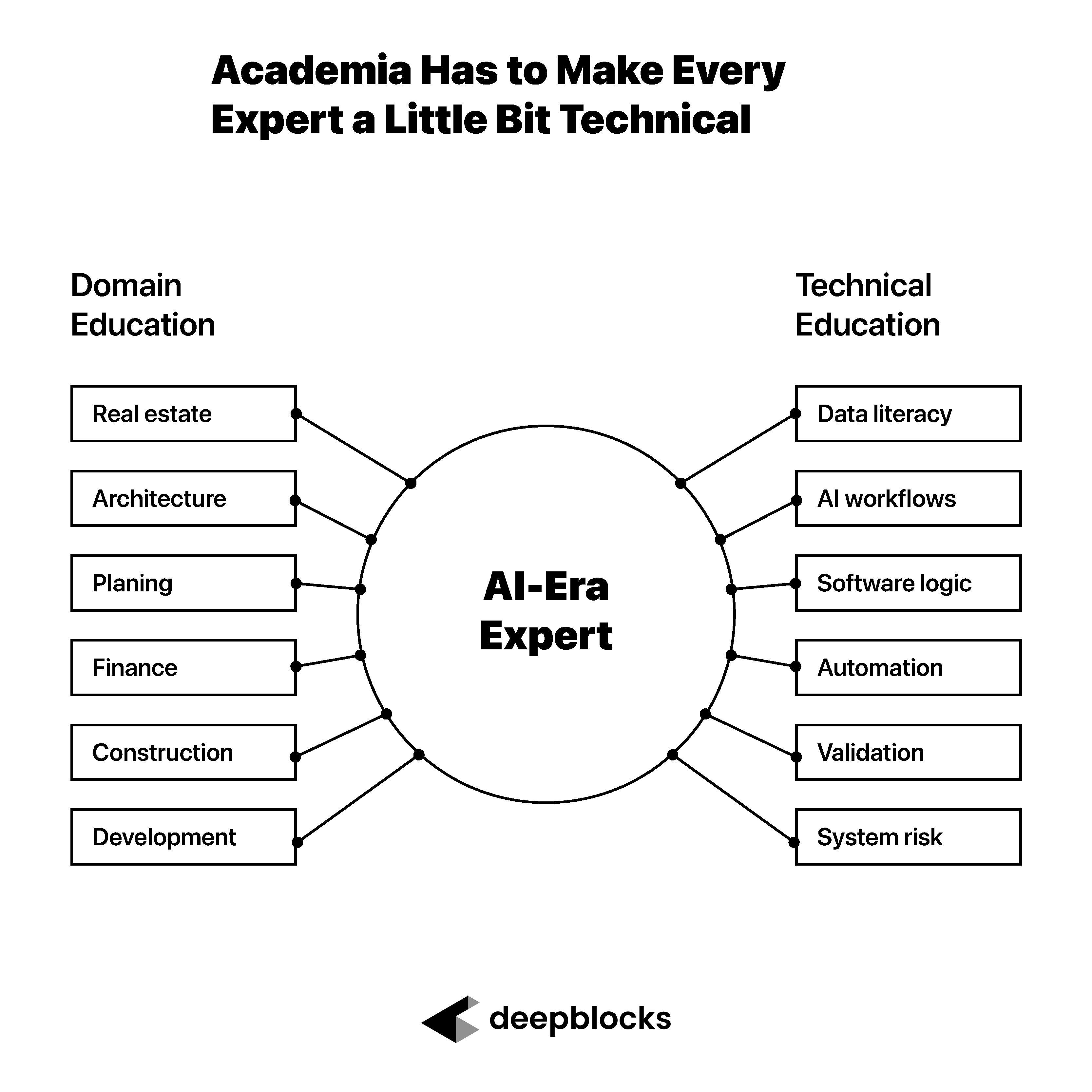
On one side is domain expertise.
That includes real estate, architecture, planning, construction, finance, development, policy, and market knowledge.
On the other side is technical capability.
That includes data, software logic, AI systems, automation, validation, and technical risk.
The future expert needs to stand closer to the middle.
They do not need to know everything an engineer knows. But they need enough technical judgment to understand how tools shape decisions.
The future engineer also needs to stand closer to the middle.
They do not need to become a full industry expert in every field. But they need enough domain awareness to understand why the software matters, where it can fail, and what makes an output valuable.
That middle ground is where a lot of future innovation will happen.
Why This Creates a New Kind of Leverage for Students
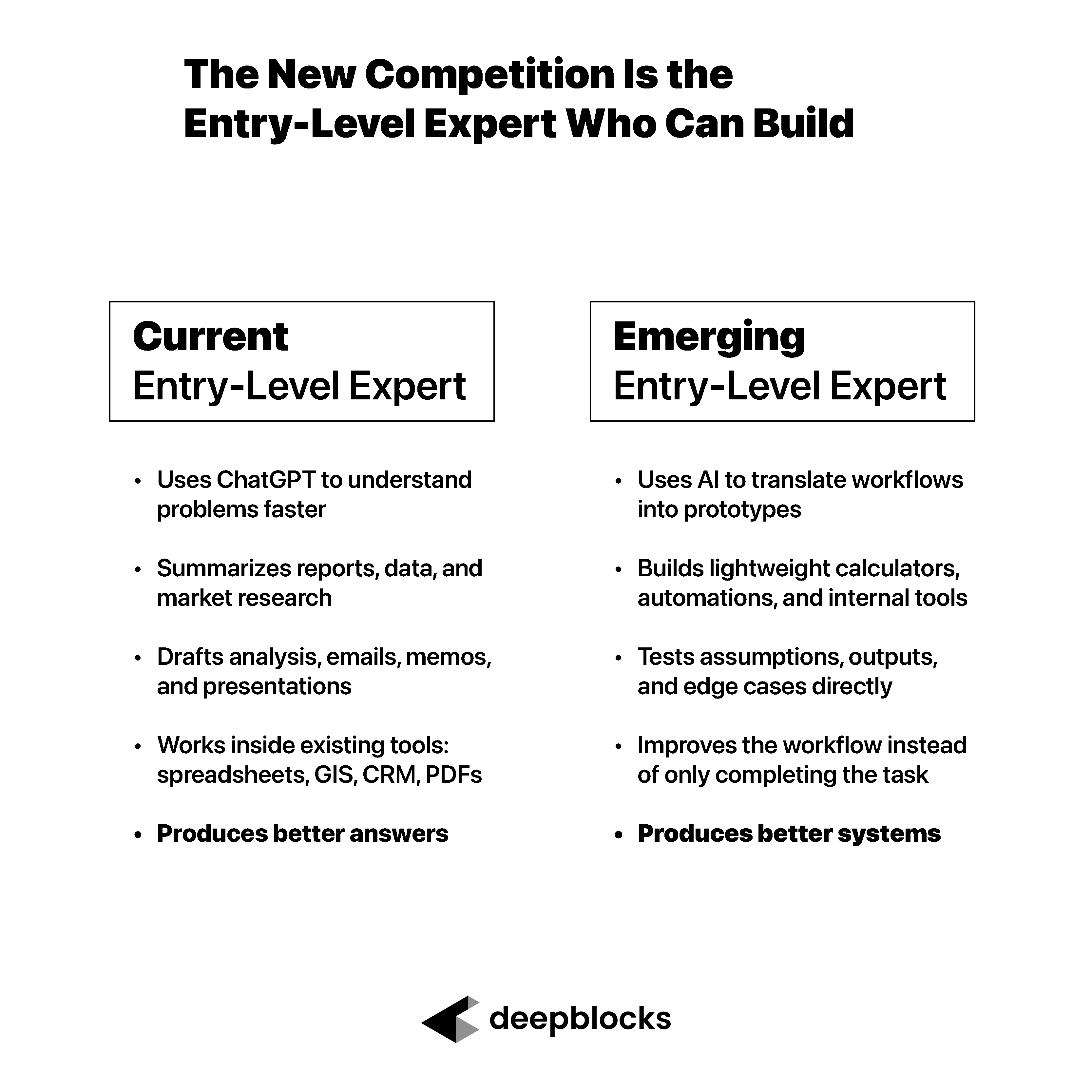
A student who understands both real estate feasibility and AI-assisted building will enter the market with a different kind of leverage.
They will not only be able to use software.
They will be able to question it.
They will be able to shape it.
They will be able to improve it.
That matters because real estate decisions are too complex to be handled by generic tools alone.
A student who understands zoning, feasibility, and AI workflows can look at a software output and ask better questions.
Why did the system make that assumption?
Where did the data come from?
Does this zoning interpretation apply locally?
Is this financial result realistic?
Is this workflow automating the right thing?
What should stay human?
Those questions are powerful.
They turn the student from a passive user of software into an active participant in the design of better systems.
Conclusion: Every Expert Needs Engineering Intuition
Academia does not need to make every student a professional engineer.
But it does need to make every expert more technically fluent.
The future expert will need to understand AI systems, data structures, workflows, validation, automation, and technical risk. They will need to know how to work with intelligent tools without blindly trusting them.
The future engineer will also need to evolve. If AI makes code easier to generate, then engineering education must focus even more on architecture, security, infrastructure, reliability, ethics, complexity, and real-world context.
The expert becomes more technical.
The engineer becomes more contextual.
And the best educational institutions will prepare students for that overlap.
Because in the AI era, the most valuable professionals will not only know how to use software.
They will know how to question it, shape it, and improve it.