AI Is Changing Who Gets to Build Software
The future competitor to a software engineer may not be another software engineer.
It may be a real estate student.
It may be an architecture graduate.
It may be an analyst who understands zoning, finance, feasibility, and AI tools well enough to build the first version of a product.
That is what makes this moment so important.
For decades, technical capability was concentrated. If you wanted to build software, you either had to learn to code or hire someone who could. That created a clean separation between two groups of people.
There were people who understood the industry.
And there were people who could build tools for the industry.
AI coding tools are blurring that separation.
From Software Consumers to Software Creators
Most professionals have historically been software consumers.
They used the tools available to them. If the tools did not fit the workflow, they created workarounds. They built spreadsheets. They exported data. They copied information between platforms. They sent screenshots. They waited for software companies to understand their problems.
That is starting to change.
A real estate professional entering the industry today may not think of software as something only a software team can create. They may see software as something they can shape.
That is a major shift.
Previous generations of professionals learned to shape spreadsheets, slide decks, financial models, design drawings, and reports.
The next generation will learn to shape workflows, automations, prototypes, and AI-assisted software tools.
They may not call themselves engineers.
But they will be able to build.
The AI-Native Entry-Level Expert
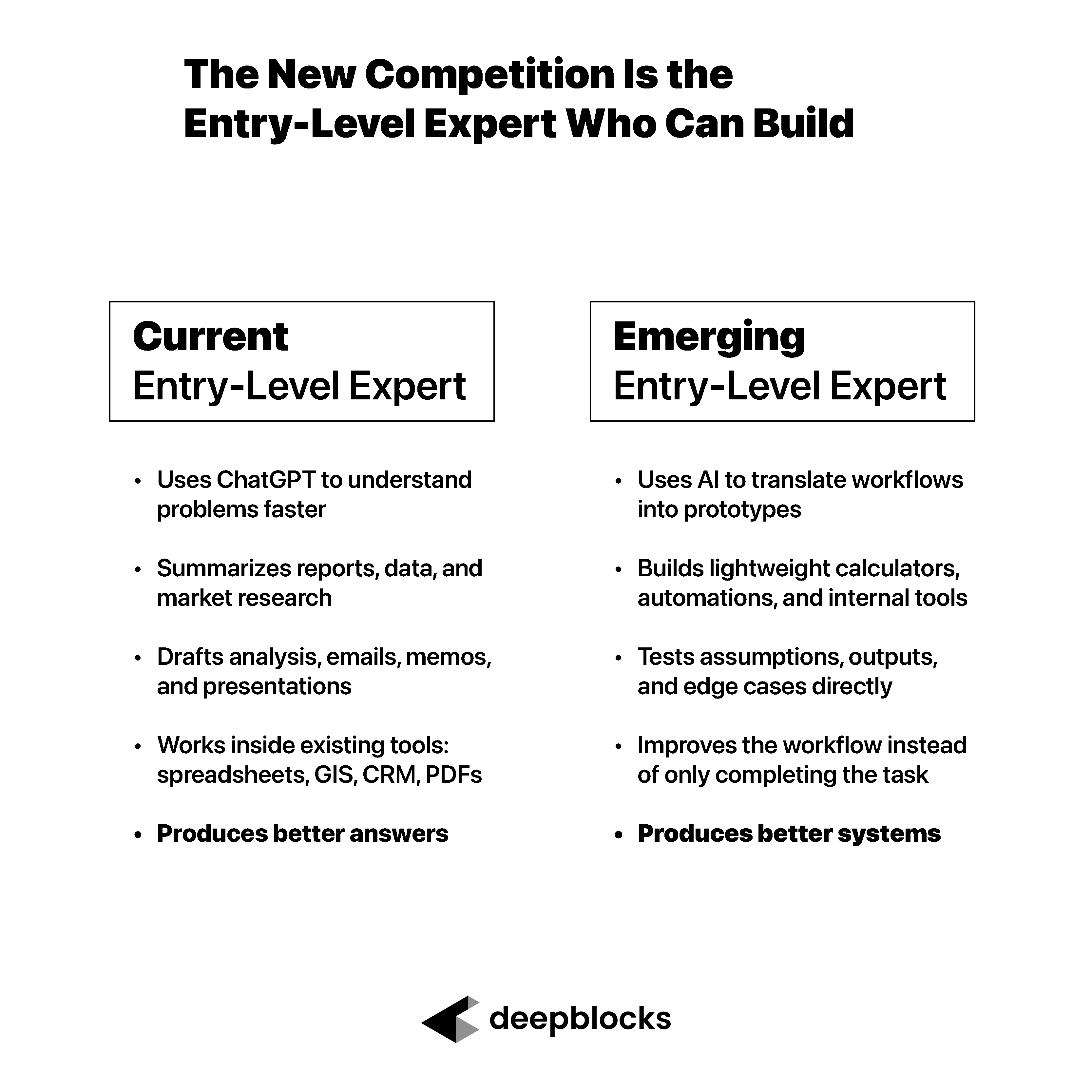
This changes the meaning of entry-level work.
An entry-level real estate analyst who understands site selection and can also build a lightweight internal tool is not just an analyst.
They are an analyst with leverage.
A planner who can use AI to prototype a zoning interpretation workflow is not just reviewing policy.
They are building process infrastructure.
A broker who can automate lead scoring based on property, market, and ownership signals is not just managing a pipeline.
They are changing how the pipeline is created.
An architecture graduate who can connect design thinking, feasibility assumptions, and AI-assisted prototyping is not just producing drawings.
They are helping define new tools for spatial and financial decision-making.
This is the new category: the AI-native entry-level expert.
They may not have decades of experience.
They may not have deep engineering training.
But they may understand enough about their industry, their tools, and AI-assisted building to create the first version of a useful workflow.
That was not possible at the same scale before.
Why This Matters for Real Estate Software Development
Real estate is full of workflows that are specific, fragmented, local, and difficult to explain from the outside.
Site selection is not just about finding parcels.
Zoning analysis is not just about reading rules.
Feasibility is not just about calculating returns.
Brokerage is not just about maintaining a contact list.
Development is not just about moving a project through a checklist.
Each workflow carries judgment, assumptions, local context, market knowledge, and a sense of what actually matters.
That is why the entry-level expert who can build is so interesting.
They are close to the workflow.
They see the inefficiencies.
They know where the spreadsheet breaks.
They know where a task is repetitive.
They know which output would save time.
And now, with AI coding tools, they may be able to prototype the solution themselves.
The Question Shifts From “Can You Build?” to “What Is Worth Building?”
This does not mean everyone becomes a professional engineer.
It means more people become capable of creating tools.
Once that happens, the most important question changes.
The question is no longer only:
Can you build?
The better question becomes:
Do you understand what is worth building?
That is a much more interesting question.
Because in a world where AI makes software easier to generate, the scarce skill becomes judgment.
What workflow should be automated?
Which task should stay human?
What output is actually useful?
What assumption is dangerous?
What would make this tool valuable enough for someone to use every week?
Those are not generic engineering questions.
They are industry questions.
Why Generic Problem-Solving Is Losing Power
The love of engineering still matters.
The ability to solve problems still matters.
But solving generic problems may become less valuable than solving specific problems with deep context.
That is the labor-market shift.
An engineer who can build anything still has value. But an industry expert who can use AI to build the right thing may be able to move faster in the earliest stages of product creation.
The first version of a tool does not always need perfect architecture.
It needs a clear problem.
It needs a useful workflow.
It needs a user who understands why the output matters.
That is where the domain expert has an advantage.
In real estate, the expert may know that a zoning field is misleading, that a parcel filter is too broad, that a return threshold is unrealistic, or that the real bottleneck is not the model but the handoff between teams.
AI can help create the software.
But the expert knows where the software should go.
What This Means for Students and Early-Career Professionals
For students entering real estate, architecture, planning, construction, finance, or development, this is a major opportunity.
It is no longer enough to only learn the existing tools.
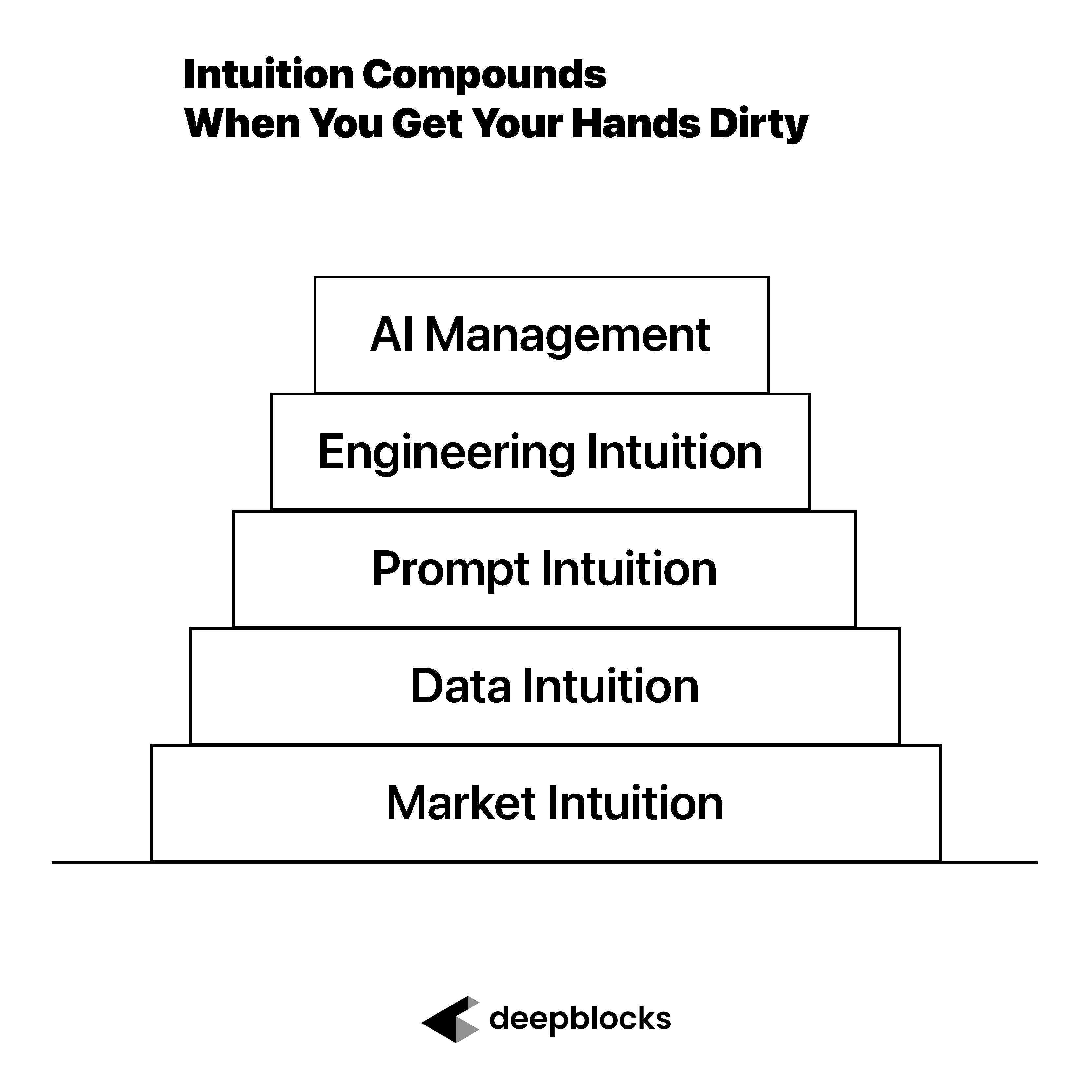
The real advantage will come from learning how workflows are built.
That does not mean every student needs to become a software engineer.
It means students need to understand enough about AI, data, automation, and software logic to shape their own tools.
They should learn how to describe a workflow clearly.
They should learn how to test whether an AI-generated output is correct.
They should learn how to build lightweight prototypes.
They should learn how to validate assumptions.
They should learn how to combine domain knowledge with AI management.
The entry-level professional who can do that will not enter the market as a passive user of technology.
They will enter as someone who can improve the systems around them.
What This Means for Engineers
This also changes the role of the engineer.
The engineer is not going away.
But the engineer may no longer be the only person who can start building.
That matters.
If AI allows real estate experts, analysts, brokers, planners, and architects to prototype their own tools, then engineers will increasingly be brought in after a workflow has already been tested.
That can be a good thing.
Instead of spending months translating vague requirements, engineers can work with experts who have already built a rough version, tested the logic, and clarified the desired outcome.
The engineer can then focus on what engineering does best: architecture, reliability, performance, security, integrations, infrastructure, and scale.
The best engineers will not resist this shift.
They will use it.
They will get closer to the industry expert, understand the workflow, and help turn validated prototypes into durable systems.
The New Advantage Belongs to People Who Understand the Problem and the Toolchain
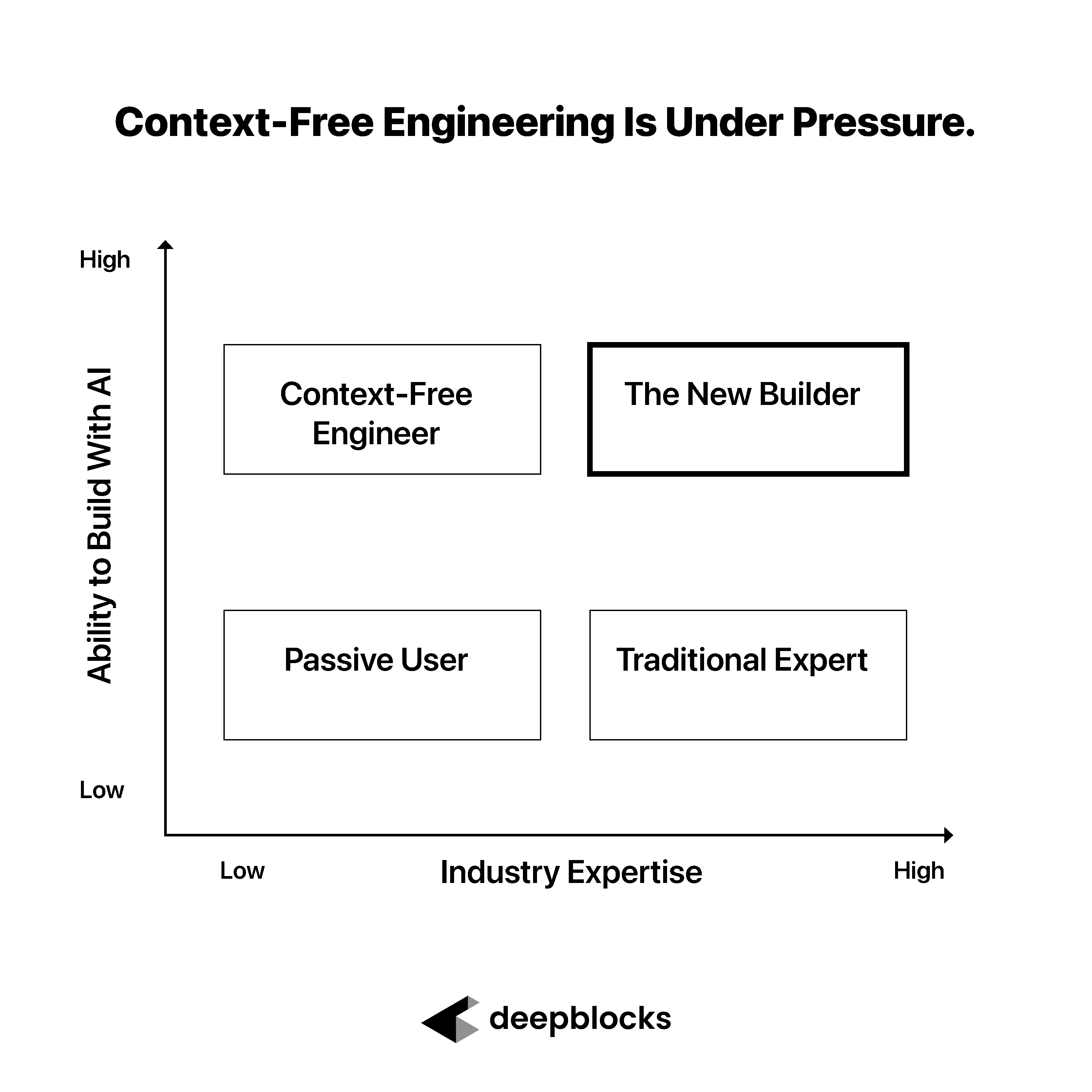
The new advantage belongs to people who understand both sides.
They understand the problem.
And they understand the toolchain.
They know the industry well enough to identify valuable problems. They know AI well enough to prototype solutions. They know enough technical logic to ask better questions, validate outputs, and recognize when the system is wrong.
That combination is powerful.
It is not traditional engineering.
It is not traditional industry expertise.
It is something in between.
And for real estate, that middle ground may become one of the most valuable skillsets in the market.
Conclusion: The Next Builder May Already Be Inside the Industry
AI coding tools are not only making engineers faster.
They are changing who gets to participate in software creation.
The next generation of real estate professionals may not wait for software companies to solve their problems. They may build early versions themselves.
They may prototype internal tools.
They may automate parts of their workflow.
They may create new products from inside the industry.
They may use AI to turn their domain knowledge into software.
That is the real shift.
The next competitor to a software engineer may not be another engineer.
It may be an entry-level expert who understands the industry and can build.