
The LLM is the brain. The harness makes it an expert.
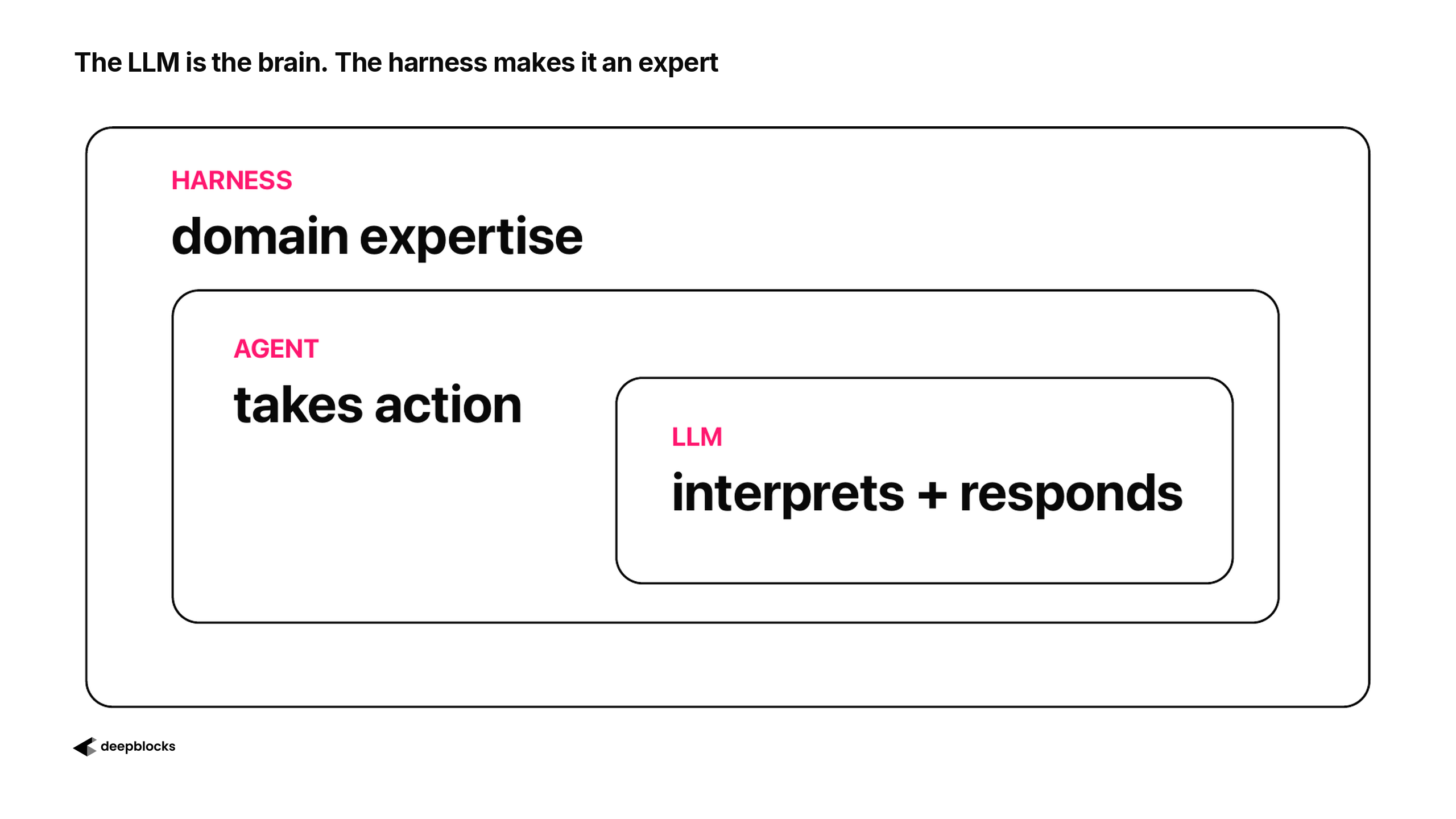
The LLM is the brain. The agent gives it arms and legs. The harness makes it an expert.
Most conversations about AI stop at the brain. Which model, which version, which company. Of the three layers, the model is the least useful one to ask about.
Explore Deal Flow: Deepblocks customized AI agent workflows
The Model Interprets
A large language model (LLM) interprets a request and produces a response. Ask it what a T6-8-O district permits and it will answer in fluent prose. It will sound like a planner.
It has read a great many zoning ordinances. What it has not done is open the one that governs your parcel, check the overlay, or run a number. A model on its own can only tell you what it already knows, phrased well.
For a developer, that is a well-read colleague with no files, no calculator and no way to look anything up.
The Agent Gives the Model Arms and Legs
An AI agent lets the model use tools to act. (AI agent, not to be confused with the other kind of agent in our industry.)
With the right tools, an agent can find a document, run a calculation, inspect the result, and take another step based on what it found. The model continues to interpret and reason while the agent acts.
Now the colleague can open the file. What it still does not have is the method: which file, in what order, checked against what.
The Harness Makes the Model an Expert
Tool use alone does not specify which information a field requires, how the work should be done, which operations the field needs, or how to check the result. Expertise is those four things, and a harness is where they live.
A harness provides the domain context, instructions, tools and checks that guide the model's work in a specific field or subject. It provides at least four things:
Context. The information the task depends on, and only that. For a zoning question, the parcel record, the district, the overlays that touch it, and the provisions that govern them. Not the whole ordinance and not the whole internet. Choosing what the model sees is the first act of expertise.
Instructions. How the work should be done. The order of operations, the definitions in force, the standard the output has to meet. A prompt used once in a chat can tolerate ambiguity. A prompt that has to run thousands of times cannot, so the instructions carry the field's rigour, not the model's guesswork.
Tools. The operations the field needs, built to return exact answers. A capacity calculation. A lookup against a parcel layer. A pro forma. The model decides which to call and in what order. The tool does the arithmetic.
Checks. Defined ways to test whether the work met the instructions. Where did each number come from, does the source say what the output claims, does the result fall inside what the rules allow. A check is what turns an answer into something you can act on.
The agent uses tools inside the domain-specific environment the harness supplies.
Expert here means equipped for one domain, not correct every time. A harness does not make the model right. It gives the model what a professional in that field would have on their desk, and a way to find out when the work is wrong.
Three Layers, One Direction
The three layers are not equals. The model comes first. A model can be used to build an agent, and the agent can be used to build a harness. Nothing runs the other way. A harness without a model is a filing system.
But the capability comes from how the three work together, and the fastest way to see each one's contribution is to remove it.
Without the model, nothing interprets an open-ended request.
Without the agent, the model produces a response but takes no action.
Without the harness, the agent acts without the field's context, instructions, specialised tools or checks. It can open files. It does not know which ones matter.
Knowing which model a system uses (GPT-5, Claude, Gemini) identifies the interpreting layer, but not the rest of the system. The model's identity does not tell you what information the system can use, what actions it can take, or how its work is checked.
So when a product claims expertise in your field, ask four questions. What information does it have? What can it actually do? What instructions does it follow? How is the result checked?
A demo that answers all four is showing you a harness. A demo that answers none of them is showing you a brain.
The Harness Changes With the Domain
The four parts (context, instructions, tools, checks) stay the same. What fills them changes entirely with the field, which is why an expert in one domain is a novice in the next.
Architecture. Companies are already building harnesses that carry the rules a city reviews a floor plan against, together with decades of construction-documentation expertise. Such a harness can review a floor plan, or draft one for a given floor plate and programme. The rules a permitting office applies take a career to learn where to look and how to apply. A system that already knows can reduce the number of review cycles and save an owner months of back and forth.
Real estate investment. An investment harness would carry the market: vacancy rates, unit size expectations, typical amenity ratios, and where to find each. It would supply the method for turning that information into a highest and best use narrative across rental, renovation and new development. And it would use a pro forma to test whether the returns are actually there before anyone believes the story.
Construction. Estimating is a bottleneck. A harness that understands the cost of material and labour by line item can save a construction company weeks of research and subcontractor negotiation. It can tell an owner what a quote should be, so a bid is gauged rather than accepted, and it can reduce the risk of a project running out of funds.
Same four slots. Three different desks. Three different experts.
The relationship among model, agent and harness stays constant across industries. The ability to evaluate a system comes from knowing how the pieces work together.